Behind the spectacle of US-China AI diplomacy lies a harder question for Australia: whether a country dependent on foreign compute can shape the rules of the next economy, or only inherit them.
Somewhere near Alaska, Jensen Huang caught up with a plane that had already left without him. The chief executive of Nvidia, whose AI Accelerator chips are powering many of the artificial intelligence systems the next decade of geopolitics will run on, was not initially listed on President Donald Trump’s delegation to China. He joined Air Force One during a refuelling stop in Anchorage, becoming part of a business delegation that also included Elon Musk and Tim Cook. However, the more pressing question at home is, what does this delegation of world leaders and politicians have to do with Australia?
The Wedding Photo in Beijing
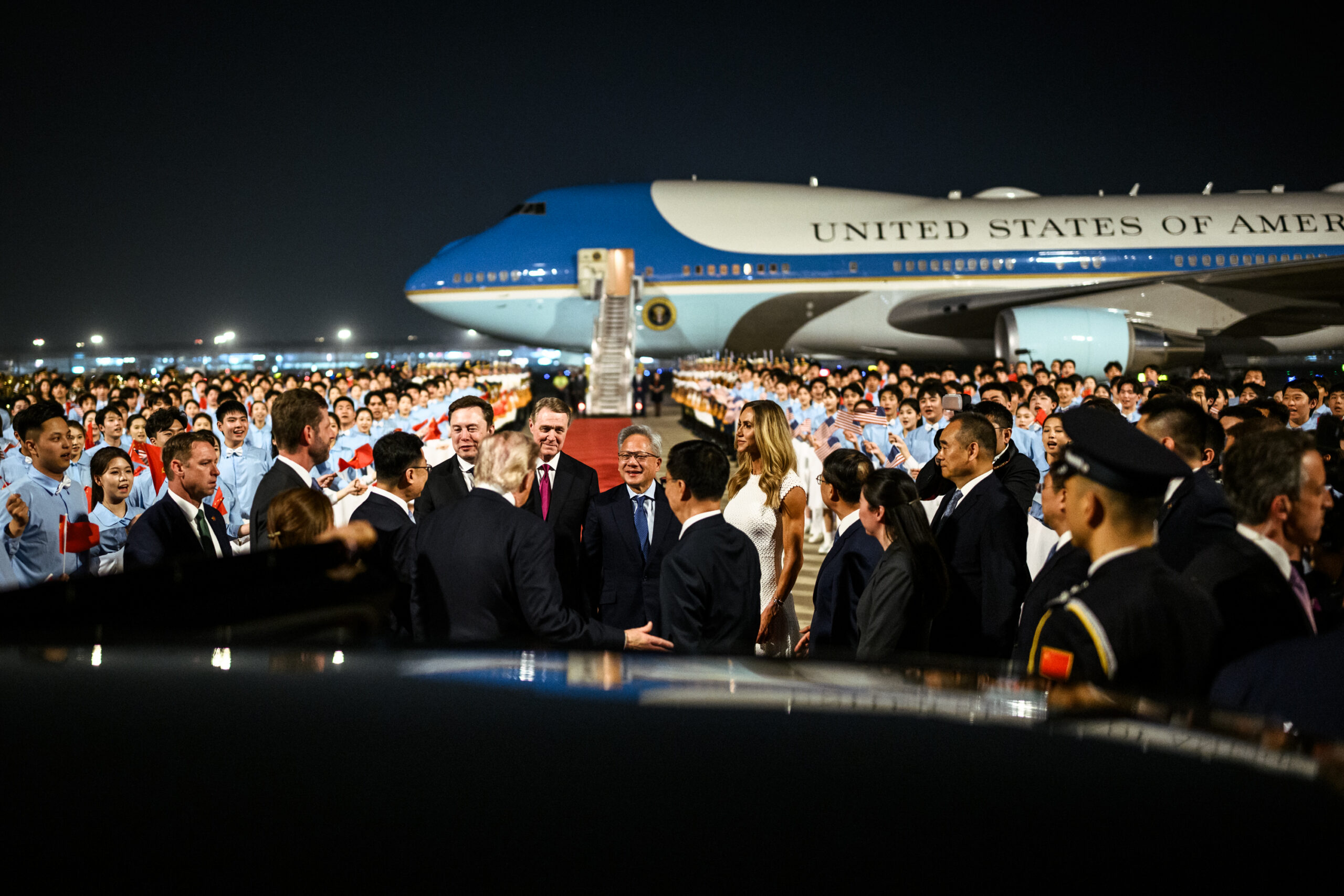
When Trump’s delegation landed in Beijing, the image that circulated showed presidents flanked by technology executives, Huang, Musk and Cook arranged in a careful row. Much of the commentary on the summit read their presence as evidence of a new diplomacy, one in which technology leaders sit beside heads of state and commerce shapes foreign policy. That reading is politically dramatic, but it misses the more instructive figure lackingin the photograph: Australia.
The wedding is between two great powers. The United States and China are settling the terms of the next technological order, deciding who may buy advanced chips, from whom, in what quantities, under what conditions. The technology executives in the photograph are not at the negotiating table. They are there because they make the image make sense, figures in a visual argument about US-China alignment whose actual terms were being drafted elsewhere. Australia, like most of the world’s middle powers, is somewhere further back in the crowd: visible enough to be affected by the settlement, distant enough to have no say in its terms.
The negotiation behind the photograph had already been established before the delegation landed. Reuters reported on 14 May that the US Commerce Department had approved around ten Chinese firms, including Alibaba, Tencent, ByteDance and JD.com, to purchase Nvidia’s H200 chips, with Lenovo and Foxconn cleared as distributors and each buyer permitted up to 75,000 units. Beijing subsequently issued guidance that led Chinese firms to pull back from completing those purchases, leaving shipments at zero despite the US approvals being in place. The rules being settled are technical, but politically decisive: approved buyers, authorised distributors, end-use restrictions, inventory certification and revenue arrangements.
This is an old form of diplomacy doing a new job. Two great powers are settling a regulatory question that affects everyone else, in a room everyone else is not in. The subject, though, is new. The rules being written around chips, compute and market access will determine who trains frontier models, who sells them, who buys them, and what they may be used for. The economic stakes are concrete: compute capacity determines which countries can develop AI applications in health, finance, agriculture and defence; access to frontier models shapes the productivity gains that will define industrial competitiveness over the next decade; and control over distribution channels determines whose regulatory standards get embedded in the systems that run critical infrastructure worldwide. These rules are the operating system of the next economy, and they are being drafted bilaterally.
Attending the Ceremony
For Australia, this is awkward. Canberra has spent years presenting itself as a constructive contributor to the international AI conversation, building standards, hosting dialogues, drafting safety principles and signing declarations. Australia’s National AI Plan was released in December 2025; an Australian AI Safety Institute is being stood up with $29.9 million in funding, and an AI and autonomy workstream sits under AUKUS Pillar 2. This posture is reasonable for a country that knows it cannot manufacture the core technology at scale. It has a limit, however, and the Beijing wedding photograph is where that limit is being exposed.
Norm entrepreneurship works where rules are still open to influence, in forums where language, principle and standard carry weight. It is less useful where rules are being settled through export licences, chip thresholds, compute access and market restrictions. Safety protocols and ethics guidelines are real contributions to a future AI order, but they are not the same as control over the infrastructure on which that order depends. An ethics charter signed in Canberra does not appear on the US Commerce Department’s licence schedule.
The asymmetry runs into the infrastructure itself. Research tracking global AI supercomputer capacity estimates that the United States controls roughly 74 per cent of the cumulative total. China sits far behind; allies and partners are smaller again. Compute is the material condition for training and deploying frontier AI systems, and without reliable access to it, AI ambition becomes dependent on someone else’s permission. Currently, this is what Australia needs to navigate as it considers its future diplomatic and economic relations.
The same pattern is visible in Washington’s own industrial policy. In December 2025, the US Department of Energy announced collaboration agreements with 24 organisations under its Genesis Mission, a national AI effort built around scientific discovery, national security and energy innovation. The listed organisations are overwhelmingly American. From Washington’s perspective this is understandable; for Canberra it is clarifying. AUKUS allies may be asked to invest billions in quantum, autonomy and advanced defence technologies, but the deepest layers of AI infrastructure remain nationally guarded. Australia, like the executives in the wedding photograph, attends the ceremony. Its name does not go on the certificate.
The Wedding Cake
What this requires from Australia is not retreat from international AI engagement, but clarity about what that engagement can and cannot achieve. Norm entrepreneurship should continue, alongside standards work, safety dialogues and AI Safety Institute participation. A country whose AI infrastructure runs on foreign hyperscalers, on supply chains it does not control, cannot secure its strategic position by writing principles alone.
The gap is already visible in Australia’s own policy record. The first arrangement signed under the National AI Plan, in April 2026, was a Memorandum of Understanding with Anthropic, an American AI lab. The problem is not the partnership itself; working with frontier AI developers has practical value. The problem is what it signals about the Plan’s direction: its first concrete instrument deepens reliance on a foreign provider rather than seeding domestic capability. An agreement that channels Australian research, data and public investment through a US company’s infrastructure does not reduce dependency; it institutionalises it. Sovereign compute belongs on the critical infrastructure list alongside energy, telecommunications and water, treated as a strategic investment with its own funding line and timeline, not an aspiration deferred to a later plan.
Australia also needs partners beyond familiar multilateral forums. A middle-power coalition with Japan, South Korea, the Netherlands and Singapore would not resolve the compute problem alone, but it would assemble states with real leverage across chips, lithography, advanced manufacturing and trusted digital infrastructure. That leverage has a practical form: a joint procurement arrangement for shared compute access, or a common export-control position on H200-class chips negotiated as a bloc, would give middle powers a seat at the table that individual norm declarations do not. The absence of such a coalition is one reason the US Commerce Department’s licensing schedule reads, today, like a bilateral document.
AUKUS Pillar 2 requires the same honesty about Australian capability. It cannot be presented as a solution to technological dependency while the compute required for its most advanced projects remains structurally controlled by the United States. Cooperation without infrastructure access is dependency under a better name, and the longer that gap goes unaddressed, the more the pillar will deliver capability on paper that partners cannot independently operate.
The photograph from Beijing will be framed and circulated. Presidents announcing deliverables, executives arranged behind them in a careful row: much of the commentary will read it as the arrival of AI diplomacy. It is more accurately read as a wedding photo, the public face of a private settlement reached in the old fashion by the only parties whose names go on the certificate. Australia can spend the next decade studying the photograph. Or it can start reading the contract.
Muhammad Amir is a PhD researcher at Deakin University, specializing in international relations and security studies. His research focuses on peace processes, strategic competition, defence policy, and emerging technologies.
This article is published under a Creative Commons License and may be republished with attribution.