The unusually candid letter sent by the China Chamber of Commerce to President Prabowo Subianto reads less like a diplomatic communication than a warning — the political bargain behind Indonesia’s nickel boom is beginning to unravel.
China-Indonesia Nickel Investment
Since the launch of Indonesia’s downstream mineral industrialisation strategy under former president Joko Widodo in 2015, Chinese capital has been welcomed with extraordinary generosity. Investors received tax holidays, privileged access to nickel ore, regulatory accommodation and political support in exchange for rapid industrialisation. Smelters rapidly multiplied across Sulawesi and Maluku, particularly after Indonesia accelerated its raw nickel ore export ban in 2020 to force domestic processing and refining. Within less than a decade, Indonesia transformed itself from a major raw nickel exporter into the world’s dominant nickel-processing hub, producing more than half of the global refined nickel supply by the early 2020s.
The Indonesian government celebrated this as a triumph of downstream industrial policy. Chinese companies celebrated it as proof of a strategic partnership between China and Indonesia.
Both stories were only partially true.
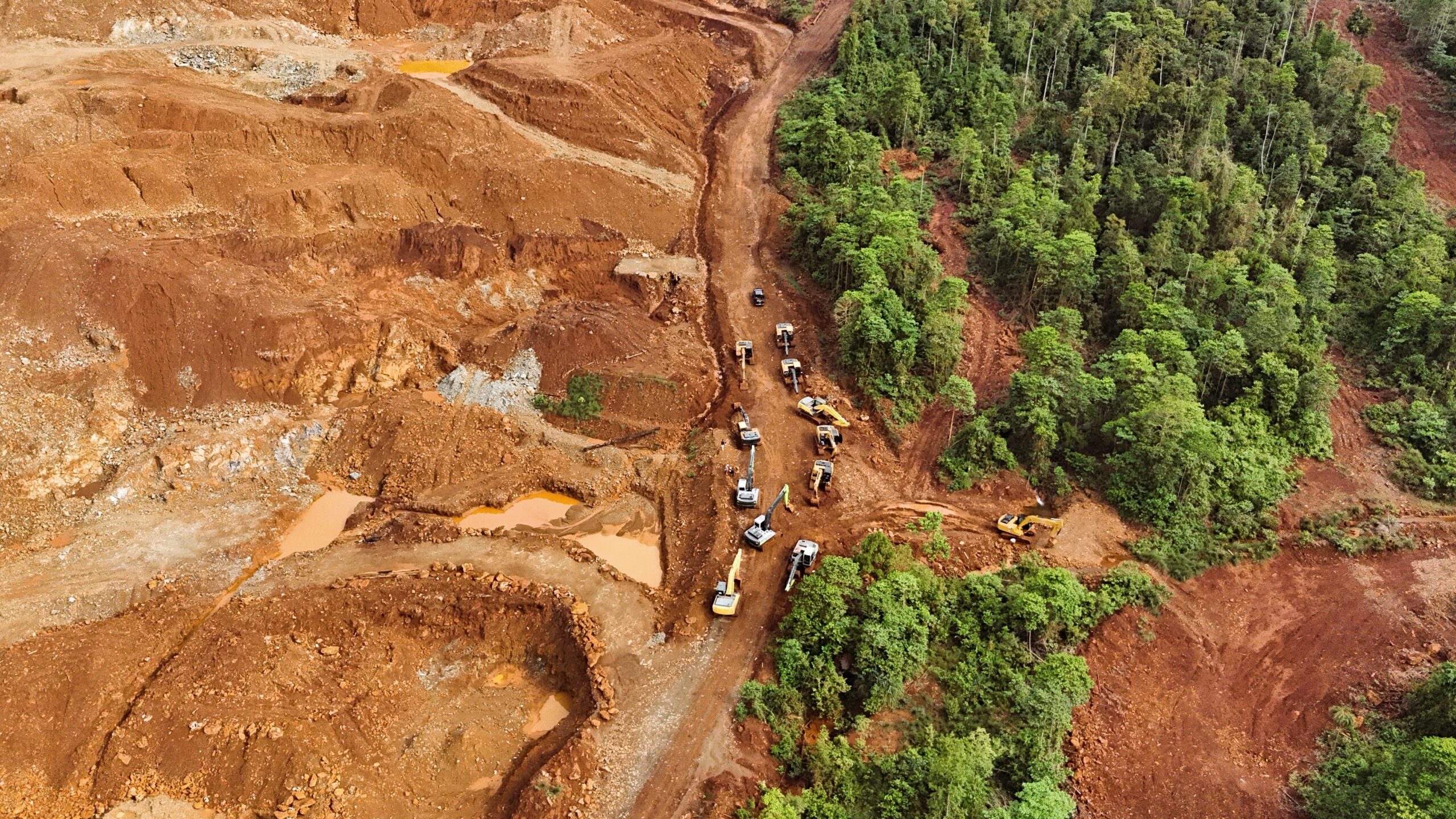
What Indonesia created was not a mature industrial ecosystem but a heavily subsidised extraction-and-processing machine dependent on cheap coal power, permissive regulation and relentless expansion regardless of long-term market realities. The model delivered strong output growth, with Indonesia accounting for more than 60% of global nickel production by 2024, alongside record smelter investment and rapid industrial clustering in Sulawesi and Maluku. However, this expansion also generated significant environmental externalities. Nickel processing and associated coal-based power generation have been estimated to produce highly carbon-intensive output—around 93 tonnes of CO₂ equivalent per tonne of nickel—while contributing to deforestation, land conversion and coastal ecosystem degradation in major production zones such as Morowali. Studies and monitoring reports have also documented large-scale forest loss linked to industrial expansion in the nickel sector, with more than 2,000 hectares of deforestation recorded annually in parts of Central Sulawesi in recent years.
Investment Breaks Down
The China Chamber of Commerce complains about rising royalties, tighter ore quotas, stricter forestry enforcement and growing regulatory pressure. Some of those complaints are understandable.
However, the returns to Indonesia have often looked surprisingly thin relative to the scale of extraction. Nickel exports and processing capacity exploded, but government revenues remained comparatively modest. Industrial parks consumed enormous amounts of coal-fired electricity while creating limited technology transfer. Local communities frequently absorbed the environmental and social costs. At the same time, the largest financial gains flowed elsewhere to foreign-owned smelters, overseas shareholders and Chinese-controlled refining networks that dominate Indonesia’s nickel-processing sector. Indonesia became indispensable to the global nickel supply chain without necessarily becoming substantially richer as a result.
The Chamber’s complaint that revised pricing rules have sharply increased nickel ore costs ignores another truth: for years, nickel ore may simply have been too cheap. Investors built their business models around abundant, low-cost Indonesian resources and now worry about profitability due to the Indonesian state’s attempts to capture more value. What constitutes unfair treatment in the eyes of investors results from Indonesia being left out of the benefits of its own industry. No sovereign government can permanently justify selling strategic minerals at prices that mainly enrich foreign industrial players while domestic fiscal benefits remain limited.
The industry’s overcapacity problem makes this even more obvious. Indonesia’s nickel sector expanded far beyond what global demand could sustainably absorb. Smelters kept being built because cheap ore, subsidised financing and policy incentives made expansion profitable even as the market became saturated. Chinese investors were not passive participants in this distortion; they were central architects of it.
The consequences are now visible everywhere: collapsing prices, shrinking margins and a global nickel market drowning in excess supply originating largely from Indonesia itself.
Institutional Discipline
Criticising Chinese investors does not fully capture the reality of the current situation. The Indonesian government bears equal responsibility for creating this fragile system.
Jakarta pursued industrial expansion with extraordinary speed but limited institutional coordination. Policies governing royalties, benchmark pricing, export controls and mining quotas (RKAB) shifted frequently, often without clear transition pathways. Overlapping authority between the Ministry of Energy and Mineral Resources, the Ministry of Industry and environmental regulators further complicated licensing and enforcement. In some cases, delayed or inconsistent RKAB approvals disrupted ore supply chains, forcing smelters to seek imports even as the state attempted to manage domestic oversupply.
The Chamber’s complaints about over-enforcement, opaque bureaucracy and reliance on intermediaries resonate because they reflect longstanding weaknesses in Indonesian governance. Foreign businesses are hardly alone in facing these problems; Indonesian companies have complained about the same issues for decades.
The deeper issue is institutional rather than purely commercial. Indonesia attempted to build a globally strategic nickel industry at an extraordinary pace without first developing the regulatory and administrative capacity needed to govern it consistently. As investment surged, the state struggled to coordinate licensing, environmental oversight, quota allocation and long-term industrial planning across competing agencies and political interests. The result was not simply regulatory uncertainty for investors, but a structurally fragile industrial model vulnerable to policy reversals, market volatility and governance disputes.
Too often, policy has shifted in response to immediate market and political pressures rather than through a consistent long-term industrial strategy. During the boom years of roughly 2020–2023, the government prioritised attracting foreign investment at any cost. Now, under fiscal and political pressure, it is trying to claw back greater national benefit through sudden royalty hikes, quota cuts and stricter enforcement. In 2025, Indonesia proposed raising nickel ore royalties from a flat 10% rate to a progressive 14–19% structure, while several producers also faced major quota reductions under revised RKAB approvals.
The Path Ahead
Since the 2020 nickel ore export ban, Indonesia’s down streaming strategy has increasingly been tied to efforts to retain more value from strategic minerals through domestic processing and export controls rather than raw commodity exports.
President Prabowo now inherits an industry trapped between economic nationalism and market reality. Indonesia wants greater control over its resources, higher state revenues and more domestic value creation. Those are legitimate goals. But they cannot be achieved through policy improvisation, opaque enforcement, and abrupt regulatory shocks, because large-scale industrial investment depends heavily on regulatory predictability, long-term planning, and stable market expectations. Sudden policy shifts may help address immediate fiscal or political pressures. Still, they also risk discouraging investment, disrupting supply chains and deepening uncertainty in an industry already facing global oversupply and falling prices.
At the same time, Chinese investors cannot continue their investment strategy of treating Indonesia merely as a supplier of cheap ore and as a source of regulatory flexibility for China’s industrial ambitions. A strategic partnership between China and Indonesia cannot mean privatising profits while socialising environmental and political costs onto Indonesia.
The challenge ahead is not whether Indonesia should tighten regulation or demand a larger share of the value from its nickel wealth; these are necessary but only secondary to addressing the issue. The challenge is whether the Indonesian government can manage the sector through transparent, predictable and coordinated policies rather than the abrupt and inconsistent interventions that have defined much of the industry’s development so far.
Because in the end, a nickel superpower governed by regulatory confusion and mutual distrust is not a superpower at all.
Yeta Purnama is a researcher at Center of Economic and Law Studies (CELIOS), whose work focuses on the evolving dynamics of China–Indonesia relations.
Dr Muhammad Zulfikar Rakhmat is a co-author, serves as Director of the China-Indonesia Desk at CELIOS, and is also affiliated with positions at the Middle East Institute at the National University of Singapore, the London School of Economics’ IDEAS, and Busan University of Foreign Studies.
This article is published under a Creative Commons License and may be republished with attribution.