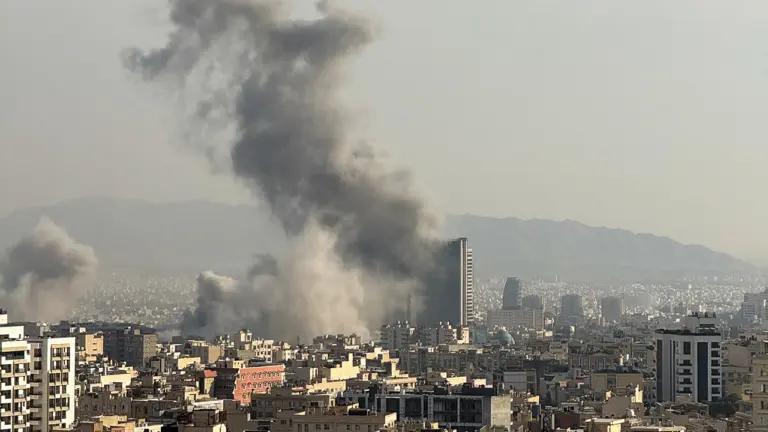
The United States and Iran seem stuck in a loop of escalation and restraint. The real danger is not necessarily deliberate war, but how easily signalling, pressure, and miscalculation can push both sides closer to unintended escalation.
If you step back and look at the past few years, the pattern in U.S.–Iran relations is hard to miss. Tensions rise, something happens—a strike, a proxy attack, a maritime incident—and then both sides pull back just enough to avoid something bigger. Then, after a while, it starts again. This pattern has appeared repeatedly following incidents such as the 2019 attacks on Gulf shipping, the 2020 killing of General Qassem Soleimani, and recurring militia strikes involving Iranian-backed groups in Iraq and Syria.
We’ve seen versions of this play out in the Strait of Hormuz, across Iraq and Syria, and through proxy activity tied to wider regional crises. Despite the hostility, both sides have repeatedly shown they want to avoid a direct, full-scale war. For Iran, a conventional confrontation with the United States carries obvious existential risks. For Washington, another prolonged Middle East conflict would come with major political, military, and strategic costs at a time when its strategic focus is increasingly shifting toward competition with China in the Indo-Pacific. Yet the cycle continues. Why?
A lot of analysis treats this as a failure of diplomacy, restraint, or leadership. But that does not fully capture what is happening. These tensions make more sense when viewed as a strategic interaction rather than a series of isolated events.
From Prisoner’s Dilemma to Brinkmanship
One common way to think about it is the Prisoner’s Dilemma: both sides escalate even though they would be better off cooperating. The problem with that framing is that it assumes backing down is relatively low-cost. In reality, it is not. For both Washington and Tehran, unilateral restraint can carry political and strategic costs by creating perceptions of weakness, both domestically and internationally.
A better way to think about it is closer to brinkmanship. Both sides push the situation closer to the edge than they would ideally like, partly to test the other side and partly to show they are willing to bear the cost. The hope is that the other side blinks first. At the same time, each side believes the strategic gains of forcing the other to back down outweigh the risks involved in approaching escalation.
That is what makes this dynamic dangerous, especially because it is not happening in a world of perfect information. Neither side really knows how far the other is prepared to go. Every move—whether a limited strike, cyber operation, or proxy attack—is trying to shape the situation while also sending a signal.
The problem is that signals are not always read the way they are intended. What begins as calculated signalling can quickly turn into unintended escalation if one side misreads the intentions or limits of the other.
A strike meant to re-establish deterrence can look like the start of something larger. A proxy attack meant to show resilience can be interpreted as escalation. Over time, both sides are effectively testing each other’s resolve, limits, and willingness to absorb costs—but they are doing so through actions that risk military retaliation, regional escalation, or unintended conflict.
You can see this clearly in the aftermath of the 2020 killing of General Qassem Soleimani. The United States intended it as a decisive signal. Iran responded with calibrated missile strikes that avoided U.S. casualties, signalling that it was willing to respond forcefully while still trying to avoid uncontrollable escalation. Both sides, in effect, stepped up and then stepped back. It was controlled—but only just.
Unequal Playing Fields, Strategic Constraints, and Instability
There is also a deeper asymmetry at play. The United States has overwhelming military power, but it also has constraints—alliances to manage, domestic politics, and a broader strategic focus that now includes competition with China. Iran, meanwhile, has built a system designed to absorb pressure over time. It relies heavily on proxies, regional networks, disruption, and increasingly low-cost drone capabilities rather than direct confrontation.
That creates a kind of slow-burning contest. The United States looks for ways to impose costs efficiently. Iran looks for ways to stretch things out through its proxy network. Neither side is really in a position to “win” outright without paying a much higher price than they are willing to accept.
Each side is constantly updating its view of the other. How serious are they? How much pain will they tolerate? Are they trying to avoid escalation, or preparing for it? Those judgments can shift quickly, sometimes based on a single event.
Then there is the question of how decisions are made under pressure. In calm conditions, there is usually time to weigh options. In a crisis, that changes. The risk of overreaction—or simple misreading—goes up.
The environment itself is also unstable. Regional actors pursue their own interests, often in ways neither Washington nor Tehran fully controls. Israeli strikes, proxy activity, Gulf security concerns, and disruptions to regional shipping all add layers of unpredictability that complicate efforts to keep escalation contained.
Put all of that together, and you end up with a familiar pattern: ongoing, limited escalation that neither side fully resolves, but neither side lets spiral—most of the time.
Identifying the Conditions of Conflict
Recent analytical approaches suggest that structured modelling frameworks can help explain how different conditions shape conflict trajectories. Similar approaches have been used in strategic studies and game theory to examine deterrence, signalling, and repeated interaction under uncertainty. Instead of treating crises as isolated events, this approach focuses on the underlying conditions that make escalation more or less likely, such as perceptions of resolve, decision-making under pressure, and the volatility of the surrounding environment. The value is not in predicting exact events, but in identifying the conditions under which the system becomes significantly more dangerous.
That kind of framework does not predict specific events, but it does help explain why the same patterns keep repeating over time, and why some moments feel more dangerous than others.
For policymakers, the implications are fairly straightforward.
If misreading signals is part of the problem, then clearer communication matters. That does not just mean formal diplomacy—it includes backchannels, indirect messaging, and public signalling that reduce the risk of misunderstanding. If proxy activity is a major driver of escalation, then mechanisms that limit or contain proxy responses also become important. And if neither side can easily step back without appearing weak, then credible off-ramps need to exist before crises spiral.
None of this, however, guarantees stability. In reality, “stability” in the U.S.–Iran context often means a tense and costly equilibrium rather than genuine resolution. But without some form of managed restraint, the risk of serious miscalculation remains high.
In the end, U.S.–Iran tensions persist not because either side is irrational, but because they are operating in a system where showing restraint can be costly, signals are easy to misread, and the environment is unpredictable. That combination does not just produce conflict—it sustains it.
And that is what makes it dangerous. Not the inevitability of war, but how easily things could slide into it.
Dr Hamed Zakikhani is an agronomist and researcher based in Queensland. He holds a PhD in Agronomy and has published widely on agriculture, food security, and strategy. His current focus is on the intersection of policy, international relations, and Australia’s role as a middle power in the Indo-Pacific.
Dr Ali Saghafi holds a PhD in Electrical Engineering and specialises in machine learning and analytical modelling. His work focuses on applying quantitative frameworks to complex decision-making problems.