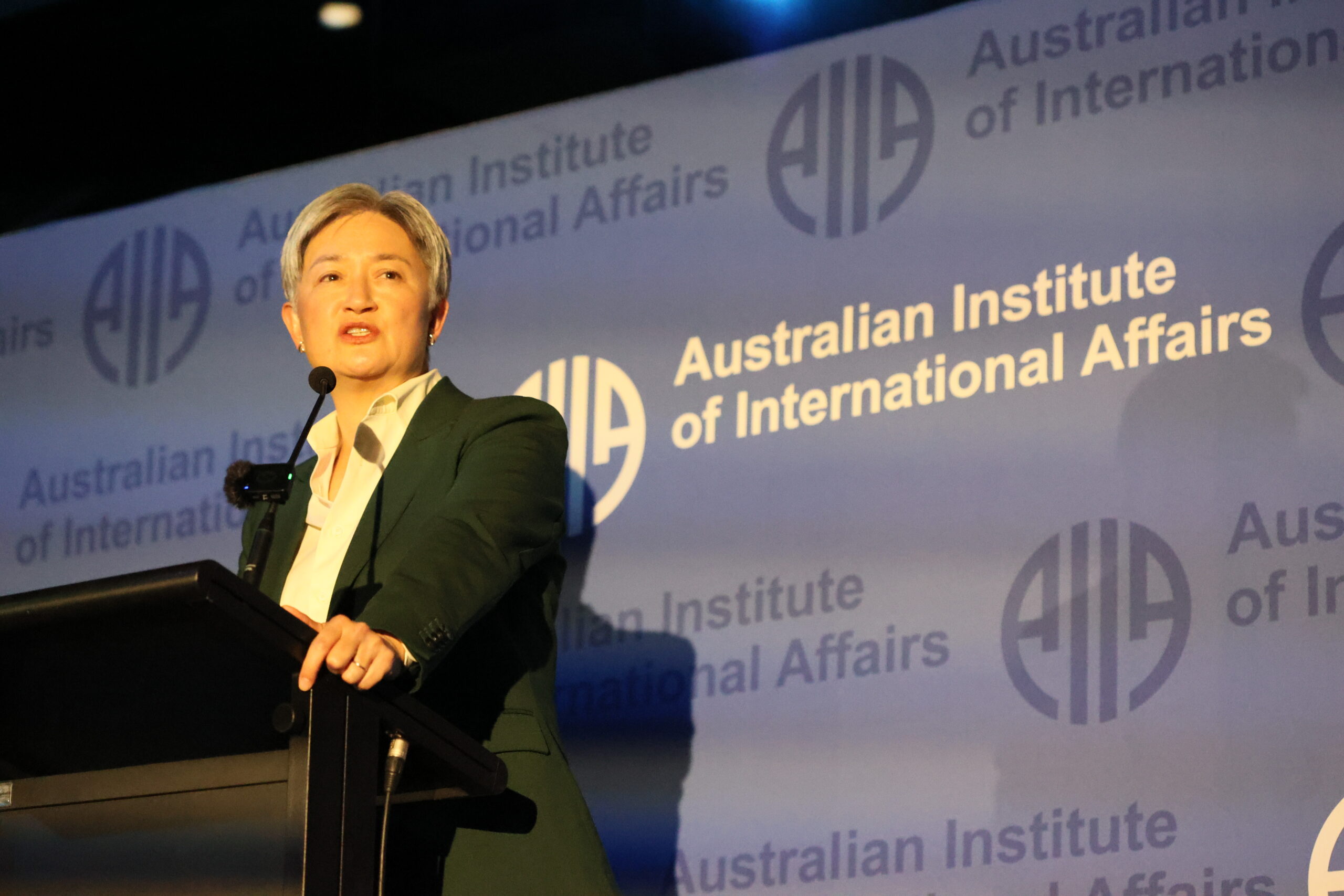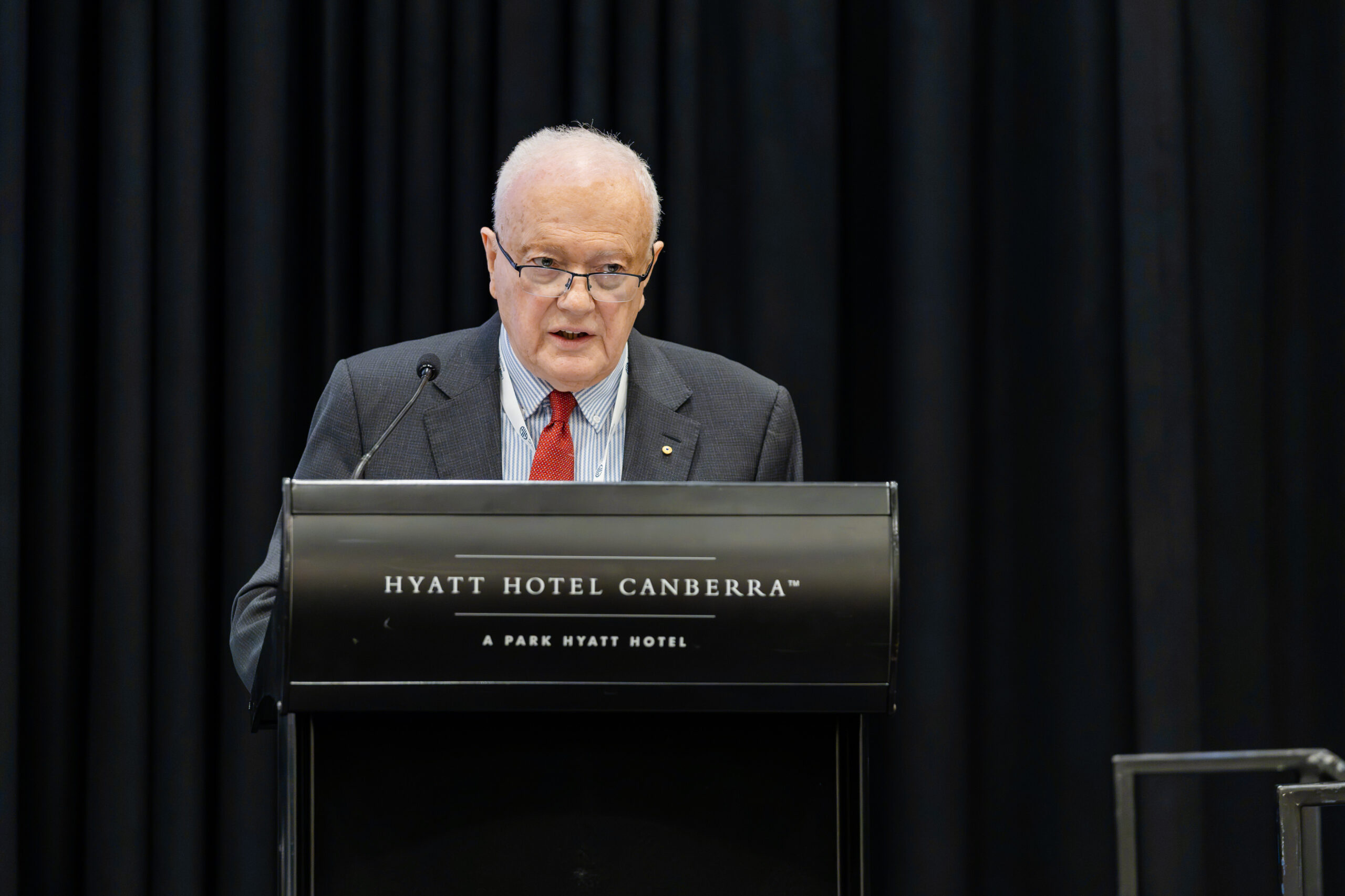
Australia faces a world of intensifying great-power contest, returning conflict, ecological breakdown and accelerating technological change, all unfolding as the rules-based order frays. In his opening address to the 2026 AIIA National Conference, AIIA National President Gary Quinlan argued that the world is entering a long contest over the nature of the international order itself. He called for forensic realism, a national resilience strategy and renewed middle-power leadership, and warned that Australia risks slipping down the ranks of the G20 just as its strategic weight matters most.
The focus of our conference is global disruption. We have panels of speakers devoted to the key elements of that, so I won’t anticipate too much of their discussions. What I’ll try to do is frame an appreciation of the broad ecosystem in which we have to survive – one whose uniqueness and difference is possibly not adequately understood.
Now, every generation believes it is living in a unique time — and, biologically, we are. But the fact is that the current generation is living through the genuinely unique moment of what is the fastest and most profound change in human history. A time when the nature of change itself has changed.
Change in the past was usually linear and incremental. It is now increasingly simultaneous and exponential.
Previous technological revolutions — the discovery of iron, the invention of printing, the technologies of the Industrial Revolution — transformed human societies, but they were essentially instrumental. They changed what human beings could do: how we worked, communicated, produced and organised our lives.
What is happening now is potentially far more fundamental. Artificial intelligence is not simply another transformative technology. It is potentially a primordial change. For the first time in human history, we are developing forms of intelligence that may ultimately surpass our own — and doing so without fully understanding how they work, where they may lead, or how we will retain control over them.
For one hundred thousand years the distinctive evolutionary advantage of Homo Sapiens — the thinking animal — has been our intelligence: our capacity to reason, imagine, create, learn and exercise judgement. We are now developing technologies that fundamentally may challenge that advantage. Now, this is serious stuff. It raises questions not simply about economics, employment, political systems, military power, technological competition and global order, but equally about human autonomy, human behaviour, human agency — and ultimately what it means to be human.
And this extraordinary technological transformation is unfolding against an international environment that is itself undergoing profound and destabilising change.
We are moving from what had been described as a “polycrisis” towards something approaching an “omnicrisis”. We need to understand the international environment not as a collection of discrete problems, but as an interconnected ecosystem of pressures.
The highest levels of armed conflict, mass displacement, people movements and humanitarian crisis since WW2; hunger; the collapse in multilateral funding and aid budgets; climate change and wider ecological pressures; global health risks; technological disruption; growing political fragmentation within and between states; and a world of “alternative facts”, misinformation and the assault on truth. All are reinforcing one another. And now we face the new risks from the concentration of enormous, transforming power in the hands of unaccountable tech titans whose market capitalization exceeds the GDP of every economy except the United States; of autonomous decision-making through technology and the erosion of the sort of restraint that prevented catastrophe during the Cold War; and now the “shadow-war” designed to produce anxiety in our communities and undermine social cohesion. Look at what the Russians are doing across Europe.
All of this is placing extraordinary demands on governments at precisely the moment where their capacity to respond collectively is being weakened — all occurring against a fundamental change in the distribution of global power.
Global Order
The institutions and understandings that have provided the framework for international cooperation since 1945 are under severe strain, while the political and strategic circumstances in which they must operate have changed profoundly.
That framework – the so-called rules-based order – was guaranteed by US primacy and US willingness to lead. President Trump did not cause the underlying shifts which have been weakening the order but his transactional and coercive approach – placing exclusively US power and self-interests at the top of his international agenda – metastasized them and fundamentally damaged the global system. He has also given greater licence to others opposed to the rules. Russia is destructive. China more revisionist.
We are not simply witnessing a transition in the international order. We are witnessing a fundamental contest — a contest over the nature of the international order itself: who shapes it, whose interests it serves, what rules constrain power, and whether international cooperation can survive in an era of renewed great-power rivalry.
One of the defining characteristics of this period is the emergence of a much more dispersed distribution of global power. The US and China remain the two dominant powers, streets ahead of everyone else, but they are no longer the only states with substantial economic, technological, military and diplomatic influence. India, the European Union, Japan, Indonesia, the Gulf States, Brazil and others are increasingly consequential.
We often describe this — or some people do — as the emergence of a multipolar world. Yes. But a more dispersed distribution of power does not in itself constitute an effective multipolar international system. Certainly, we have more powerful countries, but we do not yet have an agreed framework, a stable set of understandings or effective institutions capable of anchoring a new multipolar order.
The old order is under pressure; we know that a new one has not emerged. We are therefore entering, or have entered, a long period of contest and uncertainty. It may take a decade or more before a new international equilibrium begins to take shape. We shouldn’t assume that it will emerge automatically, or that it will necessarily be more stable than the system we are leaving behind.
We should also be realistic about the character of the order that may eventually emerge. It is certainly unlikely to be an order created and guaranteed by a single dominant power, as with the US previously. Nor is it likely to be liberal in the way that term has traditionally been understood. Liberal democracy is under pressure across much of the world, and the political consensus that once supported the liberal international order has probably been irreversibly weakened.
This does not mean that we should abandon the principles and rules on which much of the post-war system was founded. But the future world will be less about values – in themselves – than the rules, the institutions and the understandings that constrain power, irrespective of the political character of individual states.
Of course, the international order now under pressure was never as liberal, universal or consistently rules-based as we liked to think. As Prime Minister Mark Carney argued in his very refreshing Davos wake-up call, the story of the rules-based international order was only ever selective. Powerful states exempted themselves when it suited them.
But that shouldn’t lead us to dismiss the achievements of the post-war system or the principles on which it was founded. The UN Charter, international law, multilateral institutions and the development of international norms have made a substantial difference for the good. Our job is not to restore some kind of idealised past; it is to preserve what was genuinely valuable, confront what was deficient, and build a more representative and effective system of rules and institutions capable of constraining power in a much more contested international environment.
All this helps explain the important role of the Global South in whatever new order emerges – which is why China and Russia are so heavily investing in them. Many countries have problems with the predominance of Western powers in shaping the post-war international order. And their demand – pivotally – is for reform, not the abandonment, of multilateralism. Above all for reform of the international financial institutions and the wider global financial system, and of the Security Council, where the under-representation of Africa, Latin America and Asia must be corrected. These are legitimate demands for a system whose representation and influence should better reflect the world as it is today. And the future of multilateralism will depend on whether we can respond credibly to those challenges.
Existential Challenges
Now, against this background, there are three challenges that deserve singular attention. Each is potentially existential, and each illustrates, I think, why international cooperation remains indispensable.
The first is nuclear. The Bulletin of the Atomic Scientists’ Doomsday Clock has moved to its most alarming position since it was established. The risks are not confined to the possibility of deliberate nuclear use. We face the dangers of miscalculation, escalation, weakened arms-control arrangements, and the erosion of the understandings and restraint that helped prevent catastrophic confrontation during the Cold War. The war in Ukraine has brought nuclear threats back to the centre of international politics. New technologies, including AI, add further complications to crisis management and strategic decision-making.
The second big challenge is ecological. Climate change is central – we’ve failed on the 1.5 degrees ceiling – but the problem is much wider than climate alone. Seven of the nine planetary boundaries essential to livability have been breached, the seventh – ocean acidification – in September last year. The implications extend to food and water security, biodiversity, human health, economic stability and international security.
And the third is artificial intelligence — the technological transformation with which I began. AI offers extraordinary possibilities in medicine, education, scientific discovery and productivity. Yet it also presents profound risks: misuse, cyber threats, disinformation, disruption to employment, and the concentration of economic and political power. And, of course, its own ability, through recursive self-improvement, to operate beyond human control.
Its development is increasingly dependent on enormous computing power, sophisticated chips, energy and capital. These resources are concentrated in a tiny number of countries and companies, especially in the United States and China. AI could dramatically increase the advantages of those two countries over everyone else. It could also intensify inequality within and between countries, as the gains accrue disproportionately to those who own the technology, the data and the capital.
The genie is out of the bottle, of course. The most immediate challenge we face is to subject its continuing warp-speed development to public oversight – not just industry-self-regulation – and to international cooperation.
These technological developments reflect a wider transformation in the relationship between economics and security. For much of the post-war period, economic interdependence – globalisation – was regarded as a source of stability. Trade, investment and global supply chains were expected to create shared interests and make conflict more costly. That logic has not disappeared. But interdependence is increasingly being treated as a source of strategic leverage.
We have seen the use of tariffs, investment controls, export controls, sanctions and access to critical technologies as instruments of national power. Supply chains once designed primarily for efficiency are now being assessed for security and resilience. The two standout examples, highlighted at the moment in particular between the US and China, are access to and control over semiconductors and rare earths. The broader lesson is that economic security, technological capability and national resilience are now inseparable.
Conflict
The return of major armed conflict to Europe, the continuing instability in the Middle East and the strategic tensions in the Indo-Pacific remind us that military power remains central to international affairs. As David [Macalister MEP] just mentioned, Russia’s invasion of Ukraine – the first land war in Europe since WW2 – has demonstrated that territorial aggression is back on the agenda. Its settlement will shape the future order – will aggression be rewarded? Is the international community capable of and willing to resist aggression? Are security commitments credible? Russia had signed a treaty-level agreement with Ukraine in 1994 guaranteeing its sovereignty and territorial integrity, and committing to no use of nuclear threats. We’ve been down this path before.
The Middle East is undergoing profound long-term strategic shifts. The war on Iran has altered the strategic calculus right across the region and Saudi Arabia and the Gulf states are reassessing their security relationships, including with the US, their previous strategic guarantor. Israel faces a changed strategic landscape but the question of a sustainable political settlement on Palestine remains unresolved, possibly indefinitely. It looks like we’re settling into a war of attrition on Iran with Iran holding a good hand. And with its nuclear ambitions attenuated but extant.
In the Indo-Pacific, the central strategic challenge remains preventing competition from escalating into conflict. Taiwan is obviously central — not only because of its political and strategic position, but because of its decisive role in advanced semiconductor production — and a crisis there would have potentially catastrophic consequences globally.
The South China Sea and the Korean Peninsula are potential flashpoints. North Korea’s nuclearization is irreversible. This affects whether Japan and South Korea will go nuclear. Both can do so quickly.
Multilateralism
One lesson from conflict is that military power, while essential, is rarely sufficient to produce a durable political settlement. Deterrence matters. Diplomacy matters—the management of escalation, and of the political conditions that sustain conflict.
The UN Security Council continues to have a role – even President Trump utilizes it. But it is frequently paralysed by divisions among the permanent members. The use of the veto remains a serious obstacle.
Of course, the multilateral system is much more than the Security Council. It includes the international financial institutions, treaty bodies, regional organisations and a dense network of practical arrangements through which the world coheres. The work of the 15 UN Specialised Agencies in particular lays down the rules by which the world operates every single day: in the maritime domain, civil aviation, telecommunications, post, health, meteorology, labour, intellectual property, and the rest.
The UN itself needs reform – everyone agrees. And it is already doing some. It will be smaller, leaner, less funded in the future. Its mandated authority, universal membership, convening power, and operational reach cannot be replicated. As Prime Minister Carney – again – said at the UN General Assembly in September : “the post-war world is ending, but the underlying logic of that world that justified multilateral cooperation is more compelling than ever”. A new and representative group of leaders was launched at UNGA this year – Partners for Multilateralism – sponsored by Australia, Brazil, Barbados, Canada, EU, India and Kenya. It heralds multilateralism as “indispensable” and is committed to take the lead in its reform and strengthening. This will take very sustained effort.
Despite the anxieties, the world is not all lost, of course. Saving multilateralism – in whatever form – is an imperative now attracting focus. And the international system is still functioning, however imperfectly. We are right now in the midst of the major summit season, involving the G7, the East Asia Summit, APEC, and the G20 in December. These gatherings in themselves are no substitute for action. But they are serviceable and show that governments continue to see important value in meeting, negotiating and finding common ground.
Middle Powers
Now, where does this leave middle powers? In an era of great-power competition, the influence of middle powers is inevitably constrained — that’s obvious. They cannot determine the strategic choices of the United States or China or overcome fundamental disagreements between major powers. And there are inevitably limits imposed by their own security relationships with others — pre-eminently with the US. They also have different perceptions of threat and different political and strategic systems. And they are not an alternative bloc to the US as some wrongly thought Mark Carney was proposing at Davos.
But middle powers are not powerless. They can build coalitions, shape agendas, develop proposals, support international law, and help create the political conditions for agreement. Their influence comes not from their individual weight, but from their capacity to organise collective action. More variable or functional geometry is a good thing. The Trans-Pacific trade agreement, the MPIA dispute resolution agreement outside the WTO but mimicking WTO provisions, the recent E-commerce agreement – all these without US participation – are successful models.
Above all, middle powers need to assert themselves to help shape whatever the new order will be and not leave it to emerge by default — as spheres of influence, a G2, competing blocs, or just fragmented disorder.
The modern concept of middle powers originated with Canada and Australia in 1944 and 1945, in the negotiations to establish the UN system — the post-war global order. Both were major combatant countries in WW2 and insisted that establishing a new international system to avoid the catastrophe of another war should not be left to the great powers alone. Australia’s Foreign Minister, Doc Evatt first publicly used the term “middle powers” at the San Francisco Conference in 1945 which adopted the UN Charter, still the most ambitious and forward-looking agreement between states in international relations. Both countries were the leading opponents of the veto, until silenced. They then turned their attention to building up the role of the General Assembly as representative of the middle and smaller countries.
Australia
Now, what does all this mean for Australia? Time is against me, but we have all day today panels dedicated to precisely this, so I won’t try to anticipate what those panels will say. I will just make a few brief comments.
First, on the importance of strengthening our own national resilience. I believe the Australian Government should develop a comprehensive national resilience statement, setting out our vulnerabilities, the capabilities we need, and the responsibilities of governments, business and the wider community. Resilience must encompass economic security, energy, food, critical infrastructure, cyber security, public health, technology, and social cohesion — and our statecraft and diplomacy. It must also explain the economic reform needed. Our influence with others depends on strategic weight, and that reflects economic weight. On our current trajectory, we are slipping down the ranks of the G20.
Second, we need to maintain our alliance with the United States with clear eyes. It remains fundamental to our security, but it is not a substitute for our own judgement. We need to look forensically at what the alliance means – and what it doesn’t mean. We need a transactional perspective. We should be clear about our interests, our obligations, and the limits of what we can realistically expect from others.
Third, and it’s obvious, we need to sustain a stable and constructive relationship with China. To use the government’s own formulation, cooperating where interests align, competing where necessary, managing differences carefully.
Fourth, again obviously, we need to deepen, deepen, deepen our partnerships across the Indo-Pacific. The government’s latticework of new security agreements across the Pacific, the step up with Indonesia, and the new agreement yesterday with the Philippines are all impressive. We need to work emphatically with Japan which is asserting itself more to shape the region. With India, a future great power in the region, and central to our Indian Ocean interests. And with ASEAN – a successful ASEAN gives Australia strategic depth.
And fifth, we need to remain an active contributor to multilateral institutions, international law and practical international cooperation. That’s what our candidacy for the UN Security Council, for the term 2029-30, and the new Partners for Multilateralism group are all about.
Conclusion
Let me conclude with a thought about the challenges I’ve identified. Competition between major powers is intensifying; conflict has returned to the centre of international politics; the multilateral system is under perilous strain; and the pace of technological change has already created risks that we are only now beginning to understand.
It was Humphrey Bogart, I think, who in the classic 1951 movie The African Queen commented that things are never so bad that they can’t get worse.
But let’s be optimists.
It would a mistake to assume that we are witnessing the inevitable collapse of international cooperation. The world remains deeply connected. Governments are continuing to negotiate. International institutions continue to do necessary work, though less in some crucial areas. Regional partnerships are developing, and effective regionalism offers a powerful vector to help attenuate the asymmetries in the distribution of power throughout the world. Scientific cooperation, though at risk of politicisation, continues. And the current summit season demonstrates that countries still recognise the value of coming together to address shared problems.
The institutions created after the Second World War emerged from catastrophe. They were built because governments understood the consequences of failure. We need a similar sense of national purpose now to successfully navigate the future successfully. And this requires governments to explain a lot more to Australians about our strategic circumstances and what we need to do.
The report in March this year of the National Security College consultations across Australia on attitudes to risk and resilience — the most comprehensive consultations of their kind — showed a very high level of anxiety, a sense that we are underprepared, and a demand for governments to share more information.
We must respond to this. There is a responsibility on government, institutions, business, universities, and organisations like the AIIA, to contribute to that national conversation — to explain the choices we face, the costs involved, and the consequences of inaction. We need a much more informed public debate about our place in the world.
In an increasingly disordered world, neither fatalism nor complacency are options. We need forensic realism, strategic imagination, and a preparedness to take an active lead. We have a very strong history in this nation of doing this – the creation of APEC, the G20, the ASEAN Regional Forum, the Pacific Islands Forum, Non-proliferation, the Canberra Commission, the Chemical Weapons Convention, the Cambodia Peace Settlement. Others look to us for this leadership. We now need to look to ourselves to make sure we lead.
Gary Quinlan AO FAIIA is the President of the Australian Institute of International Affairs’ National Office. This is an excerpt of his keynote speech to the 16 November 2026 AIIA National Conference. A full recording of Gary’s speech is available here.
This article is published under Creative Commons License and may be republished with attribution.