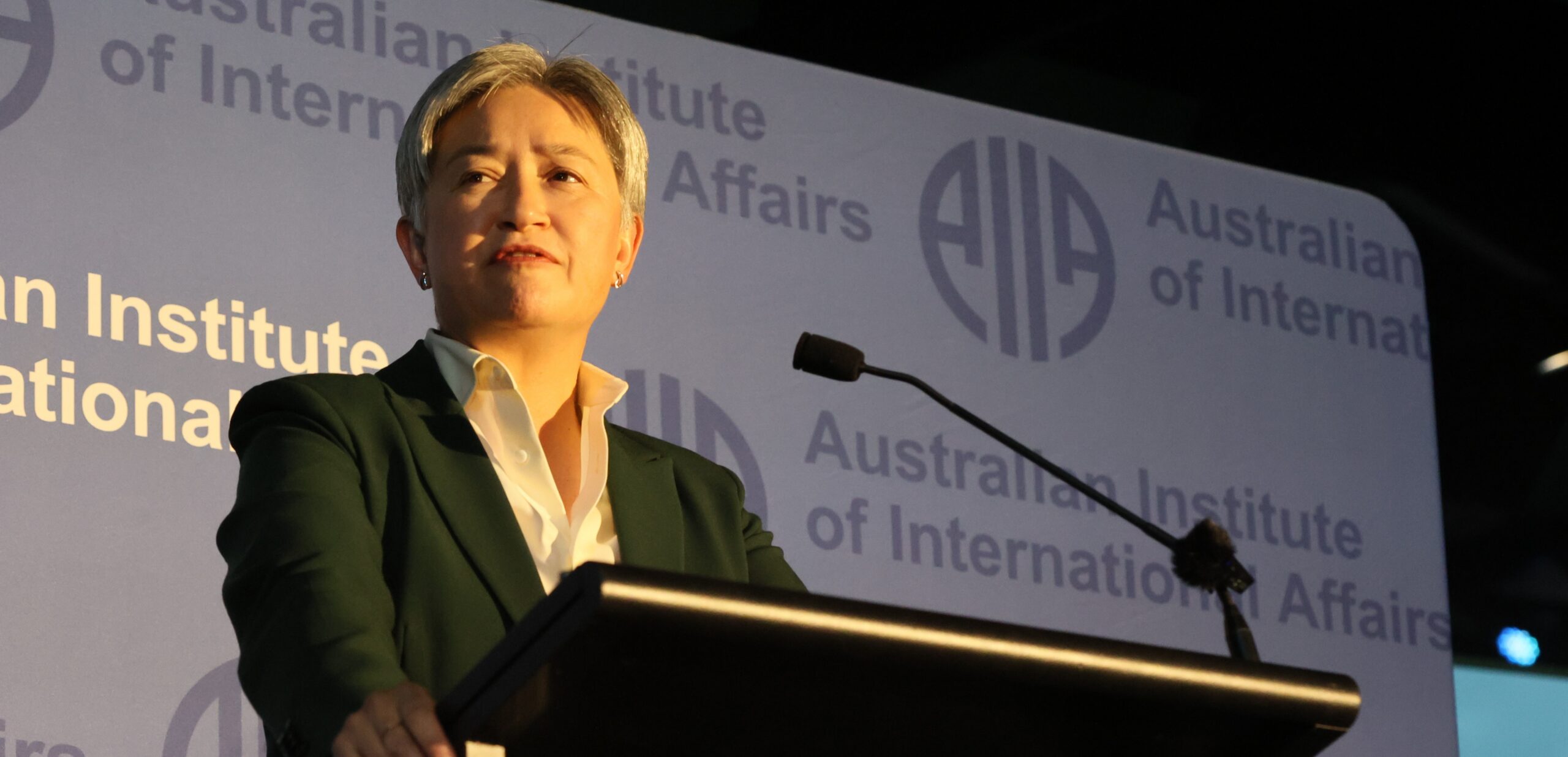
Australia now has something approaching a new and distinct foreign policy doctrine. Across three major speeches over the past year, Foreign Minister Penny Wong has articulated a coherent account of how Australia should exercise power in an increasingly unstable international system. Her treatment of the United States tells us much about her understanding of middle-power diplomacy.
In a major speech to parliament today, Foreign Minister Penny Wong will again posit her foreign policy as built around four priorities: region, relationships, rules and resilience. Wong first outlined these together as strands of her foreign policy thinking at the Australian Institute of International Affairs National Conference in November 2025, before developing their intellectual foundations in the Allan Gyngell Lecture at the Lowy Institute in August this year. Her ministerial statement to be read in Parliament today provides the most systematic account yet.
The four Rs are not particularly revolutionary in themselves. Their importance lies in how Wong brings them together, and in the strategic purpose that underpins them: increasing Australia’s power and influence by expanding the choices available to it.
As mentioned by Darren Lim and Hannah Nelson after her AIIA speech and then by Wong herself at the Gyngell Lecture, her intellectual starting point is Gyngell’s identification of three enduring strands of Australian foreign policy: the American alliance, regional engagement and the international rules-based order. These had guided Australian governments for decades, although successive governments placed different weight on each.
In today’s speech, Wong repeats this formula with clearer attention to priorities: the region comes first. Relationships rather than the alliance as a separately identified priority. The rules-based order remains essential, while resilience is added as a fourth pillar, recognising that domestic economic strength, technological capabilities and social cohesion are increasingly important sources of national power.
Replacing the American alliance with the broader category of relationships might suggest a significant move away from Australia’s traditional strategic orientation. Much of the contemporary international discussion of middle-power diplomacy has after all been driven by a reassessment and critique of American power. Witness, for example, Mark Carney’s Davos formulation this year of middle power diplomacy as an alternative to a rules-based order that no longer functioned as advertised, if it ever had. Carney’s speech was, of course, delivered against the backdrop of significant tensions with Canada’s southern neighbour.
For Wong, however, middle-power diplomacy is not an alternative to the American alliance or the existing international order. It is a means of strengthening Australia’s position within an international system in which American power and established rules remain indispensable.
This becomes clearer when the three speeches are read together.
At the AIIA in November 2025, Wong’s emphasis was on the diplomatic architecture the government had constructed in the Indo-Pacific. She pointed to the proliferation of security agreements, upgraded partnerships and closer cooperation with regional institutions as evidence of Australia’s capacity to help shape its environment.
She described regionalism as a way for smaller and medium-sized countries to counter power asymmetries. Her concept of “amplified middle power diplomacy,” repeated during her Lowy speech, involved deliberately building common ground with other countries and transforming that alignment into practical cooperation.
But even in the AIIA speech, she insisted that American leadership in the Indo-Pacific remained indispensable. Indeed, she described the United States as the great builder of alliances and networks essential to maintaining regional balance.
The point here is that Wong did not envisage middle powers organising themselves independently of American power. Rather, their cooperation would contribute to a favourable strategic balance, reinforcing an order in which the United States continued to play a central role.
The Lowy speech in August 2026 provided a more explicit explanation of the approach she introduced to Australia at the AIIA. Drawing on Gyngell, Wong argued that the purpose of Australian foreign policy was to expand the international space in which Australia could operate, increasing its options and maximising its choices.
This was the organising principle connecting the four Rs. Regional relationships, minilateral arrangements, international institutions and domestic resilience were different means of increasing Australia’s capacity to act.
Significantly, Wong also made a more developed argument about the alliance. Access to American defence capabilities, intelligence and technology, she argued, enhanced rather than diminished Australia’s sovereignty and agency. This was a direct challenge to the proposition that greater independence from the United States necessarily means greater Australian autonomy. In other words, the alliance, the rules-based order, and middle-power diplomacy were not competing strands in an Australian foreign policy. They were complementary instruments of Australian power.
Her parliamentary statement today makes that relationship clearer still. Wong now offers a more systematic account of the deterioration of the international order. She identifies six structural changes, including growing coercion, changing great-power behaviour, the redistribution of power, the weaponisation of economic relationships, technological transformation and the weakening of collective institutions.
She is particularly frank about the changing posture of the United States, citing Washington’s own acknowledgement that it no longer intends to shoulder the same responsibilities for maintaining international order. Yet this acknowledgement is accompanied by her strongest defence of the alliance across the three speeches.
Wong explicitly rejects the suggestion that uncertainty about American policy should lead Australia to abandon its closest strategic partner – admittedly something of a straw man proposed by only the most extreme critics of the alliance. Doing so, she argues, would surrender a central source of Australian strategic weight and leave the country with fewer choices.
Although she does not use the term in her most recent speech, minilateral arrangements help bridge the limitations of the alliance. Arrangements such as the Quad, cooperation among traditional allies, and flexible groupings with countries such as Canada, Japan and India allow Australia to concentrate influence on particular problems without requiring universal agreement and help sustain order where traditional institutions are struggling.
Wong’s commitment to rules similarly distinguishes her approach from more radical proposals for a new middle-power order. She acknowledges that international institutions are increasingly dysfunctional, but argues that abandoning them would only further advantage the powerful.
Her latest speech, for example, is much more explicit about the relationship between power and principle: “Rules without power cannot secure peace. Power without rules cannot sustain it.”
This may be the clearest expression of the Wong Doctrine. Middle-power cooperation, alliance relationships and national resilience provide the power necessary to defend a rules-based system. That system, in turn, helps protect the sovereignty of countries that cannot rely on power alone. It’s perhaps why she concentrates early in the speech on Australia’s relationship with Europe and Russia’s aggression against Ukraine, clearly not regional concerns, but those that undergird her broader conceptual concerns about power, relationships and rules.
It is also a powerful answer to Paul Keating’s dismissive remark in 2023 that Wong was “running around the Pacific Islands with a lei around your neck handing out money”. Keating argued that foreign policy was what Australia did with the great powers, particularly China and the United States. However, Wong’s regional diplomacy is not some naive preoccupation with smaller countries at the expense of serious power politics. It is power politics. She sees relationships with smaller and middle powers as a means of shaping the regional balance and strengthening Australia’s position in dealing with the great powers. The difference is not that Wong is less concerned with power than Keating or other “realists” preoccupied with great power relations, but that she has a broader understanding of how Australia can accumulate and exercise it.
There are tensions within the Wong Doctrine. The doctrine assumes that American power can continue to support a favourable regional balance even when Washington is less willing to accept international constraints. It also assumes that Australia’s other partnerships can expand its choices without creating obligations that limit them. Meanwhile, the question of whether Australia’s diplomatic, economic and military resources are sufficient to support the ambitions of the doctrine deserves serious scrutiny.
Nevertheless, there is a coherent strategic conception running through the three speeches.
Unlike Carney, Wong is not arguing for middle-power cooperation as a means of reducing dependence on an increasingly unreliable United States. Nor is she simply advocating a return to unquestioning dependence on the United States. Instead, she is seeking to increase Australia’s influence by combining the alliance, regional partnerships, flexible coalitions, international rules and domestic capabilities into a more effective exercise of national power.
The Wong Doctrine is therefore less a departure from Australia’s traditional strategic orientation than an adaptation designed to preserve it under changing circumstances, a recombination of power resources already at Australia’s disposal.
Whether this recombination will prove sufficient in an increasingly contested world remains to be seen. But Wong has now provided a clear framework through which that question can be debated.
ever, our shared interests, values and responsibilities are bringing us closer together.
Dr Bryce Wakefield is the CEO of the Australian Institute of International Affairs.
This article is published under Creative Commons License and may be republished with attribution.