Thousands of Indonesian officials, teachers and practitioners are now returning from China-sponsored training with more than certificates — they’re bringing skills, networks and ideas reshaping local development. As Jakarta eyes higher-value industries like AI, the real measure of this partnership is future capability.
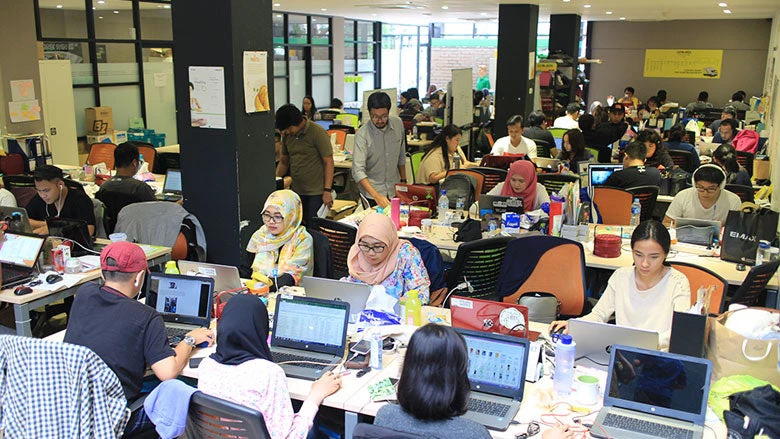
On June 11, 2026, hundreds of Indonesian civil servants, local government officials, teachers and development practitioners gathered in Jakarta for an event that would normally attract little public attention: an alumni reunion for participants in China-sponsored training and capacity-building programs. Yet the gathering, organised under the theme “Strengthening 76 Years of Friendship and Cooperation,” highlighted a remarkable development in the Indonesia-China relationship — one that deserves far more attention than another investment announcement or infrastructure deal.
The Silk Road Night Market Reunion
Speaking on behalf of Indonesia’s Minister of State Secretariat, Sari Harjanti noted that participation in China-supported training programs has grown dramatically in recent years. According to figures she shared at the event, more than 600 Indonesians took part in international training programs in 2023, and by 2025 and 2026, this figure had risen to approximately 1,600 participants, with most attending programs organised by China. She also stated that since 2024, China has provided at least 173 training programs for Indonesian government officials, including 38 degree programs and 135 non-degree programs across strategic sectors. During his remarks at the same event, the Chinese Ambassador to Indonesia said that more than 4,000 Indonesians — from civil servants and teachers to village heads — had participated in training programs and study visits in China over the past two decades. Sari described the alumni of these programs not merely as beneficiaries but as bridges connecting the people of both countries.
For years, discussions about China’s economic presence in Indonesia have centred on investment figures, industrial parks, high-speed rail projects and trade balances. But an equally important question has often been overlooked: What knowledge is being transferred alongside this capital?
That question matters because one of the most persistent criticisms of Chinese investment abroad has been that it creates infrastructure without sufficiently developing local capabilities. Across Southeast Asia, Chinese companies have often been portrayed as relying heavily on imported expertise while offering limited opportunities for local workers to acquire advanced technical and managerial skills. Whether entirely fair or not, that perception has shaped public debate about China’s role in developing countries.
The developments highlighted in Jakarta suggest a different and more promising path.
Beyond the Classroom: Program Alumni and the Lessons They Took Home
The alumni gathering showcased participants who had received training in clean energy, industrial park management, poverty alleviation, rural development, human resource management and digital technology. Their stories revealed that the most valuable outcome of international cooperation may not be a physical project but the transfer of ideas, skills and professional networks.
One participant, Bambang Nugroho from Indonesia’s Presidential Advisory Council Secretariat, described attending a two-week seminar on human resource management in Beijing and Guangzhou. The most valuable lesson was not simply what he learned in the classroom but the relationships he built. Even after returning to Indonesia, he remains in contact with Chinese experts whom he can consult when facing policy challenges. Another participant, Aji Qardhawi from the Ministry of Energy and Mineral Resources, spoke of gaining new insights into how Chinese small and medium-sized enterprises became integrated into clean-energy supply chains. The experience convinced him that Indonesian small businesses should play a larger role in the country’s emerging green economy.
Others brought home lessons from entirely different sectors. Irawati from the Ministry of Transmigration participated in training on rural development and poverty reduction in Beijing and Yunnan Province. She returned with a deeper appreciation for development policies tailored to local conditions rather than one-size-fits-all solutions. Ade Reyhan Salman from the Makassar city government described learning about green industrial zones, energy efficiency and industrial waste management, concluding that economic growth and environmental sustainability can reinforce one another when supported by effective governance and long-term planning.
These examples illustrate why knowledge transfer should become a central pillar of China-Indonesia cooperation. Infrastructure remains important, but roads, ports and factories are ultimately tools. Human capital is what determines whether those tools create lasting prosperity.
The Benefits of Knowledge-Sharing: Something in It for Everyone
The need for deeper knowledge transfer is becoming even more urgent as Indonesia seeks to move into higher-value industries. At a separate China-Indonesia Digital Economy Forum held in Jakarta the same week, policymakers, academics and industry representatives discussed cooperation in artificial intelligence, semiconductor design, electric vehicles, healthcare technology and smart agriculture. Indonesian participants emphasised that the country’s enormous digital economy should not be viewed merely as a market opportunity. It should also become a platform for technological upgrading and skills development.
The discussion around artificial intelligence at the China-Indonesia Digital Economy Forum in Jakarta was particularly revealing. Indonesian experts highlighted opportunities for cooperation in semiconductor design, battery management systems, healthcare applications and AI-powered agriculture. During the forum, Trio Adiono, Chairman of the Indonesia Chip Design Collaborative Center (ICDEC), outlined a potential model of cooperation in which China contributes AI algorithms, sensors and semiconductor-based hardware while Indonesia provides tropical datasets and implementation capacity. Such partnerships can only succeed if technology transfer and workforce development occur alongside commercial investment.
This also presents a significant opportunity for Chinese companies. Chinese firms frequently face scepticism abroad, including concerns that local workers remain concentrated in lower-skilled positions while advanced expertise stays in foreign hands. The most effective response is not a public-relations campaign, but a sustained commitment to developing local talent.
Imagine if every major Chinese-funded project in Indonesia incorporated structured apprenticeships, vocational training, university partnerships and leadership-development programs, transforming industrial parks into centres not only of production but also of learning, and enabling more Indonesian engineers, researchers and managers to advance into senior positions through systematic training and skills development.
Such efforts would benefit Indonesia, but they would also benefit China. Companies that develop local talent gain trust, legitimacy and stronger relationships with communities. They create partners rather than dependents and strengthen their long-term position in overseas markets.
China’s own economic rise was built in part on learning from others and investing heavily in human capital. It understands better than most countries that development is not simply about constructing physical assets; it is about empowering people with the skills and knowledge needed to sustain growth, innovation and productivity.
If China becomes known not only for financing projects in Indonesia but also for building Indonesian capabilities, it will accomplish something far more enduring than any bridge, railway or industrial estate. It will help create a generation of Indonesians equipped to drive their country’s future — and in doing so, it will strengthen the foundation of the bilateral relationship itself.
Yeta Purnama is a researcher at Center of Economic and Law Studies (CELIOS), whose work focuses on the evolving dynamics of China–Indonesia relations.
Muhammad Zulfikar Rakhmat is a co-author, serves as Director of the China-Indonesia Desk at CELIOS, and is also affiliated with positions at the Middle East Institute at the National University of Singapore, the London School of Economics’ IDEAS, and Busan University of Foreign Studies
This article is published under a Creative Commons License and may be republished with attribution.