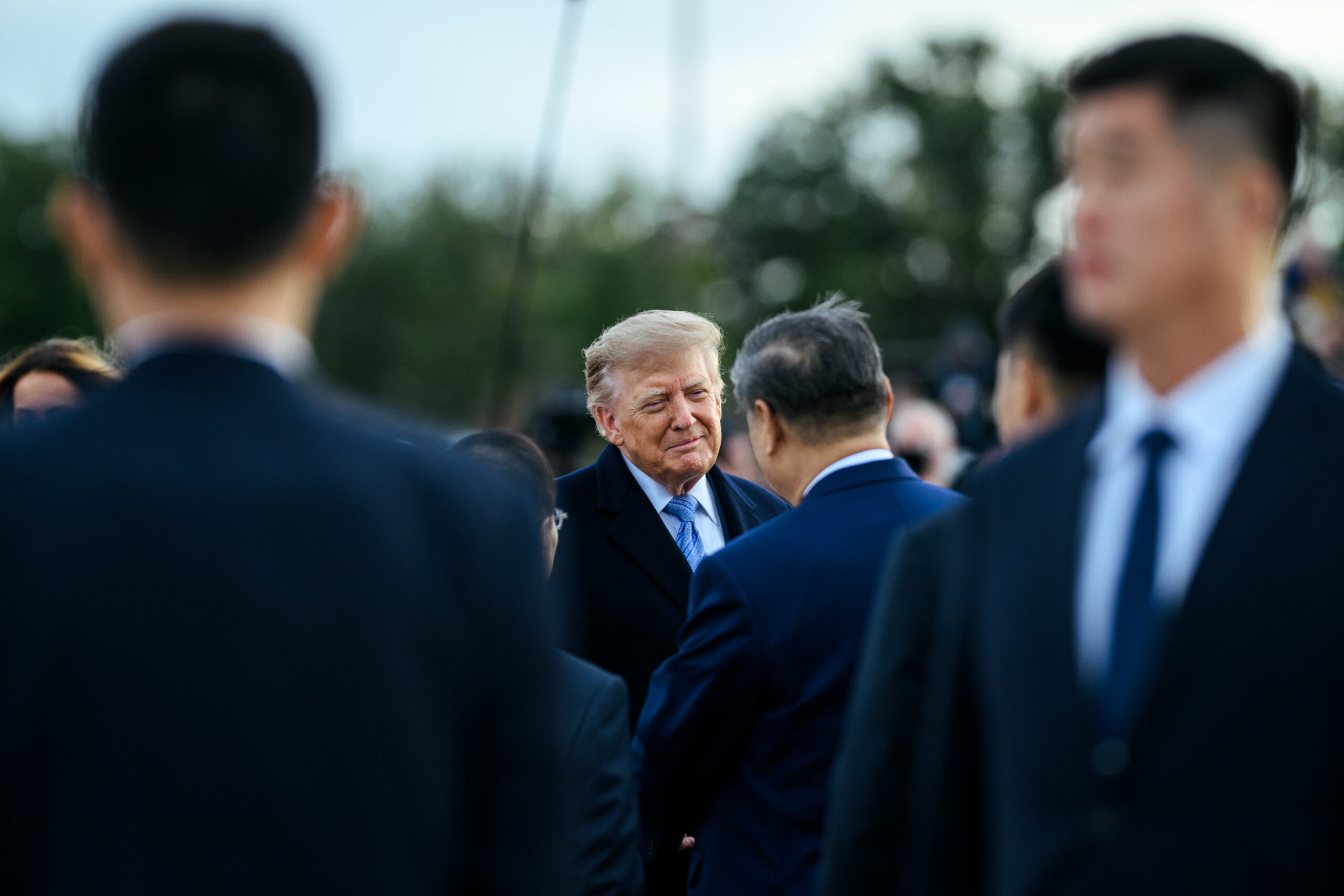
Three days of ceremony in Washington produced no grand bargain, but that was never the point. Beijing came for something quieter and largely went home with it.
US President Donald Trump made the drive to Joint Base Andrews on 23 September to greet Chinese President Xi Jinping in person, the protocol correspondents sat up. American presidents do not usually do airport welcomes. The gesture set the register for three days of unembarrassed pageantry: a review of the troops on the South Lawn, a state dinner in an East Room dressed in Chinese red, a joint stroll through the National Archives. It was Xi’s first state visit to the United States since September 2015, and the year’s summitry is not finished. The two governments have pledged mutual support for the APEC leaders’ meeting in Shenzhen this November and the G20 in Miami in December. If all these arrangements materialise, 2026 will be an unusually intensive year for face-to-face interactions between the Chinese and US leadership. The current and the forthcoming bilateral physical meetings, if they happen, from Beijing’s point of view, may not achieve a big breakthrough but soften disagreements and disputes. From China’s perspective, the more important question is how to further institutionalise and embed the limited stability that has emerged in China–US relations in recent years, and how to ensure that this stability can withstand the inevitable competition and disagreements that lie ahead.
From Slogan to Scaffolding
When Trump was in Beijing in May, the two sides unveiled a constructive strategic stability relationship(建设性战略稳定关系) and agreed to set up a Board of Trade and a Board of Investment to keep non-sensitive economic business out of the line of fire. Washington’s contribution last week was to add three qualifiers. The relationship is now to be built on “respect, fairness and reciprocity”. Each word is load-bearing. Respect means sovereignty and core interests, which in practice means Taiwan. Fairness is a shot at zero-sum dealing. Reciprocity is a claim to symmetry; American concerns will not be privileged over Chinese ones. There is a deeper point about vocabulary. Cold War strategic stability was a negative achievement, two nuclear arsenals deterring each other into caution, with arms control as the only grammar both sides shared. Beijing’s version is deliberately different. It is a positive stability, held down by trade rather than warheads, by growing the pie rather than promising to destroy it.
Xi also reached for the Thucydides Trap and insisted it can be crossed, described healthy competition as competition kept within bounds, and asked for steadier military-to-military contact. Wu Xinbo of Fudan University has called the visit a “connecting” exercise, one that consolidates the May consensus and pours the footings for Shenzhen and Miami.
Taiwan, Handled With Gloves
None of this dissolves the disagreements, and Beijing does not pretend otherwise. What it needs is for the disagreements to stop capsizing everything else. Taiwan sits at the top of that list. According to Beijing’s readout, Xi pressed the United States to oppose “Taiwan independence” and to handle the question prudently. That is a harder ask than Washington’s long-standing formula of not supporting independence, and there is no sign the administration has taken it up.
But watch the deeds rather than the words. A proposed arms package for Taiwan worth up to US$14 billion remains unannounced. Trump has described it, in front of cameras, as a negotiating chip, and the word in Washington is that any announcement may be held until after Shenzhen and Miami. Transactionalism of this kind cuts both ways. It makes warm summits easy and long-range promises cheap. Still, for the moment, Beijing’s most sensitive nerve is being touched gently rather than pressed.
The wider region will test the scaffolding too. Beijing has repeatedly criticised the Quad, the grouping of the United States, Japan, India and Australia, as an exclusive clique dedicated to ‘bloc confrontation’. In the South China Sea, overlapping claims, American freedom-of-navigation patrols and the thickening of US-Philippines defence ties produce a steady drip of friction. On none of this did the summit offer public answers. The honest conclusion is that guardrails were discussed, not built.
Truce, Not Peace
Trade is where the relationship still earns its keep, and where it is most exposed to politics. The numbers tell the story. Two-way goods and services trade came to roughly US$494.6 billion in 2025, down about a quarter from US$658.9 billion the year before. And both sides remember the escalation of 2025, tariffs peaking at 145 per cent on one side and 125 on the other, rare-earth export controls, a freeze on farm purchases. That memory explains why both delegations wanted calm more than they wanted victory.
The centrepiece economic result was actually sealed before the leaders met. On 20 September in New York, Treasury Secretary Scott Bessent and Vice-Premier He Lifeng agreed to extend the trade truce struck at Busan in October 2025, due to lapse on 10 November, through to 10 January 2027. Extension, however, is not resolution. China is hitting its soybean import target but trailing on a pledged US$17 billion in other farm goods. Washington says rare-earth shipments are running short. Tariff cuts covering some US$30 billion of non-sensitive goods await negotiation, and a further Boeing order that many had anticipated was not announced. Over the past eighteen months a tit-for-tat reflex has set in, pressure answered by matching pressure. Both sides know it. That is precisely why the truce keeps getting renewed.
Artificial intelligence (AI) has become an arena in which the two countries are competing not only for technological advantage but also for influence over third countries. The two governments stood up a formal AI dialogue and an incident-notification channel, so that an AI accident or security scare is not misread as hostile intent, with another round pencilled in for Shenzhen within about two months. The rivalry underneath is untouched: chip export controls on one side, open-source diplomacy and the Shanghai-based World Artificial Intelligence Cooperation Organisation, launched in July with 29 founding members, on the other. Xi told Trump that AI must stay “under human control“. Trump, who has taken to calling the technology “superintelligence”, said he wanted to “leave it exactly where it is“. Read the exchange twice and it is hard to say whether it was agreement or two monologues. Either way, a channel now exists where none did before.
There was softer cargo as well: fresh Chinese controls on fentanyl precursors, a promise to host 100,000 young Americans over five years, and two pandas for Zoo Atlanta. None of it settles anything. All of it lowers the temperature.
A Qualified Success?
Judged by the yardstick Beijing brought with it, the summit seemed to work. It wanted a sturdier frame for the relationship, careful handling of Taiwan, and cooperation that does not depend on strategic trust. It got some version of all three. The sceptics have their case. Scott Kennedy of the Center for Strategic and International Studies called the affair mostly “theatre” and noted that the wider stand-off already tilts Beijing’s way. Orville Schell of the Asia Society doubts the two men can arrest the downward spiral at all. Wu Xinbo’s verdict, cautiously optimistic, sits between them, and it is probably the honest one.
What Beijing sought in Washington was never an end to competition. It was a competition with rules of the road, a rivalry predictable enough to plan around, with a little room left over for cooperation. For now, that is roughly what it has. Whether the scaffolding survives first contact with a real crisis is the only question that matters, and it is the one question no summit can answer in advance.
Dr Sai Bian is a Lecturer at the School of Government, Shanghai University of Political Science and Law.
This article is published under a Creative Commons Licence and may be republished with attribution.
Photo: Daniel Torok, Official White House Photo (“P20260923DT-0615”)