As governments increasingly rely on collateralised financing, margin calls could transform market volatility into immediate sovereign liquidity crises. Recent developments in Angola and Nigeria reveal a growing challenge for debt sustainability, exposing financial vulnerabilities that conventional fiscal indicators may overlook.
In April 2025, Angola faced a demand that would never appear on a conventional bond-repayment calendar. After oil prices fell and its Eurobonds weakened, JPMorgan called for $200 million in additional collateral on a $1 billion sovereign total return swap backed by $1.9 billion in government bonds. Angola posted the money and recovered it in May when bond prices rebounded. The episode exposed a vulnerability in public finance: a government can remain current on its debt payments while being forced to find dollars on short notice.
The warning has acquired urgency. On 5 November, the World Bank reported that developing countries’ external debt reached a record $9.4 trillion in 2025, with debt service climbing to $1.4 trillion. A day later, the OECD examined collateralised sovereign financing in its Africa Capital Markets Report. The global debt figures provide context rather than an estimate of swap exposure. In October, the IMF also warned that some frontier economies increasingly depend on less transparent financing structures. Together, these developments raise a question that conventional fiscal statistics struggle to answer: how much emergency liquidity have governments promised away?
A sovereign total return swap can exchange pledged securities for hard-currency funding. Unlike a conventional bond, the financing may require collateral to be revalued during its life. If the securities lose value, the borrower may have to supply cash or additional collateral before any scheduled principal repayment. For a bank, margin protects against counterparty default. For a treasury, it can turn a change in market prices into an immediate claim on scarce foreign currency. Individually rational credit protection can amplify a country’s liquidity squeeze.
Nigeria makes the mechanism unusually visible. Its Debt Management Office confirmed a facility of up to $5 billion with First Abu Dhabi Bank, secured by naira-denominated government bonds worth 133.3% of each dollar drawn. Official figures showed $1.5 billion outstanding under the swap at the end of June. The first tranche pays the secured overnight financing rate (SOFR), a benchmark US dollar interest rate, plus 3.95 percentage points. Under disclosed terms, collateral is valued monthly, dollar-denominated margin calls have a five-business-day cure period, and demands below $30 million are waived.
Consider an illustrative shock, rather than a forecast. On $1.5 billion of borrowing, the initial coverage ratio implies roughly $2 billion in collateral. A 15% decline in its dollar value would erase approximately $300 million of collateral coverage. Assuming the original ratio had to be restored and the valuation was otherwise unchanged, a similar dollar cash call could result when margin is assessed. The amount and timing depend on contractual terms, including the minimum threshold and cure period. Angola’s experience also shows that a temporary market fall can create a genuine funding emergency even if prices later recover. Annual debt service could stay exactly as scheduled while a substantial funding need emerges within days.
The deeper danger is ‘wrong-way risk‘, because the collateral securing the loan often represents the sovereign’s own credit. And when investors lose faith in the sovereign’s ability to repay, the collateral’s value falls, provoking margin calls just as borrowing becomes harder. Local-currency collateral adds a policy trap. A weaker currency reduces its comparative dollar value, while higher domestic interest rates can lower bond prices. So if a central bank raise rates to defend its currency, it erodes another component of the collateral’s value. The combined effect depends on market reactions, while the financing contract constrains the government’s room for stabilisation. The crucial exposure is the joint shock to currency, bond prices and funding markets, when lenders demand more collateral just as the government is least able to provide it.
The price advantage also deserves scrutiny. The OECD cites potential savings of 150 to 200 basis points against comparable Eurobonds. Yet IMF staff assessed Nigeria’s planned swap as carrying an interest rate comparable to its Eurobond yield, with fees and collateral requirements adding complexity. A meaningful measure of borrowing cost must include interest, fees, the opportunity cost of encumbered securities and the cost of maintaining emergency liquidity. A headline yield comparison ignores the possibility that a seemingly inexpensive contract becomes most demanding at the worst possible moment.
The accounting problem is similarly consequential. Fitch Ratings, one of the ‘Big Three’ global credit rating agencies, treats pledged collateral as a contingent liability, while the IMF included Nigeria’s collateral in its debt sustainability assessment. The same deal can therefore look very different depending on the framework used to measure it. Investors need to distinguish the cash borrowed, assets pledged and additional payments that market stress could trigger, without missing or double-counting exposures.
Uncertainty about what a government really owes also carries a price. In separate research published on 4 November, World Bank economists found that sovereign spreads rose by nearly 250 basis points over about 50 trading days following seven revelations of hidden debt. Those episodes concerned a broader set of liabilities than total return swaps, but the lesson applies; a repricing of that size would more than erase the 150 to 200 basis points of savings these deals are said to offer.
My proposal is to add ‘sovereign margin-at-risk’, an estimate of the cash or extra collateral a government might need at short notice to meet margin calls, to the monitoring of public finances. Alongside debt-to-GDP and annual gross financing needs, governments should report the dollar cash calls they could face over five and 30 business days if exchange rates, sovereign yields and funding rates moved against them all at once.
They should then compare those calls with unencumbered, readily available foreign currency liquidity after scheduled debt payments. They should also disclose the key contract terms, including which collateral is eligible, when it is valued, what triggers termination and what borrowing fees apply. The Financial Stability Board already recommends similar margin-liquidity stress tests for non-bank institutions, such as pension funds and insurance companies. Public borrowers warrant the same discipline. An accompanying liquidity-coverage ratio, available dollars divided by stressed margin calls, would expose shortfalls that conventional debt ratios might conceal.
Derivative financing can broaden market access, especially when conventional bond issuance is costly. However, its benefits are sustainable only when a government can absorb the collateral demands that accompany them. The first warning of the next sovereign crisis may arrive as a bank’s margin call, long before a bondholder misses a payment.
Kanan Mammadov is a Master of Public Administration candidate at Columbia University’s School of International and Public Affairs, concentrating in International Finance and Economic Policy. He holds an MS in Finance and a bachelor’s degree in Finance and Economics from George Washington University. His analysis focuses on international finance, financial stability, and political economy, and his work has appeared in publications including the IMF, World Economic Forum, CFA Institute, Oxford Political Review, East Asia Forum, and International Institute for Sustainable Development (IISD).
This article is published under a Creative Commons Licence and may be republished with attribution.
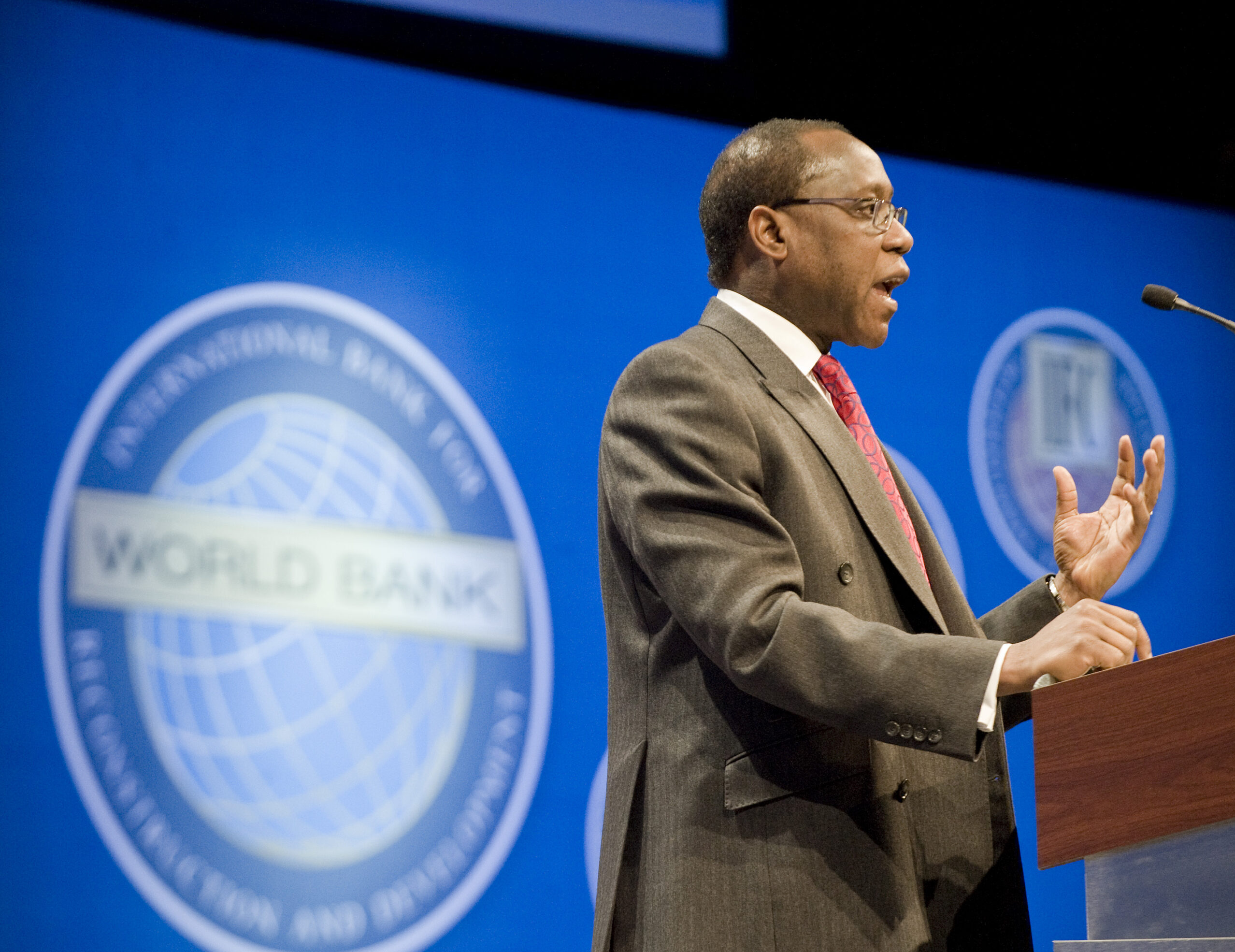
Photo: “IMF/World Bank 2010 Annual Meetings Opening Plenary” by World Bank Photo Collection, CC BY-NC-ND 2.0