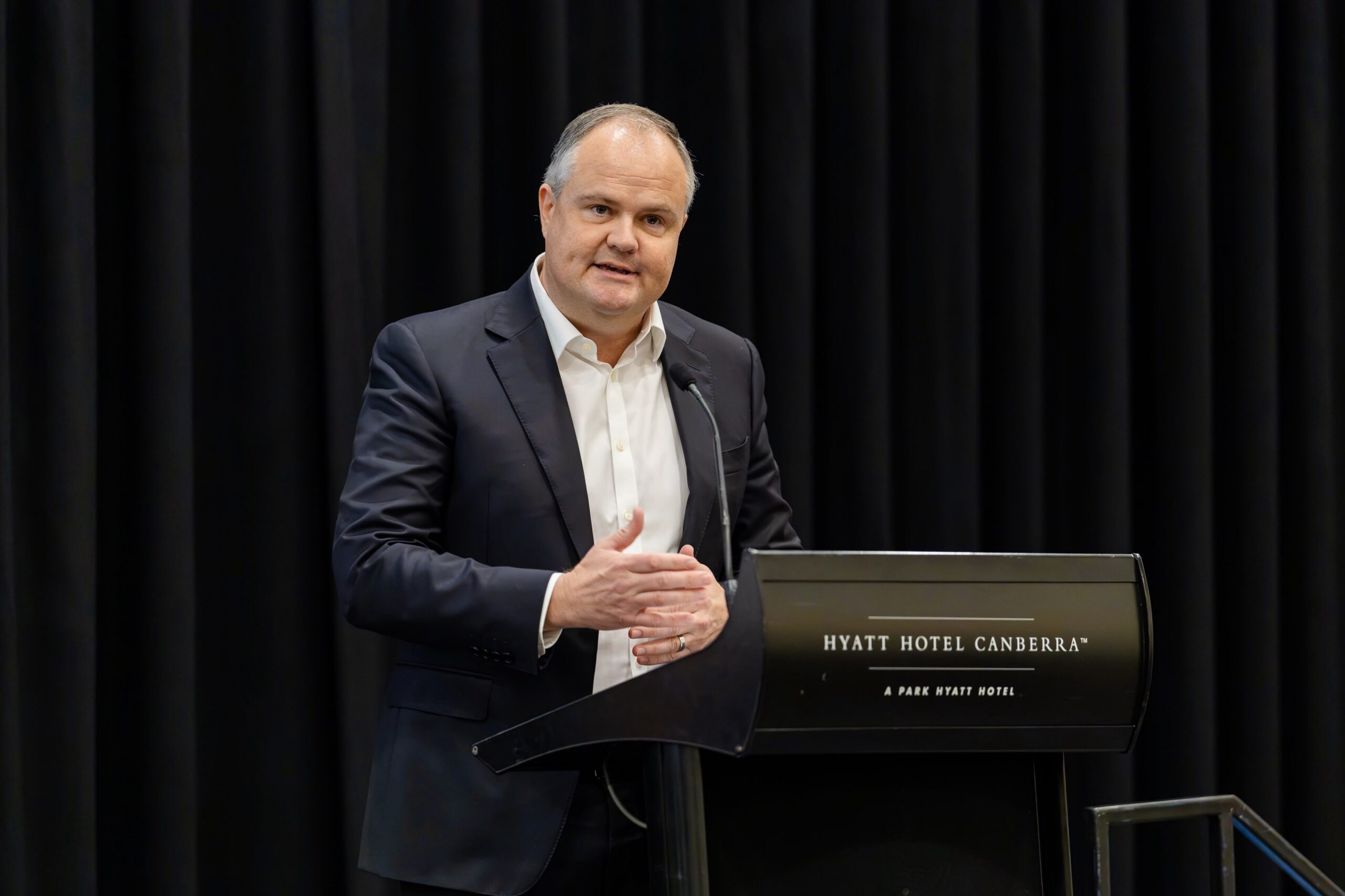
Australia is entering a new age of strategic competition, economic securitisation and technological upheaval just as its economy, resilience and social cohesion are eroding. In his 2026 AIIA National Conference Address, Shadow Foreign Minister Ted O’Brien argued that foreign policy starts at home. He called for a new model of statecraft focused on co-developing capability with partners, and warned that binding climate commitments in the Australia-EU FTA risk constraining Australia’s sovereignty and strategic flexibility.
Working overseas as a young Australian in the 1980s, 90s, and naughties, I was always struck by the standing Australia enjoyed.
Australia’s influence was built on a combination of economic strength, diplomatic credibility and an ability to contribute to regional prosperity and stability.
We led the way in expanding relations as Asia awakened and we were shapers of regional institutions.
However, my days as an Aussie expat businessman are behind me.
Now I live on the Sunshine Coast with my wife and three young children.
One early morning last week, as I sat on the veranda of my home – a classic, weathered, timber Queenslander – reading some papers, my three-year-old little girl clambered onto my lap, eager to play her latest game of make-believe: the one where she is a commanding mummy, and I am her giant, helpless baby.
As I looked at my little girl, I wondered about her future and what she might do with her life? Will she be granted the same opportunities I have been afforded? What will Australia be like by the time she reaches my age? And if, like me, she spends years working abroad, what then will be Australia’s international standing?
It is questions like these that drew me out of the private sector and into public life.
Will the next generation of Australians inherit a nation that is prosperous, strong and independent – one with the confidence and capability to shape its own future and help shape the future of the Indo-Pacific region?
Or will they inherit a poorer, weaker and more dependent Australia – one with less to offer, less influence in our region and of lower standing?
Foreign Policy Starts at Home
These questions about tomorrow will be answered by the nation we build today.
It’s why I believe that – foreign policy starts at home.
A nation’s foreign policy is an outward expression of its values and interests: a reflection of its people, their beliefs and aspirations.
But if a nation’s foundations – its economy, resilience and social cohesion – is fragile, its ability to uphold its values and pursue its interests are jeopardized.
And right now, Australia’s foundations are steadily eroding.
First, our economy is weakening. We have suffered the biggest fall in living standards in the developed world. Productivity remains weak, competitiveness is declining, debt has reached $1 trillion and households continue to grapple with cost-of-living pressures.
This leaves Australia with less room to manoeuvre – less capacity to invest in defence, diplomacy, development assistance, technology and the international relationships that matter.
Second, our resilience is being undermined. The Government, for example, is seeking to close our existing energy system before a replacement is ready to go.
This weakens our ability to produce, secure and sustain the things we need – from affordable energy and food to critical technologies and industrial capability.
And third, social cohesion is under strain. Trust in institutions is declining, divisions are deepening – nowhere more disturbingly than in the scourge of antisemitism – and our shared values and sense of national purpose are being tested.
This weakens the unity we need to resist foreign interference, withstand coercion and hold together in an increasingly contested world.
On all three fronts, Australia is going in the wrong direction.
Over time, we will have less capacity to contribute, less ability to shape outcomes and less to offer the countries in our region.
That is not a future I want for my children and their generation.
We must change course, and what fills me with optimism is – we can.
We have enormous advantages, if we’re prepared to back ourselves – our people, resources, geography, institutions and relationships.
We have agency, if we’re prepared to use it – leveraging the quiet confidence, humility, pragmatism and aspiration which make up the Australian character.
And we have the opportunity, if we’re prepared to take it – acting with ambition, urgency and courage.
A New Age – A New Model of Statecraft
In changing course, we need to strengthen our foundations – our economy, resilience and social cohesion – not to recreate the Australia of the past, but to build a future Australia fit for a new age … because the world has indeed entered a new age.
It’s an age defined by three intersecting forces.
First, entrenched strategic competition between the United States and China; second, the convergence of economics and security, and; third, extraordinary technological change.
These forces demand more of Australian foreign policy.
We need a new model of statecraft – one that uses our international relationships to build national capability, strengthen our economic and strategic security, and advance our long-term national interests.
And central to this must be a new type of international deal.
There has been a lot of public discussion lately about the Australia-European-Union Free Trade Agreement – and I will make some remarks about that shortly. But to be clear, when I say a new type of deal, I’m not talking about Free Trade Agreements.
FTAs remain important. They open markets, reduce barriers and provide greater certainty for business.
But, in a more contested world where economic and national security are increasingly intertwined, we need to go further – towards partnerships that are narrower in focus and deeper in scope; where the objective is not simply better market access, but the co-development of capabilities, joint investment and integrated supply chains; and where the scope doesn’t encompass every segment of an economy, rather areas of strategic importance, from food security and energy security to critical minerals and defence industries, and to emerging technologies such as AI, cyber and space.
We need a new type of deal in which government provides the framework, but private enterprise drives the opportunity.
Australia should back itself and pursue such deals with ambition, urgency and courage … and maybe a little imagination.
For example, we could partner with friends and allies to make Australia an AI-sovereign nation that can safely improve the lives of everyday Australians while positioning us as the Indo-Pacific’s most trusted partner for hosting other nation’s data and compute, and for exporting AI applications and services.
We could partner with friends and key trading partners to unleash energy abundance – positioning Australia as the region’s most trusted partner for guaranteeing energy-security and for the co-development of industrial capability and integrated supply chains, using that energy.
The deal possibilities go on and on.
My point is not that any precise deal should be done. Rather, that this is the mindset we should be applying as we pursue a new model of statecraft – one that is fit for the new age we are now in.
The Australia-EU FTA
However, much of our current debate is being consumed by a proposed Free Trade Agreement with the EU.
The EU FTA really consists of two deals: one on trade and one on climate.
My colleague, Matt Canavan, as the Shadow Minister for Trade, has rightly identified a series of poor outcomes on the trade component.
Today I want to focus on the climate component of the EU-FTA.
From the outset, let me say how proud I am to be part of the Coalition because, as history shows, it’s been the Coalition that has paved the way on Australia’s free trade agenda.
My colleagues and I want to see a successful FTA with Europe concluded … but it has to be in our national interest.
On Australia’s Department of Foreign Affairs and Trade website, it states: “For the first time in a free trade agreement, Australia has made a binding commitment to implement obligations under the Paris Agreement on climate change”.
Those obligations include that Australia “shall effectively implement” and “refrain from any act or omission” that materially defeats the object and purpose of the Paris Agreement.
And these obligations are to be legally enforceable with potential trade consequences for Australian businesses if they were to be breached.
In other words, the deal effectively locks Australia in to policies to achieve the Albanese Government’s climate commitments.
Labor came to office with a big 2030 climate target, promising to reduce emissions massively while cutting household power bills by $275 a year.
Now in their fourth year in office, emissions have barely reduced and the average household is paying well over $1,000 more than what they were promised.
Last year, the Government postponed submitting their 2035 target until after the election. To this day, they can’t say how they will get there, how much it will cost or who will pay.
As for net-zero by 2050, the Government’s own Treasury modelling projects that, within the next 10 years, Australian coal production will fall by 47% and LNG output by 27%.
That climate plan does not advance our national interest.
Australian families can’t pay their bills, 47 businesses a day are shutting their doors, industries are closing down, and Australia is being discussed as a sovereign risk around the board tables of our key trading partners.
And, we’re also amidst a global energy crisis.
Just as energy security is national security, so too it is regional security.
Energy is geopolitical currency, and Australia should be a powerhouse of it – not just for ourselves, but for our friends and trading partners.
And yet, we are steadily turning a position of strength into a vulnerability.
Introducing legally binding climate obligations in the EU FTA risks eroding Australian sovereignty, by constraining the choices of future Australian Governments.
It risks elevating climate commitments over energy security and jeopardising our industrial competitiveness.
It risks exposing Australia to cashed-up climate activists, including new groups like the Australia Climate Impact Initiative which is reportedly planning to direct $1.1 billion into climate activism.
It risks compromising our strategic flexibility at precisely the time when we need more flexibility, not less.
In this new age, Australia must be able to respond to changing circumstances, including geopolitical, energy and economic crises and also technological breakthroughs. This deal will limit our ability to do so.
Climate change has been one of Australia’s most contested areas of public policy. Yet the Government has chosen to embed legally binding climate commitments in an international agreement, without a public debate that is commensurate with their significance and without meaningful consultation with the Coalition.
The question is not whether Australia should engage constructively on climate change. It should.
The question is whether it is prudent to embed legal commitments in an international agreement without proper consideration of their implications for Australia’s future economic and strategic choices.
I have publicly and privately expressed concerns about the proposed climate provisions since the text was released, with my specific concerns relating to Chapter 18 on Trade and Sustainable Development and Chapter 24 on Dispute Settlement.
And what has been the response from government?
Prime Minister Albanese argues: “When it comes to climate provisions, there’s nothing special about this”.
Trade Minister Farrell argues that: “claims our trade agreements prevent Australia setting our own domestic climate policies are completely incorrect”.
And the response from the EU?
While I won’t breach individual conversations (and I have had many), last week’s public remarks by Sean Kelly, Chair of the European Parliament’s delegation for relations with Australia and New Zealand, reflects views I’ve heard from others. That is, that penalties for breaching climate provisions wouldn’t just be a last resort, but would “never happen”.
All these verbal assurances are welcome. But when the legal text says otherwise, verbal assurances alone count for little.
The solution? Put these verbal assurances in writing.
In good faith, I put forward this very proposal last month.
That is, I proposed a legally binding side-letter, with treaty status, to be agreed by both Australia and the EU to ensure the risks I have outlined can not eventuate.
Given both governments seemingly think these risks don’t exist, my proposal is not a big ask.
Side-letters are legitimate instruments of treaty-making, designed to clarify and give effect to agreements, and there are ample precedents – including two side letters already sitting alongside the draft Australia-EU FTA – on steel and the luxury car tax.
The side-letter I am proposing goes a step further.
That is, it would be propose legally binding, with treaty status.
It’s worth noting that my proposal isn’t the only way these climate issues could be resolved.
For example, Chapter 18 could be removed altogether, but I don’t think the parties want that.
Alternatively, Chapter 18 could be excluded from the dispute-settlement processes in Chapter 24 – like the way the EU’s FTA with Canada was designed.
But the parties’ preference is to avoid reopening the text which is what would be required to achieve this.
By comparison therefore, my proposal is simple, practical and reasonable.
It doesn’t require the text of the Agreement to be reopened. It simply asks Australia and the EU to confirm in writing what they have already confirmed verbally.
If the Government is genuine about wanting a bipartisan Australia-EU FTA that endures, a good starting point would be to work with the Coalition on my proposal before the FTA goes to the Joint Standing Committee on Trade.
Let us not forget that FTAs don’t always command bipartisan support at first. But when governments engage with proposals made in good-faith, compromises can be found in the national interest.
In 2015, for example, my counterpart, the now Foreign Minister, urged the then Coalition Government “to be sensible and to negotiate with the Opposition on the Chinese FTA” to secure an agreement “capable of bipartisan support”.
She pointed to the Howard Government’s previous accommodation of Labor’s concerns over the FTA with the United States.
And true to form, a Coalition Government again showed a Labor Opposition respect. In fact, we even ran a separate Senate Inquiry on the China FTA.
The China-Australia FTA was subsequently signed with bipartisan support.
I am asking the Albanese Government to apply the same principle of open-mindedness today that former Coalition Governments have applied on multiple occasions.
Conclusion
Let me end where I began.
When I think about my three-year-old daughter and her generation, I want to see Australia acting with ambition, urgency and courage to meet the challenges of the new age in which we operate.
Our foreign policy challenge is not simply that the world has changed. It is that the world has changed at a time when Australia’s capacity to respond is weakening.
There remain outstanding issues of conventional statecraft to resolve – such as the EU-FTA – but I want Australia’s main focus to be on shaping a new model of statecraft and actively pursuing a series of new deals to advance our nation’s economic and geostrategic strength.
I want to see Australia reclaim its position as a leader in our region, and become the most trusted partner in the Indo-Pacific because – once again – we have things to offer the region and – once again – our foundations at home – our economy, resilience and social cohesion – are secure.
That is how we bequeath to the next-generation, an Australia that is: not poor, but prosperous; not weak, but strong; and not dependent but fiercely independent.
Ted O’Brien MP is the Australian Shadow Minister for Foreign Affairs and Trade. This is an excerpt of his keynote speech to the 16 November 2026 AIIA National Conference. A full recording of the minister’s speech is available here.
Australian Outlook occasionally publishes pieces by figures representing government or other bodies. As with all pieces published by Outlook, these are edited and checked for facts. They do not, however, represent the view of Outlook or the Australian Institute of International Affairs.
This article is published under Creative Commons Licence and may be republished with attribution.