War is never fought only through weapons. It is also fought through narrative: through the production of legitimacy, the management of perception, and the mobilisation of domestic and international audiences. In the present conflict involving Iran and the United States, competing narratives have become central.
With pink tanks and hijab-clad women in lipstick brandishing missile launchers and chanting “death to America” in Tehran’s streets, it may appear that women stand firmly with the Islamic Republic regime in Iran. Yet the state-organised “Daughters Devoted to Iran” rally on April 17 suggests something quite different. It reveals how deeply threatened the Islamic Republic is by Iranian women and by their role in demands for democratic regime change.
In this spectacle, women are co-opted as the public face of a militarised regime. Their image is used to counter the Islamic Republic’s global reputation as a violent oppressor of women and youth, while projecting internal cohesion and moral legitimacy. The symbolism is deliberate. The colour pink is conventionally associated with softness, peace and care rather than militarism and war. Its fusion with military hardware, regimented femininity, and state violence seeks to soften coercion and repackage militarisation as social consent. The juxtaposition is striking precisely because it is so politically loaded: women’s bodies are used to aestheticise and legitimise force.
The symbolism also carries historical irony. In April 1991, a Czech student famously painted a Soviet army tank pink in an act of civil disobedience, transforming a monument of military occupation into a symbol of dissent and liberation. In Tehran, by contrast, pink does the opposite political work. It is deployed not to subvert militarism, but to humanise it. What once signified resistance to authoritarian power is here repurposed to beautify and normalise it.
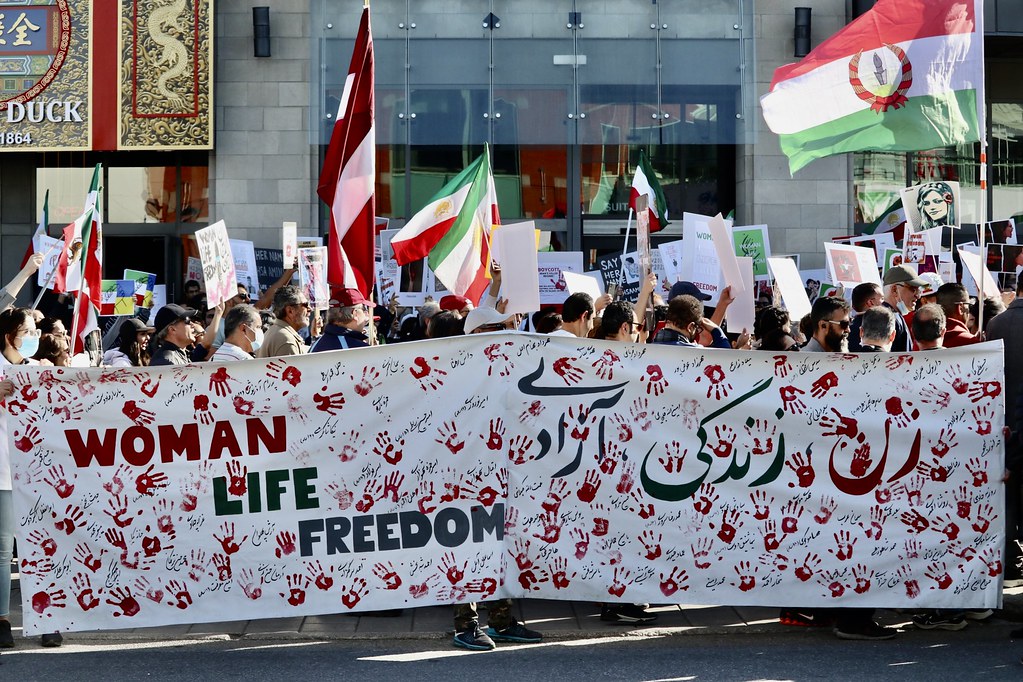
More insidiously, the event and its global media coverage seek to suppress the far larger and more consequential reality: vast numbers of Iranian women oppose the Islamic Republic. The Women, Life, Freedom movement is one of the most powerful examples worldwide of women’s leadership of movements for democratic change. Since 2022, it has mobilised Iranians across gender, ethnic, and socio-economic groups and has continued as a dispersed yet persistent form of everyday resistance. Iranian women, especially the younger generation, routinely defy compulsory veiling and other restrictive gendered regulations, including the 2024 Hijab and Chastity Law, while sustaining forms of digital embodied and street-level activism, including the recent massive January 2026 protests, under conditions of severe repression.
War is never fought only through weapons. It is also fought through narrative: through the production of legitimacy, the management of perception, and the mobilisation of domestic and international audiences. In the present conflict involving Iran and the United States, competing narratives have become central. The regime seeks to present itself simultaneously as a victim, a defender, and a victor. The United States, in turn, frames its actions through the language of strategic necessity and success. In this struggle over meaning, the Tehran rally shouldn’t be seen as peripheral, as it is a part of the battlefield itself. The staging of loyal, militarised womanhood is an attempt to rewrite the political meaning of women in Iran: no longer as leaders of dissent, but as symbols of state endurance.
This is precisely why the conflict must be read through a feminist lens. War alone cannot produce democratic transformation. Nor can militarised confrontation substitute for the difficult work of building legitimate, participatory, and socially grounded alternatives. Feminist analysis helps us see what dominant geopolitical narratives obscure: that the question is not only who holds military power, but whose political agency is recognised, whose suffering is erased, and whose visions of the future are excluded. Militarised narratives reduce political change to force. They obscure the civic infrastructures, solidarities, and forms of resistance through which democratic futures are made.
This matters far beyond Iran. The world is living through a wave of autocratisation and democratic erosion, accompanied in many contexts by the shrinking of women’s civil and political freedoms. In response to these trajectories, we established the Maureen Brunt Women and Democratic Change Network in early 2024. The international network seeks to advance collaboration among those with direct experience of authoritarian contexts and to foreground gendered perspectives on democratic change that are too often marginal to mainstream foreign policy and security debates.
This perspective also exposes the limits of conventional diplomacy. Compared with the frequently all-male, secretive and exclusionary peace negotiations, as we have seen in Pakistan this month with the US and Iran, pro-democracy movements exhibit a markedly different pattern: They are often more open and participatory, and across the world, women are now leading many of these struggles. Iranian women are part of a wider political transformation that includes women at the forefront of democratic resistance in Myanmar, Belarus, Afghanistan, Sudan, and Venezuela, among other contexts.
Yet the significance of this transformation remains overlooked by commentators and academics alike, who continue to focus on states, leaders, and military actors. Durable peace and democratic change, however, are often built from below, when people build civic and grassroots movements that establish spaces for democracy, as we saw in the revolutions in Latin America and Eastern Europe that brought about transformations from authoritarianism in the 1980s and 1990s.
For Australia and other countries that claim to support democracy, this has vital implications. Support for democratic change cannot be limited to rhetorical concern or strategic calculations about state stability or sovereignty. It requires sustained commitment to civic actors, women-led movements, diaspora networks, and people-to-people forms of cooperation. If we are serious about democratic futures in Iran and elsewhere, then these movements must not be treated as symbolic afterthoughts. They are not peripheral to political change. They are among its most important conditions.
Dr Rana Dadpour is a Research Fellow in social and economic risks at The Cairns Institute, James Cook University. She is the founding director of AUSIRAN, a diaspora advocacy group for Australian Iranians.
Professor Jacqui True, FAIIA, FASSA, is Professor of International Relations at Monash University and Director of the Australian Research Council Centre of Excellence for the Elimination of Violence against Women (CEVAW).
This article is published under a Creative Commons License and may be republished with attribution.