For a country, whose lifelines are overwhelmingly maritime, standing back and hoping for the best is not a strategy. Australia must prepare deliberately, communicate honestly about the stakes, and be willing to contribute meaningfully to coalitions that keep open the oceanic system on which our prosperity depends.
At present, Australia is belatedly rediscovering that geography still matters and that for a continent sized island sustained by the sea, water has real stopping power. Our reliance on the most efficient form of global trade, commercial shipping, sits uneasily with a political culture conditioned by digital immediacy and a foreign policy reflex towards de-escalation. In an era of contested sea lanes, that is a dangerous mismatch.
Start with the basics. Australia is one of the world’s great maritime trading nations, even if we rarely talk about ourselves that way. In 2020-21, more than 30,600 ship port calls by 6,300 different ships were made to about 70 Australian ports, moving over 1.7 billion tonnes of cargo worth over $600 billion. More recent government data show annual port calls now exceed 32,000. Simply put tens of thousands of ship arrivals each year, carrying almost everything that keeps Australian society and the Australian Defence Force functioning.
Those flows are extraordinarily efficient. A typical large container ship today carries between 10,000 and 20,000 TEU, while the biggest ultra large container vessels carry 14,000 – 25,000 TEU or more. One ship’s worth of containers represents a logistical lift that would require thousands of aircraft sorties to replicate. Even a rough comparison illustrates the order of magnitude: if one large container ship is moving on the order of 100,000 – 150,000 tonnes of cargo, replacing that with wide body airlift in the 30 – 50 tonne range would demand several thousand flights. This was the point Admiral Chester Nimitz drove home in 1947 when he noted that 44 merchant ships could carry 100,000 tons of cargo to Australia each month from San Francisco, whereas achieving the same result by air would require around 10,000 aircraft, 120,000 trained personnel and 89 seagoing tankers to keep them fueled. The details vary with assumptions, but the strategic truth does not: sea transport is irreplaceably efficient for sustaining a continent scale economy at distance.
That efficiency, however, depends on something we too often take for granted – good order at sea. The global operating system is a sea-based phenomenon and relies upon unimpeded maritime access which includes key chokepoints and capacity points which function as the operating infrastructure of the world economy. Disruptions in a few critical straits and approaches can ripple quickly across supply chains, freight rates, and insurance markets. Blockade, or even the credible threat of concentrated interference with shipping, exploits this reality.
Contemporary naval blockades remain slow, cumulative instruments of coercion, measured in months or years. Yet the current conflict involving Iran shows that in a globalised, sea-based economy, even the credible threat of interference with shipping can trigger near‑instant global reverberations – spiking insurance premiums, collapsing transit numbers, and rerouting energy and container flows.
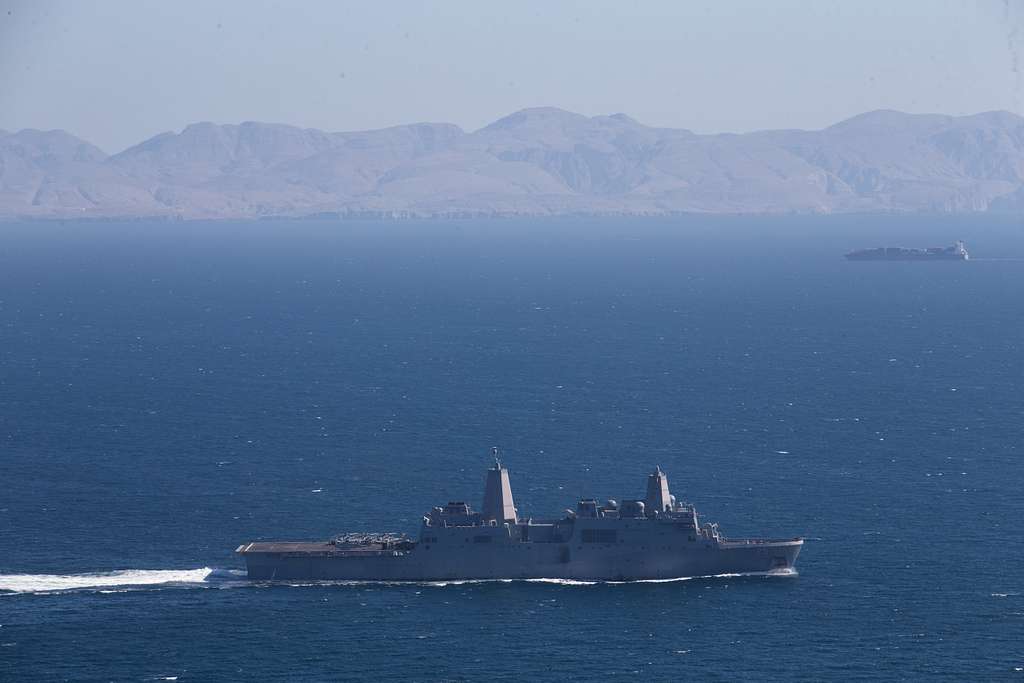
A serious campaign to restrict shipping around the Strait of Hormuz – as Iran has attempted by threatening to fire on transiting vessels and prompting insurers to suspend or massively reprice war risk cover – has produced immediate spikes in insurance premiums and freight costs, driven a collapse in daily ship transits, and forced widespread rerouting of energy and container flows. In turn, these disruptions have contributed to sharp, rapid movements in oil and gas prices and renewed inflationary pressure in economies far removed from the Gulf, prompting warnings from institutions such as the IMF about the risks to global growth if the closure persists. The pain is dispersed and politicised globally long before the target state is truly strangled.
Australia sits squarely inside that shock zone. As a major maritime trading nation and a net energy importer exposed to global pricing, we would feel the effects of a Gulf blockade almost from the moment it was credibly signalled regardless of whether the Royal Australian Navy was directly interdicting traffic. That reality collides with a domestic strategic culture conditioned by on‑demand information and short political attention spans, where complex problems are often expected to yield to rapid, technical solutions.
Blockade is the antithesis of this mindset. It is a campaign, not an event. It requires coalition cohesion, sustained naval presence, and the political will to accept friction, contested narratives and domestic economic pressure over time. The risk for Australia is that a foreign policy framed primarily around avoiding escalation, rather than shaping the terms of competition, leaves us ill-prepared for the sort of grinding maritime coercion that is becoming more, not less – central to major power rivalry.
Australia’s external policy rests on two anchors: secure maritime access and a rules‑based order that protects that access. Both are directly engaged by any disruption to shipping in the Strait of Hormuz. As one of the world’s heaviest users of maritime trade, we are not a disinterested bystander. Both are engaged by any serious disruption to shipping in the Strait of Hormuz. We are not a disinterested bystander. Our economic welfare and our broader strategic interest in maintaining norms of lawful passage and noninterference in commerce converge in that narrow waterway.
Supporting a mission to help uphold good order at sea in and around Hormuz is thus both a public good and a national interest. It is a public good because stable, predictable conditions for maritime trade benefit not only Australia and its friends, allies, like minded partners and regional neighbours but also the many states – developed and developing that rely on seaborne energy and food flows through the Gulf. It is a national interest because, as one of the world’s heaviest users of shipping, we have more to lose than most from a world in which coercive disruption of maritime trade becomes normalised.
The question is not whether Australia should avoid escalation. The question is whether we can think and act on maritime timelines, recognising that the most useful naval tasks right now are backing diplomacy and keeping trade moving (and seafarers safe), even as the economic shock spreads fast.
For a country whose lifelines are idiosyncratically maritime, the answer cannot be to stand back, hope for the best, and treat the sea as an abstract backdrop. It must be to prepare deliberately, communicate honestly with the public about the stakes, and be willing to contribute meaningfully to a coalition that is trying to keep open the very oceanic system that keeps Australia alive. If Canberra is serious about those two abiding interests – maritime access and the rule of law, it should say so plainly in the context of Hormuz, and act accordingly.
Dr Sean Andrews, CSC, is a retired Royal Australian Navy officer and maritime strategist, currently Senior Fellow at the Strategy, Statecraft and Technology – Changing Character of War Centre, Pembroke College, Oxford University. He has led Australia’s Sea Power Centre, commanded ADF operations in the Middle East, and publishes widely on Indo-Pacific sea power, maritime security, and the global oceanic order.
This article is published under a Creative Commons License and may be republished with attribution.