Australia’s National Defence Strategy 2026 (NDS) reflects a decisive shift in how Canberra perceives the current strategic environment in the Indo-Pacific and the strategies it intends to pursue to mitigate the challenges. In particular, relations with India have moved to the forefront, reinforcing and deepening bilateral ties and elevating India’s strategic relevance in Australia’s defence posture and future planning.
Increasing Australia-India Relations
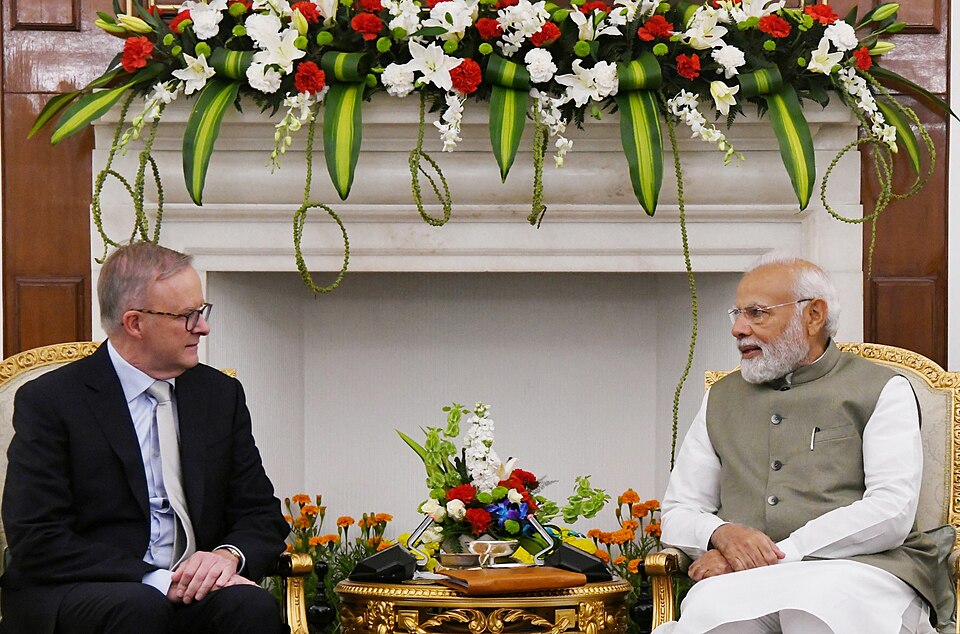
Australia-India relations gained momentum following Prime Minister Narendra Modi’s visit to Australia in 2014, marked by his emphatic statement that “Australia will not be at the periphery of our vision but at the centre of our thought”. Since then, several high-level visits, including Modi’s visit to Australia in 2023, India’s Defence Minister Rajnath Singh’s visit to Australia in 2025, have enhanced a deeper mutual understanding and produced several key security agreements, such as the Comprehensive Strategic Partnership, Mutual Logistics Support Agreement (MLSA), 2+2 Ministerial Dialogue, and Maritime Security Cooperation, among others. Collectively, these developments indicate a transition from dialogue to operational defence cooperation, with enhanced interoperability, intelligence sharing, and maritime coordination.
Building on these developments, the NDS 2026 outlines several strategic initiatives that align closely with the Indian Maritime Doctrine 2025 (IMD). Both documents emerged against a shifting geopolitical backdrop: a more assertive China, persistent grey zone competition, and a United States recalibrating its strategic priorities like America First and a renewed focus on the Western hemisphere and the Atlantic theatre. This raised questions about the efficacy of US primacy in the Indo-Pacific.
Against this backdrop, envisaging limited support from partners and allies, both the NDS and IMD emphasise self-reliance (Atmanirbhar in Hindi), signalling a shared ambition to develop credible deterrence capabilities. In this direction, Australia is aspiring for a strategic autonomy long practised by India.
NDS, IMD and Regional Security
The NDS underscores the importance of an integrated defence force across five domains, air, cyber, land, maritime and space, while the IMD highlights Multi-Domain Operations encompassing air, cyber, cognitive, land, sea and space. India further emphasises “Jointness”, referring to a high degree of cooperation, coordination and collaboration across military services, whereas Australia stresses a coordinated, whole-of-government and whole-of‑nation approach. The NDS prioritises a strategy of denial through regional partnerships and alliances to deter coercion, the IMD focuses on strengthening partnerships with Indian Ocean littoral states. Overall, the NDS and IMD aim to foster comprehensive tactical and strategic deterrence through regional cooperation.
Both documents support a rules-based order and freedom of navigation, as recently reflected in their shared interest in keeping the Strait of Hormuz open. Similarly, Canberra and New Delhi, taking serious note of the shifting balance of power in the Indo-Pacific and the increasing dominance of grey zone activities, describe grey zone activities as below the threshold of war and a No War, No Peace condition, respectively. To address such challenges, both countries are increasing their respective defence spending.
The NDS places significant emphasis on developing Australia’s sovereign defence industrial base, including domestic production of critical military capabilities. This aligns with India’s Make in India initiative. While India considers Australia as central to its strategic framework, the NDS identifies India as a top-tier security partner. This conjunction reflects shared interests, common challenges, and a strengthening partnership.
New Avenues for Cooperation
Despite this convergence trajectory, a critical gap remains that, if addressed strategically, could be narrowed during Modi’s Australia visit in July 2026.
First, there is a compelling case for a coordinated choke-point strategy of resilience and denial. In this regard, the Lombok, Malacca, and Sunda Straits act as critical arteries of Indo-Pacific trade and energy flows. India’s tri-service command in the Andaman and Nicobar Islands provides a forward-operating advantage in the eastern Indian Ocean. Australia, in turn, can enhance its strategic footprint through the Cocos (Keeling) Islands. A coordinated approach encompassing surveillance, access, and contingency planning would significantly enhance collective maritime domain awareness and deterrence.
Second, both countries must adopt a more coordinated approach towards small island states in the Indian Ocean and the South Pacific. These states, increasingly subject to external economic inducements, may lead to strategic leverage. A joint framework for development assistance, infrastructure investment, and capacity building would not only mitigate vulnerabilities but also reinforce a rules-based regional order.
Third, the MLSA remains underutilised. While bilateral and multilateral exercises have improved interoperability, including in areas such as mid-air refuelling, there is scope to institutionalise more regularised logistics support, joint deployments, and access arrangements. This would transform the MLSA into a force multiplier.
Fourth, defence-industrial cooperation remains the most underexplored sector. India’s expanding indigenous defence manufacturing base – including capabilities in shipbuilding, combat aircraft, and emerging technologies – offers Australia a cost-effective and scalable partner. Similarly, Australia’s strengths in advanced research, niche technologies, and regulatory standards can complement India’s industrial capacity. Joint ventures in areas such as artificial intelligence, autonomous systems, and advanced robotics would not only enhance defence capability but also contribute to resilient and diversified supply chains.
Amid intensifying uncertainty, competition, and fragmentation in the Indo-Pacific, Australia and India must chart a long-term strategic roadmap guided by the NDS and the IMD.
Dr Dalbir Ahlawat is a Senior Lecturer in Security Studies at the School of International Studies, Macquarie University, Sydney.
Dr Abhishek Dadhich is an Assistant Professor at the School of Police Science and Security Studies, National Forensic Sciences University, Gandhinagar, India.
This article is published under a Creative Commons License and may be republished with attribution.