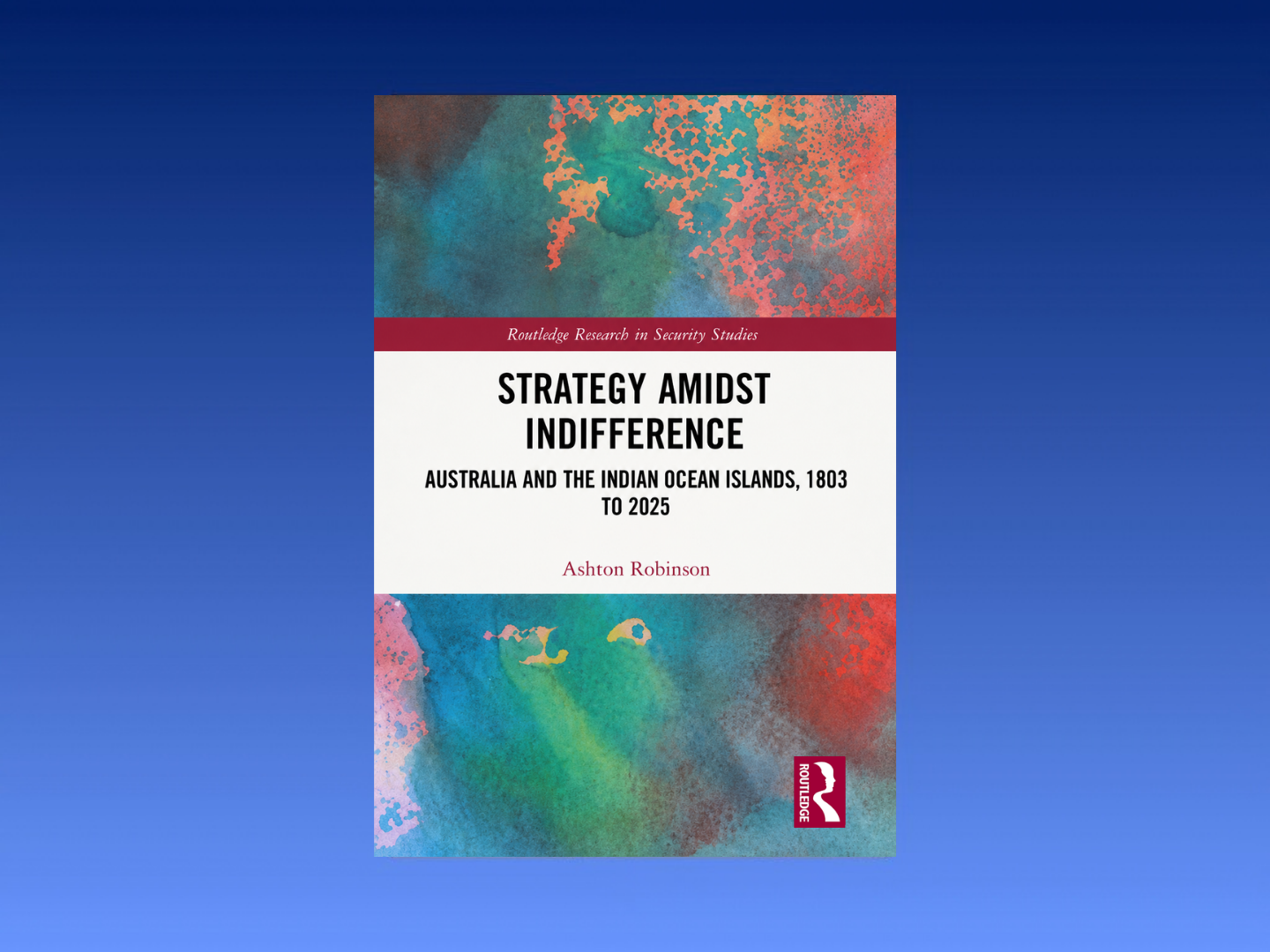
From graphite mining in Madagascar to illegal fishing off Heard Island, Australia’s stakes in the Indian Ocean islands have been growing, with almost no presence there. Ashton Robinson’s timely study Strategy Amidst Indifference: Australia and the Indian Ocean Islands explains what this neglect is costing.
On the Neglected Other Half of the Indo-Pacific
Airservices Australia manages 11 per cent of global airspace and the traffic within it. The Australian Search and Rescue Region covers almost 53 million square kilometres, which is almost one tenth of the earth’s surface. The Indian Ocean comprises a considerable part of these spaces. Yet Australian engagement with the islands of the Indian Ocean basin is at best limited and episodic. The Pacific is a region of intense Australian diplomacy and the recipient of the greater part of Australian official aid, and now is the location of major bilateral security commitments. The other half of the ‘Indo-Pacific’ is missing in the current security imaginary. The central argument of this scholarly, thoroughly researched and fluently constructed study is that this neglect creates lacunae in government policy and opens the way to vulnerabilities, no less scientific than economic and strategic. As Robinson indicates in a telling example, at one point the external intelligence service of the Seychelles was effectively privatised, and subsequently fell under criminal control. A single mission in Mauritius of modest size is the most visible Australian regional diplomatic presence, and its staff must also take responsibility for Seychelles, Comoros and Madagascar as well as discharge consular tasks for Reunion Island. A defence attaché in Addis Ababa has responsibility not only for all the Indian Ocean islands but for the entirety of Africa as well.
Despite the ostensibly neutralist stance of the island states (including their membership to the Non Aligned Movement), in practice the role of external powers is accepted. The proclamation in 1971 of the Indian Ocean Zone of Peace soon fell into abeyance. The major players in the Indian Ocean are France and India, with the United States effectively in control of an essential joint military base on the Island of Diego Garcia (though now of an uncertain sovereign status). However, such efforts as have been made to develop security modalities with France have been damaged by the scuttling of the French role in Australia’s future submarine force. Extraordinarily, the abrupt termination of this arrangement occurred just as Australia had entered a new strategic arrangement, the Australia-India-France Trilateral Dialogue. As Robinson contends, ‘the basis of trust for Australia to deal with the most capable maritime partner in the Indian Ocean was destroyed.’ India’s pre-eminent role as a regional actor—setting aside Diego Garcia, the Indian base on Agaléga (a dependency of Mauritius) though ‘a statement rather than an asset’ is unique—has been insufficiently acknowledged. Defence Minister Richard Marles’ statement to an Indian audience that New Delhi was the basin’s ‘natural leader’ was, Robinson suggests, ‘gauche and obsequious.’
Australian mining interests hold a stake of around USD $1 billion in mining in Madagascar, a mineral that is an essential component in the current global competition for strategic minerals. According to Robinson, Madagascar holds around 50% of the world’s graphite reserves. Yet there is no Austrade or DFAT presence in Madagascar, the mission in Mauritius being the closest official presence. There is no bilateral investment treaty that could be used to defend Australian interests if they were the object of commercial sabotage. Moreover, government contacts have rarely been cultivated. The visit of head of state Philibert Tsiranana in 1965, the first African head of state and only the third head of state to visit Australia to that point, received a bemused and uncoordinated response, and was never reciprocated. Potential education links have not been exploited. Curtin University’s Mauritius campus remains a pioneer outlier.
Australian engagement with the essentially francophone Indian Ocean Commission is weak, and the Australian presence in Indian Ocean Rim Association is not prominent. Australian government figures are most likely to encounter the leaders of Indian Ocean states at Commonwealth Heads of Government Meeting, which is perhaps a measure of official interest.
This neglect extends to Australian territory. Sovereignty over Heard and McDonald Islands, transferred to Australia in 1947 in a British act of post-colonial ‘tidying’, brought an official Australian presence to the mid-ocean. Australian whalers and sealers had been prominent as visitors in the nineteenth century. In 2012, Australia proclaimed an extended continental shelf surrounding the islands of 1,130,000 square kilometres. While fishing is banned from the immediate territorial waters, the zone hosts a valuable fishery that has seen many instances of illegal, unreported and unregulated fishing. Notwithstanding, there is no physical Australian presence on Heard, and any likely official visit is dependent upon the cooperation of commercial fishing vessels. Robinson likens this state of affairs to ‘sovereignty by press release.’ The 10% tariff imposed by the Trump administration on exports to the United States from Heard and McDonald—despite the islands having no export trade—was indicative of the lack of prominence of Australia’s status.
Perhaps the greatest consequence of the neglect that Robinson describes can be seen in the intelligence sphere. While Australia’s future force of AUKUS submarines—presuming they are built and acquired—would be focussed northwards, operations would require a much more extensive knowledge of Indian Ocean bathymetry than currently exists.
Cocos/Keeling and Christmas Island are also considered in the book. While remoteness from the other Indian Ocean islands and their unique Australian status render them largely part of a separate narrative, the theme of neglect that runs through the volume is applicable also to them. Christmas Island might host a tourist industry, for example, but lacks a hotel, though it provides accommodation of a different kind.
From Angry Anderson to Ralph Babet, the Indian Ocean islands have made a contribution to Australia. Australian actors, for their part, have left a reciprocal imprint, notably in their roles in attempted coups against governments in the Seychelles and in the Comoros. Nevertheless, these island groups and nations are only fleeting items in the Australian consciousness. For a full understanding of the Indo-Pacific this work is an essential resource devoted to its neglected half.
This is a review of Ashton Robinson’s Strategy Amidst Indifference. Australia and the Indian Ocean Islands, 1803 to 2025. London: Routledge, 2027. ISBN 9781041315681.
James Cotton is Emeritus Professor, University of New South Wales, Canberra. He is editor of 4 of the AIIA series, ‘Australia in World Affairs’ and a former editor of ‘the Australian Journal of International Affairs.’ He is also a Fellow at the AIIA.
This article is published under Creative Commons License and may be republished with attribution.