Australia should engage in the Pacific on its own terms, not because it has been lulled into a contest with China.
In June 2024 Foreign Minister Penny Wong told the ABC that Australia had lost the chance to be the Pacific’s “only partner of choice”. According to Wong, Australia was therefore locked in a “state of permanent contest” in the region.
At first blush, Wong’s framing is understandable. China has become more active in the Pacific Islands region over the last decade, which has triggered Australia’s longstanding anxiety about powers with potentially inimical interests establishing a foothold in the region from which to threaten Australia. That anxiety had escalated after Solomon Islands signed a security agreement with China in April 2022, which Wong described as Australia’s “worst Australian foreign policy blunder in the Pacific” since the Second World War. Wong’s framing also does valuable political work in Canberra, as it justifies Australia’s increased spending on the region, and latterly, the new treaties and security agreements Australia has signed with several Pacific Island countries to embed its role as their primary partner of choice.
But Australia should step back from this framing. A contest implies two or more comparable partner countries offering equivalent assistance to Pacific Island country “prizes”. That is both inaccurate and unhelpful.
Not Substitutable
The contest framing treats Australia and China as interchangeable partners. They are not.
Australia remains – by far – the region’s largest development partner. Australia disbursed US$1.5 billion in ODF to the Pacific in 2024, which was 37 percent of all development flows to the region and more than three times as much as the next largest partner, the Asian Development Bank. China disbursed only 6 percent of regional ODF. Australia has also overtaken China as the region’s largest lender, behind the multilateral banks.
China has built several infrastructure projects in the region. Chinese migrants are highly visible in the small business sector, and most Pacific capitals have a “Chinatown”. But Australian officials and consultants are embedded across many Pacific governments, as well as all major regional bodies, including the Pacific Islands Forum. For example, Australia offers extensive maritime security assistance, including patrol boats (with accompanying maritime security and technical advisors) and aerial surveillance, with Australians working at the Forum Fisheries Agency. Australia also engages in wide-ranging defence cooperation, policing assistance, and disaster response. And Australia offers labour mobility and permanent migration opportunities. Importantly, Australia cooperates closely with the other major regional partners, including New Zealand, the US, the UK, France, and Japan.
China has neither the inclination nor – arguably – the capacity, to replicate what Australia delivers.
Not Morally Equivalent
The contest framing also implies moral equivalence between Australia and China. But they are different kinds of states.
Australia’s long history in the Pacific is far from blameless, but we know a lot about it because Australia is a democracy. The government’s Pacific policies are debated in Parliament, scrutinised in Senate Estimates, reported by a free press, tested in the courts (when necessary), and held to account at the ballot box. Pacific leaders can therefore be confident that policies that negatively affect their region will be scrutinised and that broken promises will be noticed.
Because China is further away from the region it has been less involved, which may make it seem like a more benign partner. But China is a single-party state, which Freedom House describes as “a repressive authoritarian regime” that “maintains tight control over all aspects of life and governance, including the state bureaucracy, the media, online speech, religious practice, universities, and businesses”. China is ranked 178 out of 180 countries on the World Press Freedom Index. China’s citizens therefore cannot hold their government to account. Nor can Pacific citizens: the 2022 security agreement with Solomon Islands has never been published.
No country is a perfect partner, but Australia is a more accountable one. If China begins to coerce Pacific Island countries as it has done the Philippines, there will be little they or Chinese citizens can do to hold it to account.
Pacific Island Countries Are Not “Prizes”
Contests are intended to be won. But Pacific Island countries are not “prizes”.
Pacific Island countries make their own foreign and strategic policy decisions for their own reasons. The contest framing implies that engagements between Pacific Island countries and China are “losses” for Australia, which underestimates the ability of Pacific Island countries to distinguish between partners and their offerings. This framing also risks provoking the outcome that it fears: Pacific Island countries may calculate that the best way to resist perceived Australia pressure to “choose” a “side” and to demonstrate their sovereignty is to seek greater engagement with China.
Australia’s interests are best served by being a good neighbour and giving Pacific Island countries space to reach their own conclusions. Australia should be confident that Pacific Island countries can evaluate the risks of normalising China’s presence in their region. Australia can assist their decision-making by sharing information candidly and by continuing to support the independent media, parliaments, ombudsmen, and civil society organisations that let Pacific communities scrutinise all partners, including China and Australia.
Engaging on Australia’s Own Merits
None of this means that Australia does not have legitimate strategic concerns about China’s interest in the Pacific, particularly about the risk of a Chinese military presence. But Australia’s best protection against that outcome is to be the partner that Pacific Island countries engage with because of what its policies offer for their people, rather than because Australia is involved in a cycle of reacting to Chinese initiatives. This is also the most sustainable approach, because a “permanent” contest has no obvious end point – escalation is often the most likely outcome.
Joanne Wallis is Professor of International Security in the Department of Politics and International Relations at the University of Adelaide. Joanne is a leading academic voice within the Australian strategic and foreign affairs policy community. She has been a delegate to the Australia-America Leadership Dialogue, has been invited to participate in strategic dialogues in Washington, Wellington, Canberra, Taipei and Port Moresby, and has appeared before the Joint Standing Committee on Foreign Affairs, Defence and Trade. Joanne is the author or editor of seven books, including Constitution making during State building (CUP 2014) and Pacific Power? Australia’s Strategy in the Pacific Islands (MUP 2017).
This article is published under a Creative Commons Licence and may be republished with attribution.
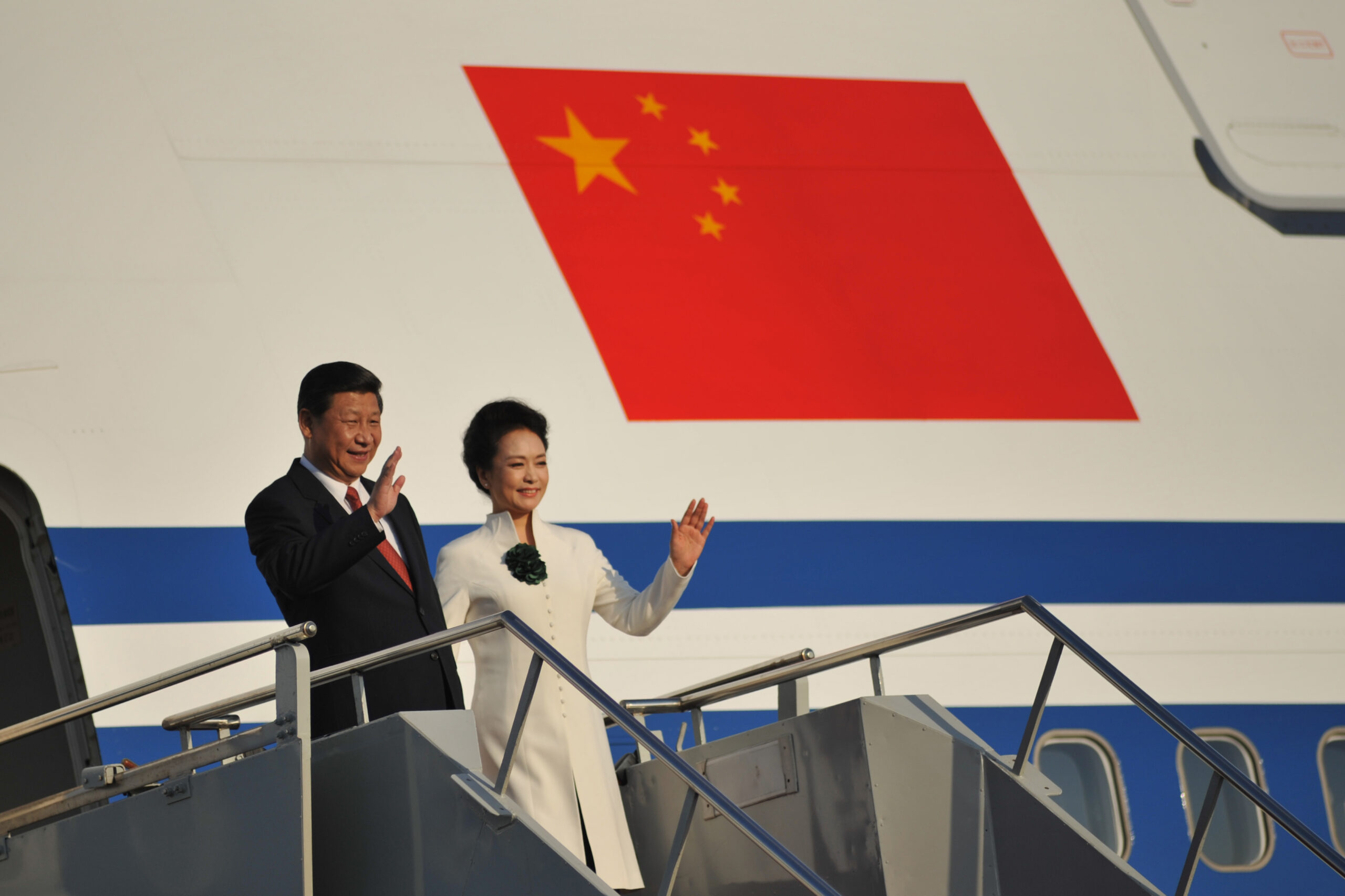
Photo: “President China Hadiri APEC 2013” by APEC 2013, CC BY 2.0