Bangladesh’s July 2024 revolution won its leaders a rare store of legitimacy, but corruption, selective justice and stalled reforms are now spending it fast. If India, Algeria and Tunisia are any guide, the result could discredit the country’s liberation legacy and open the way to a more radical vision of national identity.
Plato’s Republic warns that those unwilling to participate in government risk being governed by someone worse. Yet good men sometimes rise against tyranny, and the resulting upheaval often brings unavoidable dysfunction—especially when the tyrant was once celebrated as a liberator. Bangladesh is a recent example. This article examines how corruption and bad governance after the 2024 July Revolution, including perceptions surrounding the 2026 general election, may erode the revolution’s founding principles, viewed against comparative experience.
The Bangladesh Awami League led the 1971 Liberation War. The Proclamation of Independence dated 10 April 1971 expressed the new nation’s aim to ensure for the people of Bangladesh equality, human dignity and social justice. Yet during 2009–2024, the party that claimed guardianship of those ideals and near-exclusive credit for liberation became associated with corruption, cronyism, abuse, and disregard for democracy and the rule of law.
After the 2024 July Revolution removed the Awami League government, Bangladesh faced an uncomfortable paradox: the authoritarian conduct of a once liberal, secular and constitutional establishment fuelled anger that now rejects the ideological foundations on which the party says Bangladesh was built. The result has been renewed religious-conservative politics.
Its proponents argue that Awami League corruption, repression and denial of justice discredited the political centre, legitimising a movement that seeks not only a new government but a new definition of Bangladesh. Three countries illustrate comparable transitions, though with different outcomes.
India comes first. The Indian National Congress anchored the independence movement and, after 1947, a broadly secular and pluralist nationhood. Yet it also used religious issues electorally, while Indira Gandhi’s 1975–77 Emergency damaged democratic institutions. By the 2014 election, corruption allegations, economic difficulties and governmental paralysis had weakened Congress. Scholars also identify its religious compromises, organisational weakness and ineffective response to Hindu nationalism. Hindu nationalism therefore advanced not simply because of corruption or repression, but because Congress’s credibility crisis opened space for an existing alternative national identity.
Second is Algeria. The National Liberation Front (FLN), which led the armed struggle against French rule, lost influence amid severe economic and political problems in the late 1980s. The October 1988 riots were widely seen as anger at a corrupt, inefficient government and a party protecting elite privilege. A new constitution in 1989 ended single-party rule, opening the way for the Islamic Salvation Front (FIS), whose rise was linked to deteriorating economic and social conditions. In the June 1990 local elections, FIS won about 54 per cent of the popular vote, against 28 per cent for the FLN. When FIS won the first round of national elections in December 1992, the army pressured the president to resign and the second round was cancelled, plunging Algeria into a decade of civil war.
The final example is Tunisia. Before 2011, its stable but authoritarian regime prioritised growth over political liberalisation. Since gaining independence from France in 1956, the country had only two presidents, Habib Bourguiba and Zine El Abidine Ben Ali, both ruling through the same party. Founded as the Neo Destour, it was renamed the Socialist Destourian Party in 1964 and, under Ben Ali, the Democratic Constitutional Rally (RCD) in 1988. Ben Ali ruled for 23 years after deposing Bourguiba in 1987, but corruption, nepotism, repression and regional inequality steadily undermined confidence in his rule. After his fall, the previously banned Islamist party Ennahda won the most seats in the October 2011 Constituent Assembly election. Tunisia nevertheless remained “an echo chamber of the ideological conflicts” between Islamists and secularists, with Ennahda central to debates over religion, state and identity.
These examples – albeit arising under different geo-political climates – share a common undercurrent: when a party (like the Congress in India, FIS in Algeria and the RCD in Tunisia (and its predecessors Neo Destour and Socialist Destourian Party) claiming a national liberation legacy embraces corruption, repression and exclusion, an alternative movement (like BJP in India, FLN in Algeria and Ennahda in Tunisia) can capture the language of national identity. In Bangladesh, the vacuum created by Awami League’s institutional failure may likewise be filled by the movement best organised to give the anger of July 2024 a broader ideological meaning.
This is the challenge facing the centre-right BNP, which won the February 2026 election. The National Citizen Party (NCP) and Jamaat-e-Islami (JI) have criticised it for failing to implement reforms endorsed in that month’s referendum. After BNP took power, several ordinances introduced by the post-revolution interim government were repealed or allowed to lapse. These covered judicial appointments and the Supreme Court Secretariat, enforced disappearances, the Anti-Corruption Commission, a police commission and the referendum itself. NCP and JI argue that this abandons promises on judicial independence, anti-corruption, police reform and checks on executive power. BNP says it remains committed to the July Revolution but wants further scrutiny and consultation before proceeding.
Before taking power in February this year, BNP acting chairman Tarique Rahman publicly reaffirmed the party’s identification with the 1971 Liberation War. Meeting the left-leaning Democratic United Front on 5 January 2026, Rahman reportedly told them that Bangladesh’s existence could not be imagined without the war. The question, however, is whether that rhetorical commitment to 1971 has been matched by governance practice.
So far, BNP’s deference to the spirit of 1971 appears largely sanctimonious. Transparency International Bangladesh’s report on the government’s first 100 days, published on 07 June 2026, found “clear signs of backtracking in institutional reforms and accountability mechanisms”. It said repealing the Supreme Court Secretariat Ordinance, 2025, the Supreme Court Secretariat (Amendment) Ordinance, 2025, and the Appointment of Judges of the Supreme Court Ordinance, 2025 signalled “a retreat on the issue of judicial independence, reflecting a stance contrary to the government’s commitment to ensuring it”. It also found “no visible implementation plan” for making good governance and corruption prevention the government priorities.
The government’s treatment of popular social media influencer Salman Muqtadir has also drawn criticism. After he criticised BNP and the law-and-order response to vandalism at his studio, the Bangladesh Financial Intelligence Unit (BFIU), Bangladesh Bank’s agency for combating money laundering and terrorist financing, directed all banks and financial institutions to hand over his account details within an hour. Whatever the motive, such a heavy-handed use of state machinery makes the government appear petulant in its response to criticism.
BNP therefore stands at a precipice. As a beneficiary of the 2024 July Revolution and current torchbearer of Liberation War ideals, it must honour both the revolution and the Proclamation’s promise of equality, human dignity and social justice. On 14 November 1993, FIS communiqué No. 42 attacked Algeria’s FLN establishment as a “junta” that had betrayed the people’s and martyrs’ covenant. If BNP appears hypocritical or applies the law asymmetrically amid corruption, citizens may conclude that elections merely rotate elites. Religious-conservative or other opposition movements could then describe the transition, colloquially, as going from the Awami League frying pan into the BNP fire—and not without reason.
Internal divisions are another serious challenge for the BNP in power. In August–September 2026, senior BNP leaders and its lawyers’ wing, the Jatiyatabadi Ainjibi Forum, intervened to end a month-long protest by pro-BNP lawyers. The protesters demanded the Attorney General’s removal and new government law-officer appointments, arguing that they had been overlooked. The dispute creates the public impression that political activity, rather than merit, determines government legal appointments.
A caveat is necessary: the picture is not entirely bleak for the BNP since it came to power in 2026. Prime Minister and BNP Chairman Tarique Rahman appears sincere in governing. After the Radda MCH-FP Centre, a maternal and child healthcare facility in Dhaka’s Mirpur, was demolished and looted on 25 September 2026, reserved-seat BNP MP Ferdousy Ahmed resigned on Tarique Rahman’s instruction; local BNP leaders and activists associated with her were implicated. The BNP’s top leadership must therefore also enforce internal party discipline.
In 1802, responding to Lord Wellesley’s questionnaire on moral character, judges of the Dacca (now Dhaka) Division described a “readiness of communication with persons of infamous character” as the cause of “a total and general want of moral feeling”. Perhaps the moral failures of Bangladesh’s past generation of politicians illustrate Plato’s warning: avoiding governance risks being governed by someone worse. But the 2024 July Revolution showed that young Bangladeshis remain a major political constituency: people aged 15-29 account for nearly 28 per cent of the population. If BNP abandons the ideals of 1971 and the spirit of July 2024, people may cease to believe that Bangladesh’s institutions belong to them. Someone else, however radical or unpalatable to the old secular guard, will then offer a different idea of Bangladesh.
The burden now falls on the BNP to show that political change can produce institutional change.
Junayed Chowdhury is an international lawyer, political commentator, academic author, and the Managing Partner of Vertex Chambers (Dhaka) and Vertex Icon Corporate Services Provider (Dubai and Sydney). He is a Senior Advocate of the Supreme Court of Bangladesh and specialises in international taxation, international arbitration and alternative dispute resolution.
This article is published under a Creative Commons Licence and may be republished with attribution.
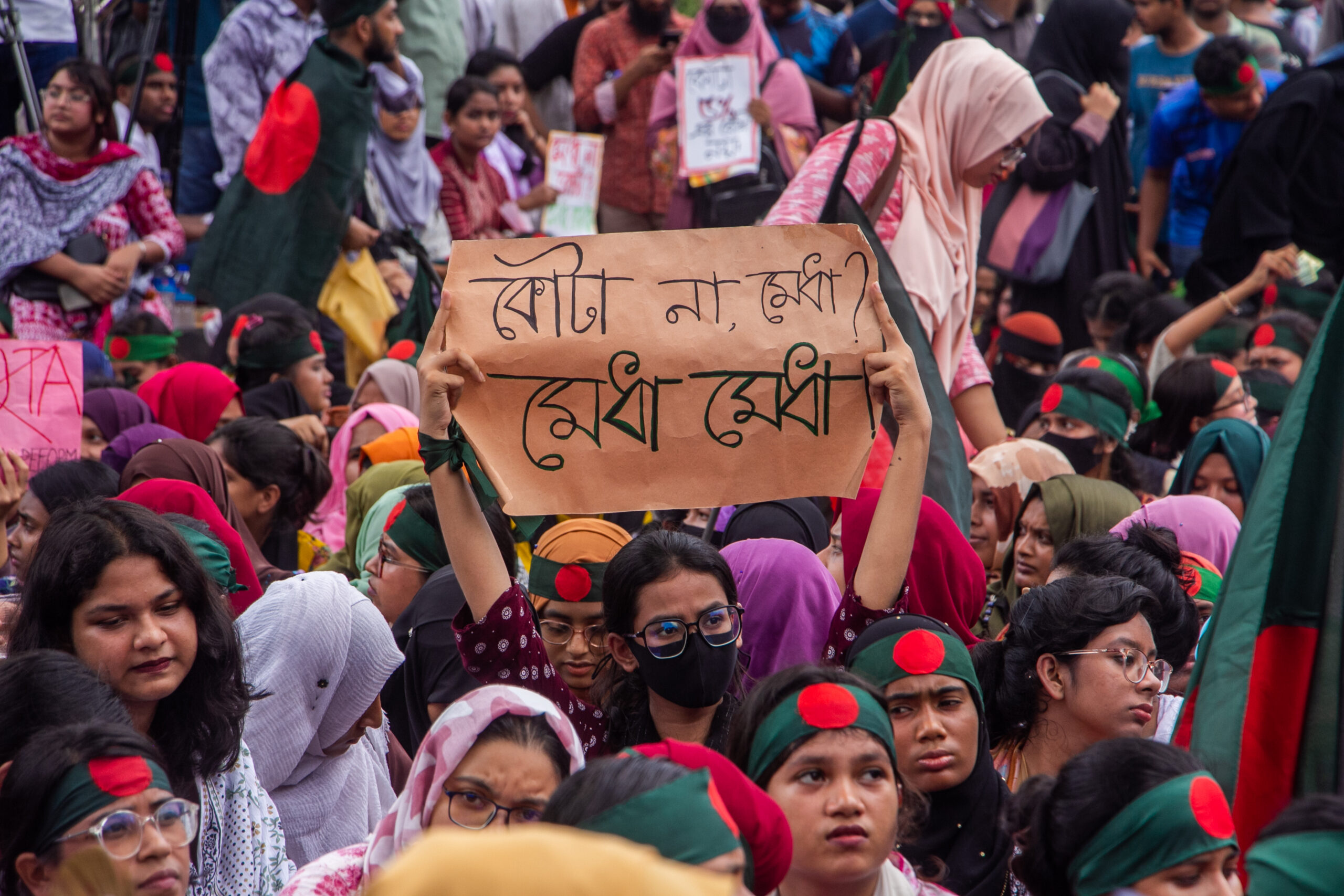
Photo: “Quota or Merit? Merit Merit!” Wikimedia Commons, CC BY-SA 4.0