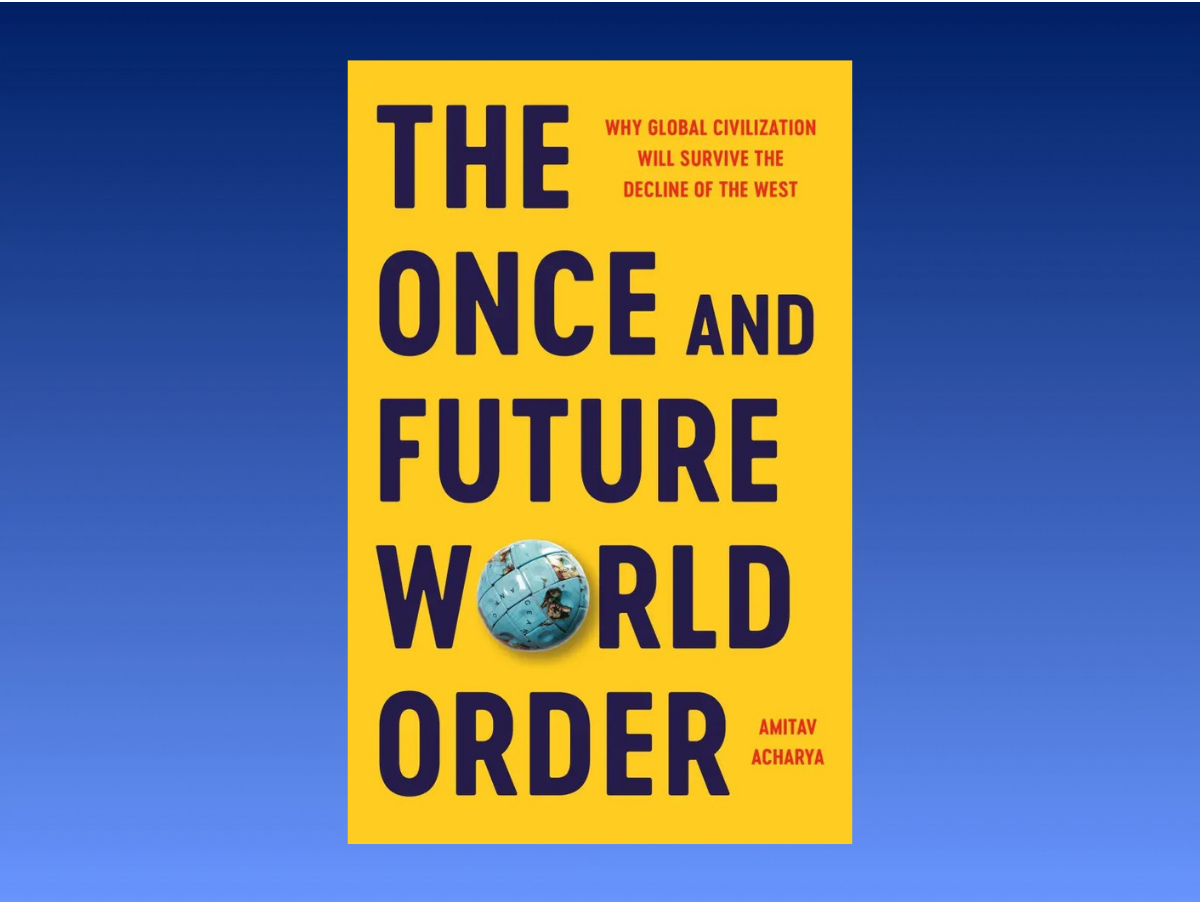
Every time American power wobbles, Washington declares the death of world order. In The Once and Future World Order, Amitav Acharya asks why the West’s decline should mean chaos for everyone else, though his compelling history offers more critique than roadmap.
When Henry Kissinger sat down in the early weeks of the 2020 pandemic to write his dark prognosis for the Wall Street Journal, he was indulging in an old Washington ritual: declaring the death of the world America built. Every few years, like clockwork, the same funeral dirge echoes through the corridors of power. Russia’s tanks roll into Ukraine, and analysts lament the death of global norms; China flexes its muscles in the Taiwan Strait, and commentators mourn the end of international law; a sudden crisis flares in the Persian Gulf, and diplomats panic over the collapse of stability.
Each time a crisis hits, Western commentators rush to the same breathless conclusion: as American power recedes, global order must inevitably slide into chaos.
It is a dramatic, apocalyptic narrative—and, as Amitav Acharya quietly demonstrates, a completely self-serving one.
In The Once and Future World Order, the American University scholar opens with this endless chorus of Western anxiety, only to ask the one question Washington never dares to raise: why should the decline of Western dominance mean the decline of world order itself?
Dismantling the Westphalian Myth
To understand why this question is so radical, one must look at how modern international relations are taught. The standard Western history of world order follows a neat, self-congratulatory pipeline: it begins in classical Athens, passes through the Pax Romana, matures in Europe with the 1648 Peace of Westphalia, and reaches its glorious apex with the post-1945 American-led rules-based order. In this telling, international law, diplomacy, and global trade are uniquely Western inventions exported to an unruly planet.
Acharya dismantles this myth with surgical precision. Drawing on roughly five thousand years of history, he forces us to broaden our definition of “order” beyond Western sovereign states and American-built institutions. Empires, tributary networks, and regional councils across ancient Egypt, Persia, India, and China were not chaotic dark ages waiting for European enlightenment; they were sophisticated political systems that managed power, conducted diplomacy, and kept the peace for centuries.
However, his generosity toward the non-West is never uncritical. Kautilya, the Indian theorist of power politics, is placed alongside the emperor Ashoka, who embraced moral rule after conquering the kingdom of Kalinga in the third century BC, and Acharya candidly shows that the land was never returned by Ashoka.
The Global Multiplex
If the West did not invent world order, what happens now that its global monopoly is slipping?
Acharya’s answer is the “global multiplex”—a concept that serves as the intellectual spine of the book. Borrowing from the metaphor of a modern cinema, he envisions a world with multiple screens showing different films simultaneously. There is no single master narrative and no central projectionist.
A multiplex world is post-Western, not merely post-American. China will play a massive role, but it will not simply move into the Oval Office and run the world on its own terms. India, Brazil, African states, and regional blocs will demand a say in setting global rules, defining development, and managing regional crises.
This argument intersects neatly with Henry Kissinger’s classic insight: a stable international order requires a balance between power and legitimacy. Where Kissinger focused narrowly on great-power diplomacy, Acharya widens the lens to include the Global South—societies whose contributions were systematically erased by centuries of imperial dominance.
Among the book’s noteworthy contributions is its precise differentiation between “multiplex” and “multipolar.” While multipolarity is centred on great powers and their military and economic strength, the multiplex concept also takes into consideration corporations, foundations, civil society, and the force of ideas and culture, which cannot be controlled by a single state.
The mere presence of multiple participants does not ensure the equal distribution of power. Participation of corporations, regional organisations, and weaker states in global governance does not change their status as followers to stronger actors. While the term “multiplexity” signifies numerous participants, whether this diversity translates into a just system is still unclear.
The Real World Test: Iraq, Afghanistan, and Beyond
The strength of Acharya’s historical framework lies in its ability to explain contemporary geopolitics. The American interventions in Iraq and Afghanistan demonstrated precisely what Acharya’s ancient examples suggest: military power can overthrow a regime, but it cannot buy legitimacy. Two decades of blood and treasure in Afghanistan ended with the Taliban’s return to power, while the invasion of Iraq shattered regional balance and empowered Iran. Pax Americana generated trade and connectivity, but it also masked profound inequalities and unilateral violence.
Yet, this is where Acharya’s optimism encounters its toughest test. The failure of American hegemony does not automatically make its challengers benign. Regional powers can be just as tyrannical to their smaller neighbours as global empires ever were. A world of competing regional spheres might give local powers greater freedom to coerce their neighbours without fear of Washington’s intervention.
Graham Allison’s work on the Thucydides Trap points out the potential hazards of changes between rising and established powers, but his historical analyses and their interpretations continue to be contentious. Peaceful transitions suggest that war is not inevitable, but they do not explain which institutions or diplomatic practices are conducive to maintaining peace. While Acharya’s framework is more persuasive as a critique of hegemonic assumptions, it falls short as an explanation for how a multiplex order might prevent conflict.
A Warning, Not a Blueprint
The Once and Future World Order is a vital, persuasive book that forces a deep historical re-think. By recovering the forgotten histories of non-Western diplomacy, Acharya delivers a devastating critique of Western exceptionalism.
The book functions better as a historical corrective than a concrete roadmap for the future. Ancient regional orders operated in worlds without nuclear weapons, climate change, or global supply chains. Showing that coexistence was possible in ancient times does not tell us how a multipolar world will prevent catastrophic conflict today.
In the end, Acharya’s ultimate contribution is asking us to abandon a comforting, arrogant fiction. The West was never the whole world, and its retreat does not mean the sky is falling. But building an order where no single power mistakes its part for the whole remains the defining challenge of our century.
This is a review of Amitav Acharya’s The Once and Future World Order: Why Global Civilization Will Survive the Decline of the West, New York: Basic Books, 2025 (ISBN: 9781541604148)
Azher Ahmad dar is a Master’s student of political science at the University of Delhi. His work has featured in the University of Chicago, Indian Express, etc.
Maleeha Shafi is a postgraduate in political science from the University of Kashmir. She writes for national dallies like the Indian express, Print, etc.
This article is published under a Creative Commons Licence and may be republished with attribution.