AUKUS promised Australia nuclear-powered submarines and the UK thousands of new jobs. Five years on, as rising costs, workforce shortages and an unpredictable Washington test what’s at stake for both countries.
The world is in a very different state than it was when AUKUS was initially announced on September 15th, 2021. In brief, AUKUS is the trilateral security partnership between Australia, the UK and the US focused on advanced defence technology and capability sharing. It achieves this through two ‘pillars’; Pillar 1 focuses on providing nuclear-propelled submarines to Australia through the sale of US Virginia-class submarines to Australia and the building of the new SSN-AUKUS class submarines by Australia and the UK, and Pillar 2 focuses on advanced defence capabilities across various technology areas, including quantum, cyber and AI.
To explore the impact of AUKUS on the Australia-UK relationship, the Australia and UK chapters of Women in International Security (WIIS) will co-host a webinar on November 23rd, 7:30pm AEDT/8:30am GMT. Experts from both countries will explore key areas to watch to ensure AUKUS delivers on its initial promise for both Australia and the UK. For some easy homework, this article provides some explainers of how the UK and Australia are dealing with the implications of AUKUS.
Basics of Nuclear Submarines
Nuclear energy comes from either splitting heavy atomic nuclei (known as fission) or combining light atomic nuclei (known as fusion). Fission is typically carried out with enriched uranium or plutonium. Fission powers nuclear reactors for many purposes, including research, medicine, electricity generation, and propulsion. Six countries currently operate nuclear-propelled submarines, all using enriched uranium: the United States, France, India, China, Russia, and the United Kingdom. AUKUS will make Australia the seventh country in the world. Brazil also has a nuclear-powered submarine program in the works, and South Korea has recently expressed significant interest in it as well. Importantly, nuclear-powered submarines are not the same as nuclear weapons, and Australia remains a non-nuclear-weapon state under the Nuclear Non-Proliferation Treaty.
For navies, nuclear propulsion offers significant advantages. Nuclear-powered submarines can remain submerged for extended periods, travel long distances without refuelling, and operate with greater endurance than conventional submarines. For Australia, whose strategic environment spans vast ocean distances, these capabilities are a central part of the rationale behind acquiring nuclear-powered submarines through AUKUS.
UK: Nuclear Energy, Security Partnerships, and AUKUS
AUKUS discussions in the UK sit across three live policy discussions: domestic energy policy and security, the UK’s international partnership priorities, and defence spending.
For the UK, AUKUS has been framed as supporting Euro-Atlantic security as part of its formal adoption of a ‘NATO first’ defence policy, as well as increased deterrence in the Indo-Pacific. Despite high political leadership turnover in the UK since AUKUS was first signed, there has been broad cross-party support for the partnership, with the Labour government continuing its support following their election in 2024.
Domestically, AUKUS has been marketed as a boon for the UK economy, with the recent Geelong treaty valued at up to £20 billion in UK exports over 25 years, and over 7000 new UK jobs. At its peak, 21,000 workers are expected to work on SSN-AUKUS; however, many of these roles require specialised nuclear skills, highlighting the need for further investment in the UK’s nuclear workforce. There have been calls for an AUKUS Visa, to facilitate the movement of skilled workers and prevent production delays; however, the government has rejected these calls.
AUKUS has also been wrapped up in a larger debate on defence spending. In June 2026, the Secretary of State for Defence, John Healey resigned, unable to accept the Defence Investment Plan, referencing the inability to deliver on the Strategic Defence Review. Since then, he has been sworn in as Chancellor of the Exchequer, a signal that the Burnham Government might be looking to prioritising defence spending.
A recent House of Commons Defence Committee enquiry found that in the UK AUKUS ‘has suffered from a lack of meaningful public engagement.’ As the UK factories prepare to ‘cut steel’ in 2027 for the first AUKUS submarine, greater discussion at both the high levels of politics and in the media will be needed to properly scrutinise the partnership, an approach already underway in Australia.
Nuclear Security in Australia
For decades, the Australian public has been a staunch voice on the side of nuclear non-proliferation and disarmament, and governments in charge have therefore typically not broached nuclear propulsion as a serious policy point. AUKUS is therefore an outlier in this general attitude. Concerns of capability gaps started seriously emerging in the early 2010’s as the Collins-class submarines currently in use started aging and by 2016 Prime Minister Malcolm Turnbull had approached the French to create a new conventionally powered submarine.
As part of his announcement of the AUKUS deal in 2021, PM Scott Morrison cancelled the French submarine contract, marketing AUKUS as a better fit for the Australian strategic theatre. The agreement was also presented as part of a broader response to deterioration in the Indo-Pacific security environment. Rather than being solely a submarine acquisition project, AUKUS was framed as a long-term strategic partnership designed to deepen both deterrence and cooperation amongst Australia, the United States, and the United Kingdom.
However, the domestic conversation around AUKUS consistently returns to one key point, that being that the deal reinforces Australia’s reliance on its traditional partners, particularly reinforcing its dependence on the US for military support.
Looking to the Future
Debate around the financial strains and the length of time it will take for both Australia and the UK to truly benefit from AUKUS have only exacerbated in response to the US’s pattern of engagement since the return of Trump to office. Five years on from the initial announcement, dissident voices across both nations highlight that the success of the deal requires “heroic optimism.” But the trade-offs that exist for either Australia or the UK to pursue alternatives to AUKUS – including suggestions to cancel the development of the SSN-AUKUS class submarines – are particularly difficult to navigate for policymakers in this era of geopolitics. Neither nation can afford to totally let go of AUKUS and its promise of increased defence capabilities or increased cooperation with allegedly staunch allies when the world order appears unstable.
Nina Lopez is currently an Events Officer with Women in International Security – Australia and the Australia–Latin America Emerging Leaders Dialogue. She holds a Master of International Relations from the University of Melbourne, with academic and research interests spanning nuclear security, the role of intelligence in international affairs, the inclusion of marginalised voices in post-conflict justice processes, and Australia’s diplomatic engagement with Latin America. She previously completed a year-long internship with the Australian Institute of International Affairs Victoria, where she supported the coordination and delivery of numerous events and initiatives, including the 2025 International Careers Conference.
This blog is part of a joint series between AIIA and WIIS-A, which aims to elevate the work of female and gender-diverse individuals in the field of international affairs.
This article is published under a Creative Commons License and may be republished with attribution.
If you want to be part of the conversation as WIIS-A and WIIS-UK take on the task of exploring AUKUS in depth through the lens of the UK-Australia relationship, please join them on November 23rd for their WIIS-A x WIIS-UK ‘AUKUS 101’ webinar.
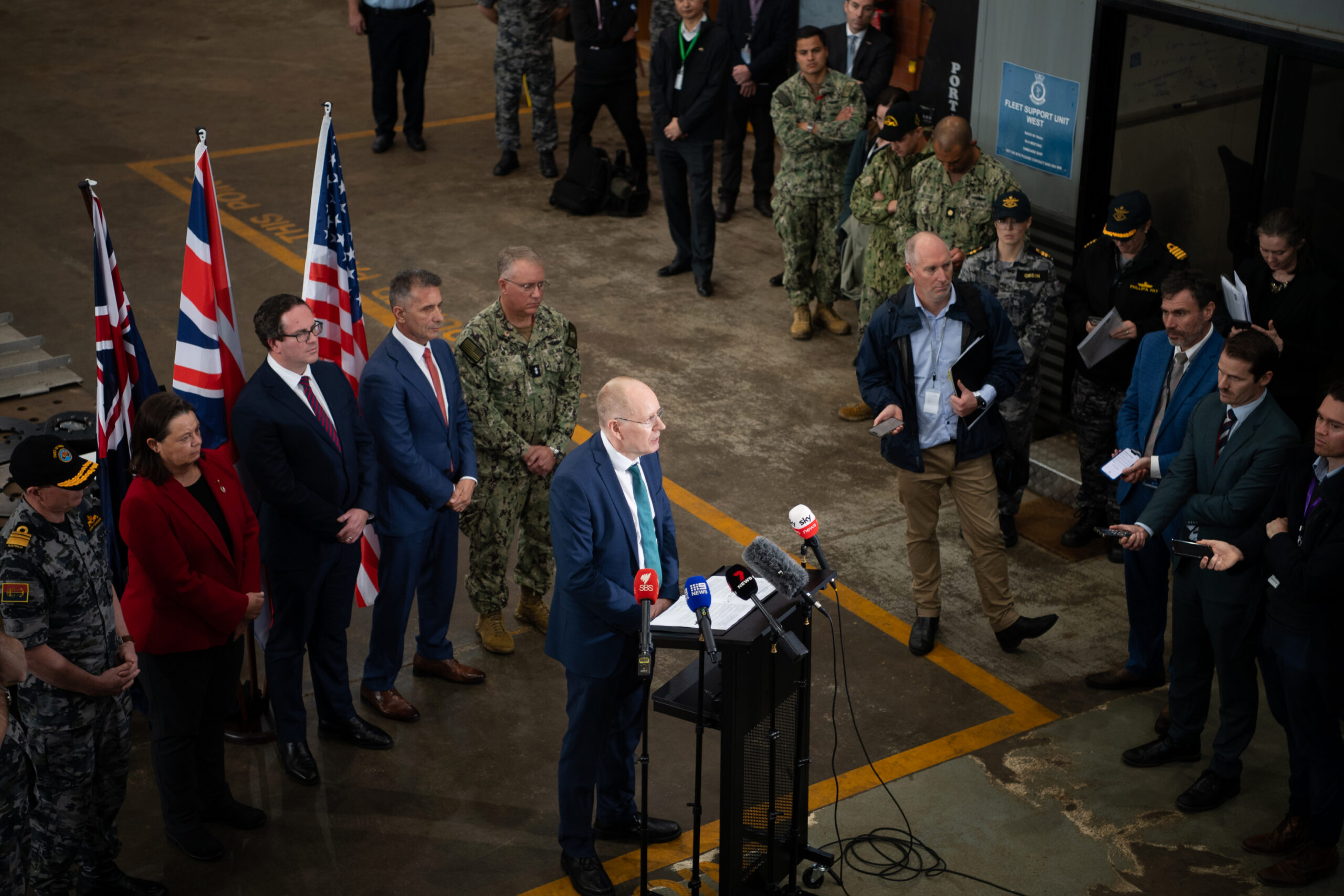
Photo: U.S. Navy Photo by Mass Communication Specialist 1st Class Vanessa White, CC0