President Tokayev’s call to “freeze” the war came not from Kyiv or Brussels but from inside Russia’s own security architecture. If other CSTO and EAEU members follow his lead, Moscow’s grip on its closest allies may prove more precarious than it looks.
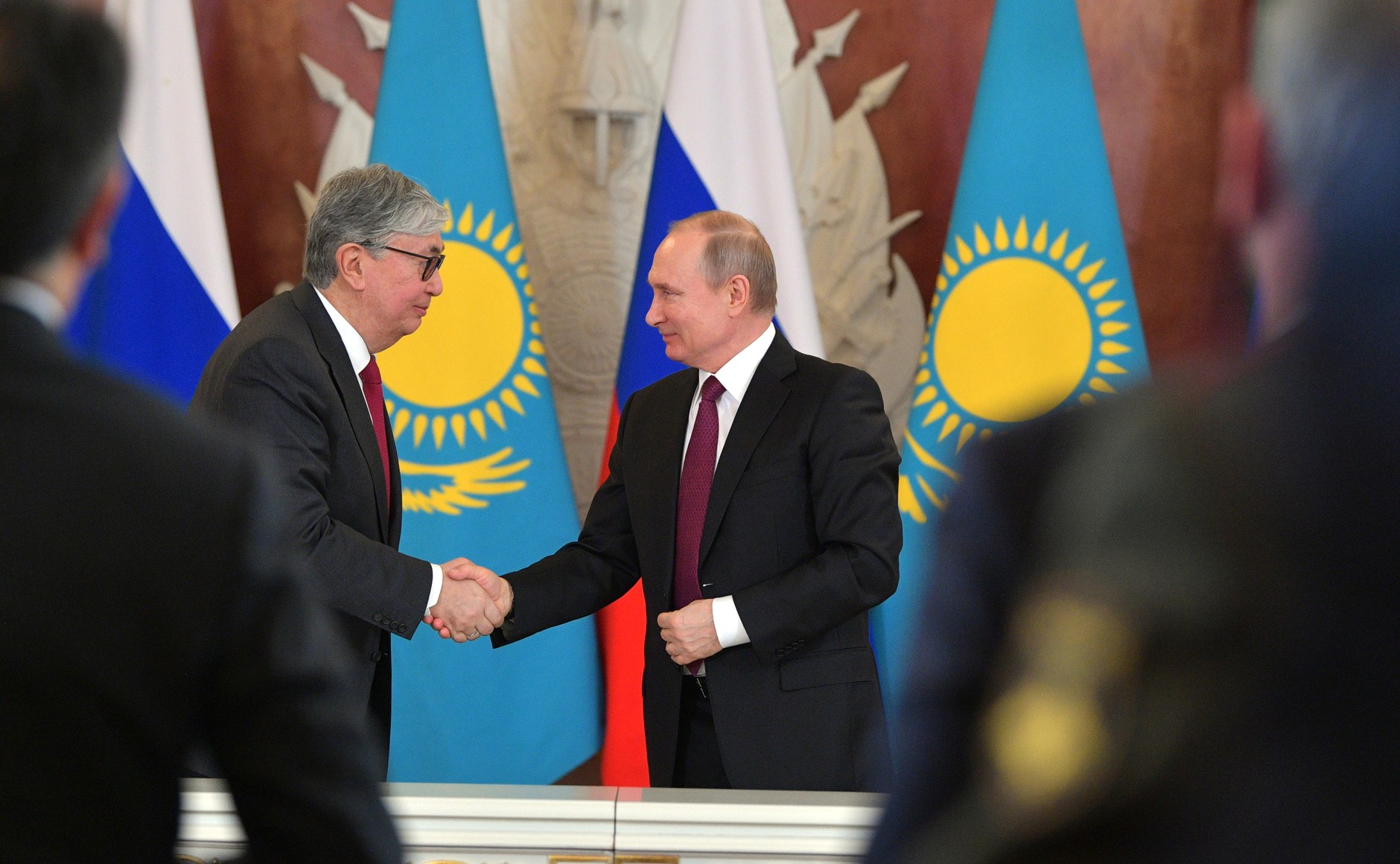
At a meeting in Omsk last month, one of Russia’s closest allies, Kazakhstan’s President Kassym-Jomart Tokayev, offered some advice to Vladimir Putin, telling the Russian President he was better off to “freeze” the war in Ukraine.
The Kazakh president is known for making bold public statements when discussing Russia’s war in Ukraine with President Putin. In 2022, at the St. Petersburg International Economic Forum, Tokayev said, in Putin’s presence, that Kazakhstan does not recognise the “quasi-state formations” of Luhansk and Donetsk. It was a rare moment, given that while post-Soviet states have never recognised these regions, they have generally avoided making direct public statements or criticism about the war, especially alongside Putin on an international stage.
This time, however, Tokayev went further, saying “the nature of this conflict is not entirely clear to many, including us”. Although calls for peace and an end to hostilities are not new, this one comes from one of Russia’s closest allies.
Small State Influences
Kazakhstan might be a small country compared with Russia, and therefore seemingly unlikely to influence Russian policy. However, as a member of the Russia-led Collective Security Treaty Organisation (CSTO), the Eurasian Economic Union (EAEU), and other regional organisations that Russia either leads or strongly supports, including the Commonwealth of Independent States (CIS) and the Shanghai Cooperation Organisation (SCO), Tokayev’s statements carry weight.
The comments come at a time when Russia is facing growing domestic economic pressures, continued sanctions, and ongoing Ukrainian attacks on Russian oil infrastructure. Other countries within Russia’s close orbit have never been enthusiastic about the war or its continuation. Tokayev’s comments may now provide some diplomatic space for them to express similar concerns more openly.
Countries in Central Asia and the South Caucasus, especially those that share the resources of the Caspian Sea, worry about the potential expansion of the war into the region following Ukraine’s reported attack last month on an Iranian cargo ship in the Caspian Sea. As the world’s largest inland body of water, the Caspian Sea contains petroleum and natural gas reserves that are central to the region’s economy. Three of the five Caspian littoral states are post-Soviet states that are considered part of Russia’s “Near Abroad”. While some of these states, such as Turkmenistan, pursue a policy of neutrality in their foreign policy, others, including Kazakhstan, remain heavily reliant on Russia because of their security and economic ties. Azerbaijan, on the other hand, has taken a much more outspoken approach towards Russia. Following the Azerbaijan Airlines plane crash in December 2024, President Aliev’s discourse continued to emphasise the narrative of calling on Russia to take responsibility – something that many post-Soviet states in the region have usually been reluctant to do whenever tensions have arisen. But Azerbaijan’s consistent official stance on this matter eventually led Putin to publicly admit responsibility almost a year later, in October 2025, during his meeting with President Aliev of Azerbaijan.
Great Power Asymmetry
But does the stance of so-called smaller states really matter when dealing with great powers? The answer is not straightforward and may depend on the relationship between the smaller and bigger states. Referring to the power asymmetry between great powers and smaller states, Long (2017) argued that “Through the lens of asymmetry, a relationship may be overwhelmingly asymmetrical in military terms, but less so economically, diplomatically or institutionally”. Smaller states may not fundamentally alter the behaviour of great powers or determine the outcome of major wars, but in particular geopolitical cases, depending on the relationship between the states, they can significantly influence how great powers pursue their foreign policy.
While this call to “freeze” the war from a small state, might not make any difference to the actual course of the war, it can affect Russia’s foreign policy and its sphere of influence if other allies within the CSTO or EAEU begin making similar calls. Armenia, another important ally that was once a key member of the Russia-led security alliance, froze its participation in the CSTO in 2024. It could therefore become a concern for Russia if Kazakhstan or other members were to follow a similar path.
Small states may not determine the course of international politics, but under certain geopolitical conditions, they can exercise meaningful diplomatic leverage. The Central Asian states have been important for Russia in UN General Assembly voting on resolutions condemning Russian aggression against Ukraine. While some states abstained from voting on multiple UN resolutions concerning Russia, on other occasions they simply chose not to vote. These states have tried to strike a careful balance, given their geopolitical realities of bordering Russia, having hundreds of thousands, if not millions, of migrant workers in Russia, and being members of Russia-led security and economic institutions.
The Central Asian region, together with parts of the South Caucasus, remains one of the few regions where Russia continues to exercise strong political, economic and security influence. It would therefore not be in Russia’s geopolitical interest to allow that influence to weaken. For this reason, Moscow is likely to care greatly about what states in its so-called “Near Abroad” think and, more importantly, how they act.
Dr Dilnoza Ubaydullaeva is a Lecturer at the ANU National Security College (NSC). Prior to joining NSC, she was a Lecturer in Government at Flinders University and an Honorary Research Fellow at the ANU Centre for Arab and Islamic Studies (Middle East and Central Asia). Dilnoza’s research interests include securitisation theory, the geopolitics of Central Eurasia, radicalisation, Russian foreign policy in Central Asia and the nexus of security and policymaking.
This article is published under Creative Commons License and may be republished with attribution.