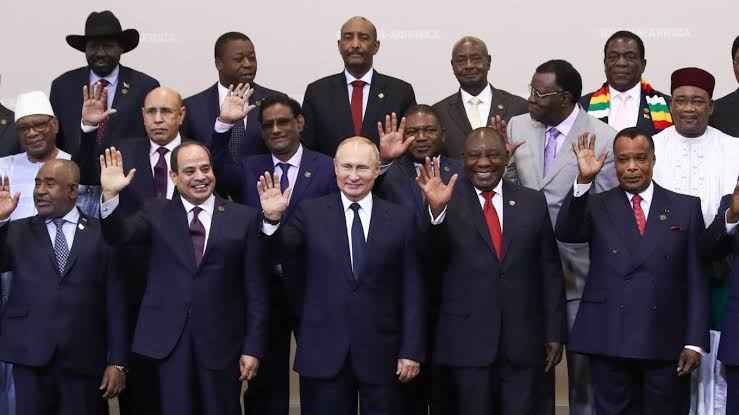
In July 2023, at the second Russia-Africa Summit, held in St. Petersburg, the event was predominantly seen as a reflection of geopolitical manoeuvring, with Russia advancing multipolarity and positioning itself as an alternative to the West, appealing to non-aligned sentiments. However, the reality is different: Russia’s engagement in Africa arises from economic, domestic, and demographic considerations.
Russia is deploying a significant proportion of its workforce on the Ukrainian front, losing skilled labour due to emigration, restricted by a framework of unparalleled sanctions and being isolated from the technology and capital of the West. The African Continent can be a gateway to Russia, offering access to labour networks, essential mineral resources, unexplored markets, food security alliances, and an expanding coalition of pro-Russia voices on the global stage. The notion that Russian security assistance leads to lasting political allegiance fundamentally misinterprets the transactional acumen with which African governments manoeuvre within the great-power rivalry.
The sanctions imposed by Western Countries have disconnected Russia from essential banking systems and advanced technology. In contrast, oil revenues redirected through discounted agreements with Asian purchasers can no longer yield profits as they did earlier. Moscow has abundant resources, but it is still hindered by institutional limitations, leaving it with significant hard-power capabilities and fewer economic alternatives. Also, the demographic collapse in Russia is not a recent phenomenon; the Ukrainian conflict has significantly accelerated its effects. Moscow’s working-age population has experienced a structural decline for more than 20 years. The conflict with Ukraine further extends the situation, which resulted in the battlefield casualties estimated in the hundreds of thousands, a substantial emigration of educated, working-age Russians and a reallocation of labour to the defence industries, ultimately leading to severe shortages in construction, services and agriculture.
Africa as Russia’s Strategic Frontier
The African Continent’s strategic importance to Russia encompasses several interconnected realms. The primary aspect is diplomatic: among the 54 member nations of the UN, Africa represents the largest voting bloc in global multilateral organisations. Africa is expected to comprise more than one-quarter of the world’s population by mid-century, with a median age that sharply contrasts with Russia’s ageing workforce. The nation-state, which is experiencing high labour shortages, has organised migratory partnerships through educational exchanges, vocational training frameworks, and bilateral labour agreements, thereby representing a significant medium-term strategic resource. To broaden academic engagement between Africa and Russia, Moscow has significantly expanded scholarship initiatives for African students in medical, technical, and engineering fields, fostering professional networks that may facilitate future economic ties.
Africa’s mineral deposits play a pivotal role in global resource assessment. In this continent, there is a significant abundance of essential minerals, including manganese, lithium, uranium, cobalt, and various platinum-group metals. These resources play a crucial role in various industrial applications and are vital to technological and energy advancements. These minerals will also support industrial processes and help develop technology-based energy sources. Due to their importance in mapping the world’s natural mineral resources, they will play an important role in shaping the world’s future technological and energy revolution.
Although over 33% of Africa’s mineral exports flow to the European Union and less than 1% to Russia, Moscow has strategically pursued a security-for-resources exchange model, deploying Wagner/Africa Corps mercenaries in Mali, Niger, Sudan, and the Central African Republic to secure gold, uranium, and lithium concessions. At the same time, Rosatom has signed nuclear and mineral cooperation agreements with over 20 African nations, positioning Russia as a disruptive geopolitical actor seeking access to resources beyond Western-dominated supply chains.
Russia recognises that the strategic significance is not limited to access to these resources, but also involves their extraction, processing, and export to maintain its influence over global supply chains at a time when Western entities are striving to lessen reliance on the rare-earth networks controlled by China. Moscow’s ‘grain diplomacy’ strengthened this stance, as the dissolution of the Black Sea Grain Initiative turned Moscow’s influence over African food security into a more overtly political tool. With the provisions of concessional grain agreements to Ethiopia, Egypt, and several Sahelian nation-states, Russia has ingrained itself in food security frameworks that countries on the African continent find difficult to extricate themselves from, given bilateral political affiliations.
Limitations
What Moscow has to offer in terms of policy on Africa exposes its structural flaws rather than strong proposals. Financially, Russia is unable to match the investment portfolio-building of the Gulf states or the EU’s Global Gateway, which significantly restricts its investment options on the continent in large‑scale infrastructure and/or development projects. As a result, and to attract its audience, Russian involvement emphasises security assistance and arms sales, with security provision acting as a substitute for, rather than a complement to, sustainable financial mechanisms, and the lack of similar financial tools in its Africa policy.
The African agenda is also driven by Moscow’s ambition to gain access to natural resources by securing military guarantees from fragile regimes, which is a fragile strategy since the future of some of these regimes, including those in Sudan and Mali, hangs in the balance due to continuing civil war and insurgency. African governments still have a great deal of room to manoeuvre, however, since they can use Russian security assistance, Western and Chinese economic deals and Gulf financing, and do so in a very transactional way that can make it hard to figure out who is getting the benefits.
Egypt, a key Arab and African power and one of the biggest importers of wheat in the world, has been successfully negotiating grain and potentially “grain and energy hub” deals with Russia, but has also been pursuing closer ties with Western nations and Gulf investors, including in nuclear power and infrastructure, and a formally nonaligned position on the Ukraine war that promotes dialogue and hedging rather than alignment with either side. South Africa reaps the political and economic benefits of being a member of the BRICS, but is not overly careful in managing its trade relations with Western countries. Ethiopia also selectively engages with Moscow and has good relations with the Gulf nations, China and the West.
In contrast to passive nation-states, these states are independent, conducting transactions with multiple external parties to strategically manage their relationships. But these are basic shortcomings and are accentuated by reputational risks. The military involvement of Russia has been linked to the human rights abuses in many regions, channelling opposition from African civil society, which ultimately makes it difficult for the African governments that are relatively sensitive to domestic opinion to maintain political partnerships in the security sector. Hence, the wider population of the African continent, albeit doubtful of the Western double standards, does not consistently endorse the narratives set by Russia, especially when the soldiers of Russia are viewed as facilitating authoritarian consolidation at the expense of civilians.
Conclusion
The major variables, such as the cohesion of the sanctions architecture, competitive responses of China, the European Union, Turkey and the Gulf, the governance trajectories of African states and the duration and outcome of the conflict in Ukraine, should be taken into consideration by Russia to determine whether or not Moscow’s Africa strategy will be economically sustainable over the next decade.
The predominant security-for-resources framework marking Moscow’s involvement is, although strategically successful, financially insufficient for a sustainable economic partnership and institutionally insufficient. The African continent is of great significance to Russia’s long-term economic strategy.
There are, however, real limitations on Russia’s ability to fulfil its obligations under the partnership. African nation-states are neither clients of Russia nor the default friends of the West; rather, they are sovereign actors seeking the best possible options in an increasingly competitive multipolar environment. Since the African continent is constantly evolving and shifting, any framework that reduces the continent to a chessboard for external powers will systematically misread one of the most consequential strategic dynamics of the coming decade.
Akshan Ranjan is a PhD research scholar at the Centre for African Studies, School of International Studies, Jawaharlal Nehru University, New Delhi.
Ravi Raj is a PhD Research Scholar at the Centre for Russian and Central Asian Studies, Jawaharlal Nehru University, New Delhi and works at the India Eurasia Integration Forum.
This article is published under a Creative Commons License and may be republished with attribution.