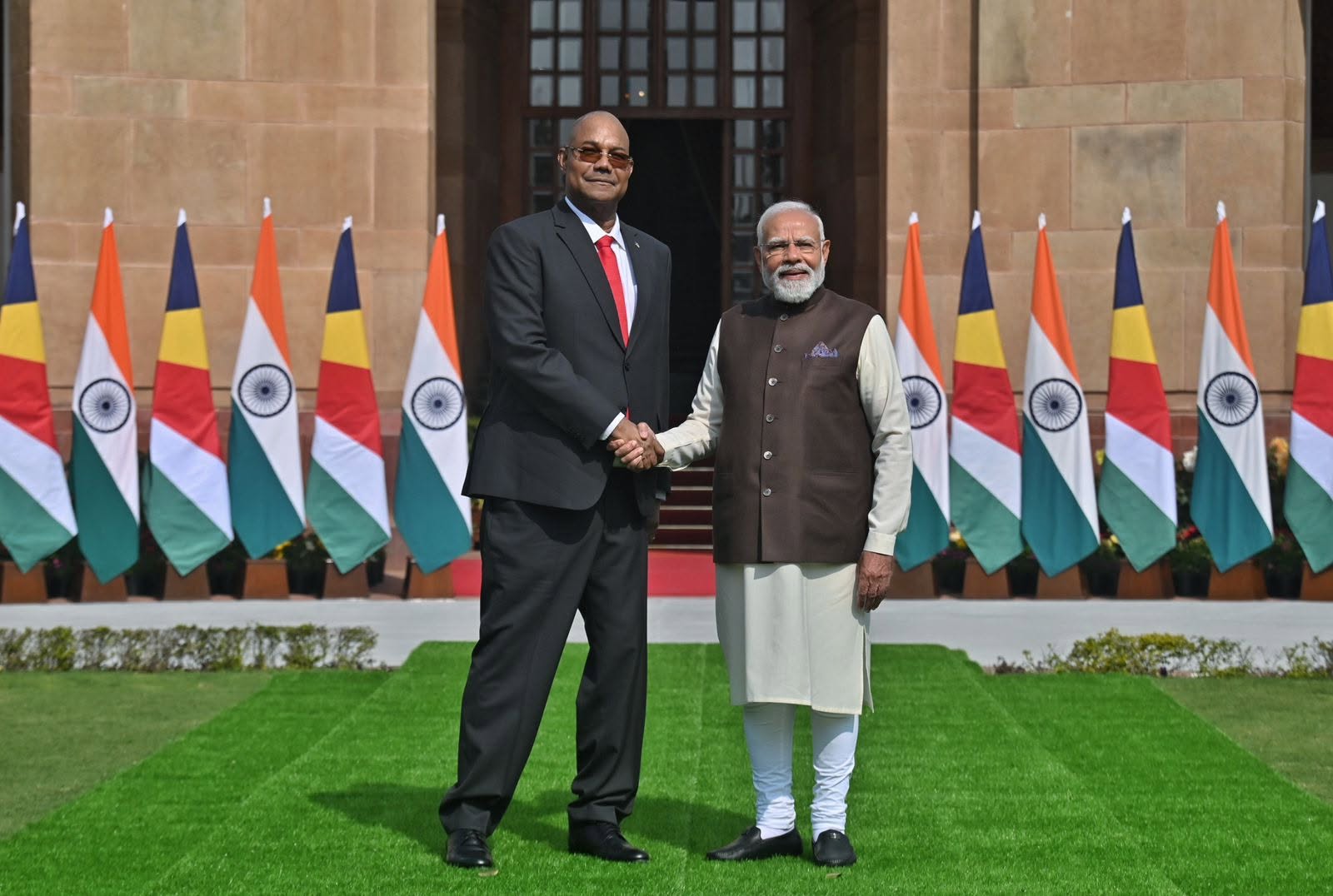
Small island nations have gained renewed strategic attention in Indo-Pacific geopolitics. The 50 years of the establishment of diplomatic relations between India and Seychelles coincided with the recent maiden State visit of the new Seychellean President, Patrick Herminie, to India, and reflected the intensifying maritime competition in the Western Indian Ocean.
It also signalled Seychelles growing role in India’s Mutual and Holistic Advancement for Security and Growth Across Regions (MAHASAGAR) vision through the announcement of a joint vision for SESEL and a Special Economic Package of $175 million to advance maritime security and sustainable development. Alongside the commemoration of five decades of ties, converging interests in maritime security, developmental partnerships, and climate resilience reflect the contours of India’s island diplomacy with Seychelles.
Maritime Security
Seychelles has an Exclusive Economic Zone (EEZ) larger than its landmass, making it vulnerable to Somali pirate attacks. Developing maritime surveillance and counter-piracy laws is no longer a matter of domestic politics but of national interest. Seychelles responded with protection through resourcefulness. The establishment of a Supreme Court enabled the prosecution of suspected pirates, making it the first among the small island nations to do so.
Mechanisms such as Regional Fusion and the Law Enforcement Centre for Safety and Security at Sea ensure a coordinated, efficient and effective response to maritime threats. Evidently, Seychelles became a regional stakeholder in maritime law enforcement. Yet for an island nation with a population of 100,000, domestic capacity has a ceiling. In practice, without multilateral engagement involving larger regional partners, the piracy threat cannot be curbed – and that is where India’s strategic position in the region becomes consequential.
In response, the Indian Navy has maintained a continuous mission-based deployment in the Gulf of Aden, in a joint effort with anti-piracy escorts along international transit corridors. It further strengthens India’s operational reach, securing the Sea Lanes of Communication (SLOCs) as a net security provider. Consequently, India has developed its Information Fusion Centre-Indian Ocean Region initiative to better understand, improve, and share real-time maritime information, thus building reliability among partner countries.
Strategically, the naval interoperability between India and Seychelles is enhanced through initiatives that help address challenges to maritime governance, thus building a cooperative security architecture. The patrol vessels, Dornier aircraft, and training of naval personnel of the Republic of Seychelles institutionalise mutual trust without reliance on formal alliances. Maritime security alone cannot sustain the geopolitics, thus making a reliable developmental partnership inevitable.
Developmental Partnership
Seychelles, due to its proximity to major SLOCs, faces a double-edged threat: its geopolitical visibility doesn’t reflect its economic strength. Within the maritime security architecture, SIDS like Seychelles are caught between geopolitical power tussles due to their dependence on foreign investment for overall development amid the imminent threat of rising sea levels. This positions sustainable development and economic resilience as a national interest. However, to maximise developmental gains, diversification of partners is necessary.
India’s regional presence captures Seychelles attention for a reliable development partner capable of providing technical and human resource support. Institutional collaboration with India helps in recognising the necessary areas for the development of Seychelles, underscoring the contours of India’s MAHASAGAR. Such coordination, along with small, in-demand and focused projects like the installation of a one-megawatt solar plant, helps locals by uplifting their livelihoods. Boosting Seychelles trust and reliability also facilitates India’s strategic presence on the island amid China’s expansionist infrastructure diplomacy in the Indian Ocean Region.
Although China offers rapid development to Seychelles, driven by centralised financing, it is often linked to state-owned enterprises, with little to no local company involvement, creating a dependency and strategic leverage for China. Here, Seychelles needs an alternative. India’s partner-oriented approach to strengthening local institutions and human resources under South-South cooperation provides Seychelles with independence over time, which China avoids. Despite such tensions, Seychelles adopts the principle of a ‘small state agency’ to institute measures that maximise development by diversifying external support alongside preserving its own national interests. The development will only matter if the island adapts to climate change.
Climate-Resilience
Climate change is not distant but a nearing reality for island nations like Seychelles, disrupting their coastal communities. The record rainfall in Mahé in 2023 exemplified the disruptions affecting the fishing boats, trade and tourism at the Port of Victoria. The Seychellean government acknowledged climate vulnerability and adopted the National Climate Change Strategy. Initiatives like the Sovereign Blue Bond and the Seychelles Conservation and Climate Adaptation Trust focused only on providing financial support and marine governance. But such initiatives have remained siloed. The gap lies in bridging them with institutional coordination and the capacity to build, implement, and sustain climate action. Addressing these constraints requires external cooperation, thereby positioning India’s engagement as pivotal.
For Seychelles, seaports operate as a vital lifeline. India’s flagship initiative, Infrastructure for Resilient Island States under the Coalition for Disaster Resilient Infrastructure, will identify vulnerable port-level facilities through maritime risk assessments scheduled within 2025-2027. The objective is to provide guidance on early warning systems and flood defence mechanisms for Seychelles to prepare proactively for future calamities. Through its resources, India enhances the resilience of Seychelles ports, safeguarding critical infrastructure. India’s MAHASAGAR vision emphasises South-South cooperation through knowledge exchange and partnerships with Seychelles, rather than providing development aid.
There has been domestic friction in Seychelles regarding the Assumption Islands – whether sovereignty is compromised by the joint agreement allowing both nations to build and operate a coast guard facility. India has moved beyond the controversy. India’s island diplomacy is evolving based on partnership, while institutionalising cooperation in maintaining a rules-based maritime order. India has acted as a net security partner through its island diplomacy, providing maritime security and engaging in climate resilience action, which has strengthened India’s emergence as a preferred partner for climate-vulnerable island nations such as Seychelles. Ultimately, India is balancing its strategic interests with local legitimacy by accelerating support for the growth of the blue economy and for Seychelles security.
Ipsa Sahu is a PhD Fellow at the Jindal School of International Affairs, O.P. Jindal Global University, New Delhi, India and an ICSSR Doctoral Fellowship recipient (2024-2026). Her research focuses on maritime security and India’s diplomacy in the Indo-Pacific region.
This article is published under Creative Commons License and may be republished with attribution.