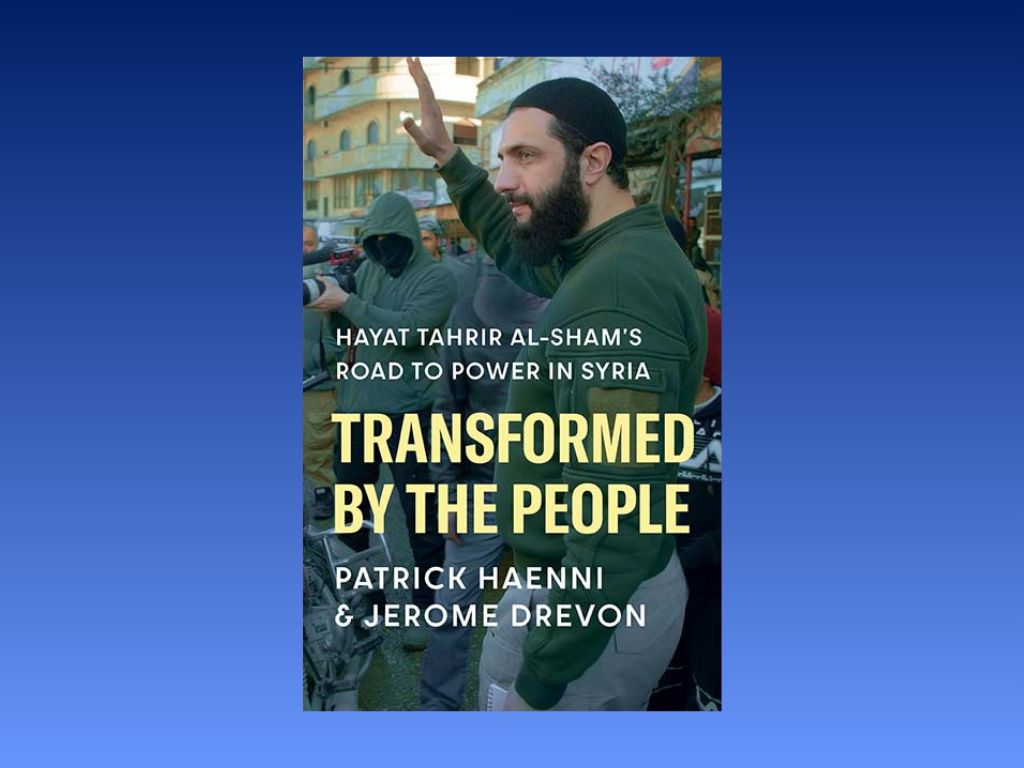
In Transformed by the People, Patrick Haenni and Jerome Drevon outline the emergence, development, deradicalisation and ultimate victory of Hay’at Tahrir al-Sham over the Assad regime of Syria, in December 2024. While no transferable blueprint for the deradicalisation of similar groups, HTS’ evolution is pivotal in understanding the new Syria.
On 30 March 2026, Syria’s interim president, Ahmed al-Sharaa (previously known by his nom de guerre, Abu Muhammad al-Jolani), arrived in Berlin for an official state visit with German chancellor Friedrich Merz, after their previous meeting, scheduled for January 2026, had been cancelled due to unrest in northern Syria. Previously, and less than one year after wresting power from the Assad regime, al-Sharaa became the first Syrian leader to visit the White House in Washington, D.C., in November 2025, as the West attempted to formulate a coherent assessment of the terrorist-turned-statesman. Already in May 2025, al-Sharaa had met with French President Emmanuel Macron in Paris. The underlying question among policymakers before, during, and after these meetings has been how ought the international community view Syria’s new government and leader?
To understand this new regime, a comprehension of al-Sharaa’s group, Hay’at Tahrir al-Sham (HTS), is necessary to grasp how a hitherto al-Qaeda and Islamic State-aligned organisation could be seen by many as the supposed agent for change in a post-Assad Syria. In Transformed by the People, Patrick Haenni and Jerome Drevon extrapolate on several years of fieldwork in Syria, and numerous interviews, to outline how a terrorist group was able to morph into a purportedly pragmatic government. However, herein the authors seek not an analysis of HTS in its contemporary form, but rather to understand the mechanisms by which it transformed in the first place. Notably, they caution against utilising the HTS case as a blueprint for understanding how other erstwhile jihadi groups might pursue deradicalisation. This is because HTS’ deradicalisation was fairly unique and the cumulative product of several dynamics.
A Product of Their Environment: Strong Local Norms and Governance Realities
The authors argue that HTS’ path toward deradicalisation was fundamentally shaped by its “relocalisation” around Idlib, which sensitised the group to that local environment and gradually moved it away from an ideology rooted in global jihadism. Here, the authors argue that the group was confronted by the so-called “inertia of the social” phenomenon, wherein the persistence of the local populace and their core beliefs and values essentially pressured HTS into adapting and conforming thereto. While the beliefs and values of the inhabitants in and around Idlib might be understood as Islamically conservative, they were not Islamist or jihadi. To this reality HTS had to conform, which it was ostensibly able to do because of its aversion to formulating written doctrinal edicts, granting it greater normative flexibility, in comparison to other jihadi groups. By placing the inertia of the social into the centre of HTS’ deradicalisation process, Haenni and Drevon shine a light on the agency of local populations, which are not mere subjects to the rule of governments or groups, but by various means shape developments on the ground. This assertion of the authors clearly undergirds their selection of the book’s title.
Related thereto is the concept of a “Thermidorian moment,” originally observed and conceptualised in the context of the French Revolution. According to this concept, revolutionary movements can adapt to the realities of their environment, as well as the realities of governing, once their initial objective of attaining authority is achieved and political trade-offs are required, while they do not necessarily depart from the ideological motivations they espouse. Strikingly, Haenni and Drevon propose an intriguing parallel between HTS and contemporary European far-right parties when the latter attain governing mandates. That is, these parties typically begin from a more radical and ideologically rigid starting point, but sometimes can become more moderate as they draw closer to the prospect of forming government, not least due to the effects of the inertia of the social and the Thermidorian moment. They propose that these phenomena are somewhat akin to HTS’ development, which appears especially intriguing to readers with an understanding of contemporary European political developments.
Final Remarks
From a historical perspective, the most striking proposition of this book is one that could easily be missed, namely Haenni and Drevon’s account of the emergence of HTS’ precursor organisation, Jabhat al-Nusra. Contrary to most other accounts (as found in the works of Tore Hamming’s Jihadi Politics or Charles R. Lister’s The Syrian Jihad, for instance), Haenni and Drevon argue that “[…] from the beginning al-Sharaa – not ISI [the Islamic State of Iraq], let alone al-Qaeda – initiated the formation of Jabhat al-Nusra.” This well-argued and substantiated assessment of Jabhat al-Nusra’s origins is an intriguing caveat when considering the subsequent fissure between al-Qaeda and the so-called Islamic State, though it should also be understood alongside more commonly proposed accounts of Jabhat al-Nusra’s formation.
Overall, Transformed by the People is an exceedingly well-written and substantiative work, and undoubtedly constitutes mandatory reading for anyone who wishes to understand the group that presently governs Syria, or at least its origins and the process of its deradicalisation. However, it is worth stating that the book does seemingly assume some pre-existing understanding of Syria, the global jihadi movement, as well as key actors of the latter, on the part of its readers.
This is a review of Patrick Haenni and Jerome Drevon‘s Transformed by the People: Hayat Tahrir al-Sham’s Road to Power in Syria. Hurst Publishers, 2025. ISBN: 9781805264101
Jasper Hufschmidt Morse is a postgraduate student of War and Conflict Studies at the University of Potsdam, Germany. He previously attained a Bachelor of International Security Studies, with a Major in Middle East and Central Asian Studies, from the Australian National University, in Canberra.
This article is published under a Creative Commons License and may be republished with attribution.