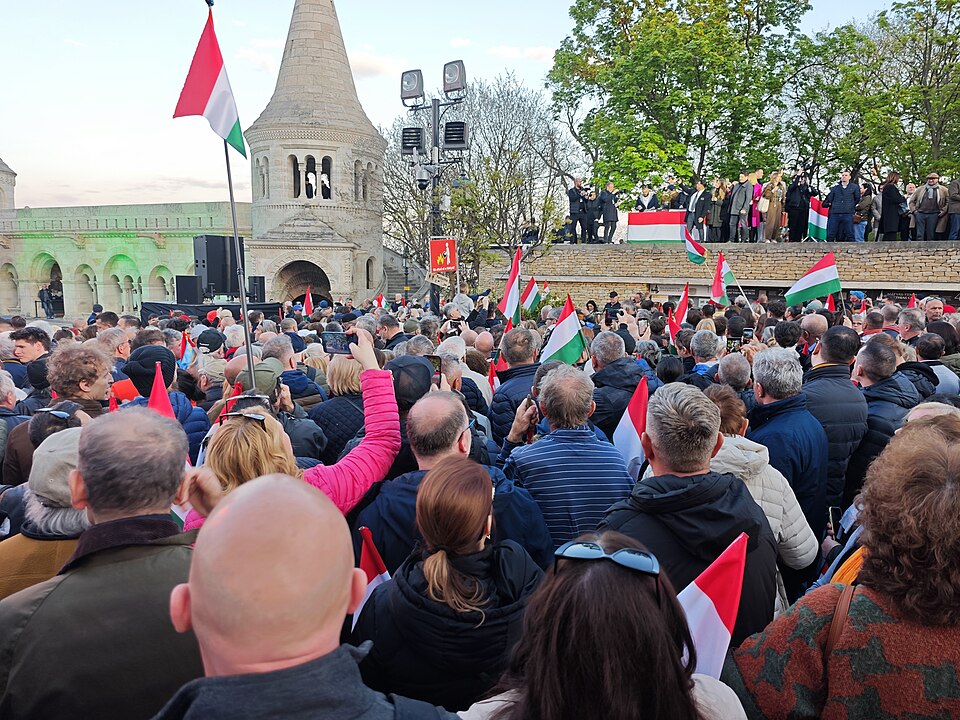
Following Tisza’s victory over Viktor Orbán’s ruling Fidesz party in Sunday’s election, the opposition faces an uphill battle in trying to restore Hungary’s democracy. Tisza leader Péter Magyar has much to learn from Polish Prime Minister Donald Tusk, especially the importance of experimenting with bold solutions.
WARSAW—After 16 years of illiberal rule under Viktor Orbán, the Hungarian people have voted the main opposition party, Tisza, into power, marking a turning point for the country. But make no mistake: Tisza leader Péter Magyar now faces formidable challenges in trying to restore democratic norms.
Magyar has much to learn from Polish Prime Minister Donald Tusk, who returned to office in 2023 after eight years of populist rule under the Law and Justice (PiS) party. Despite moving quickly to stop public media from spewing propaganda, unlock €137 billion ($160 billion) in frozen European Union funds through rule-of-law reforms, and strengthen economic growth, Tusk’s government has battled low approval ratings.
The democratic successors to far-right populists are, sad to say, almost condemned to disappoint, given the high hopes their victories engendered. But dissatisfaction with Tusk’s government mainly reflects the many ways PiS warped and weaponized state institutions—a problem that Magyar also faces in Hungary. In both countries, systemic change requires a parliamentary supermajority, a cooperative president, and an independent constitutional court.
Through no fault of his own, Tusk has not been able to meet any of these conditions. Magyar, however, has managed to secure a constitutional majority, putting him in a position to be able to rebuild the system from the ground up. But illiberalism is far more entrenched in Hungary than it was in Poland. Therefore, the rebuilding process will take time, and voters’ expectations will have to be met sooner.
Magyar’s first step must be unlocking the EU funds that were frozen over Orbán’s rule-of-law violations. But that money, while necessary, may provide fodder for criticism of the new government: some morsel will go to a project—say, benefiting minorities—that Orbán’s minions can blow out of proportion. In Poland, it initially sparked a scandal and public outrage, and the government didn’t see a boost in the polls until people began to feel the tangible benefits.
In both Hungary and Poland, restoring the old legal order is not as simple as retracing the far right’s steps. Few uncorrupted personnel remain in the judiciary, and an illiberal president or high court can block the appointment of new judges. The PiS-aligned Polish president, Karol Nawrocki, has refused to appoint 46 judges and left 88 ambassadorships vacant since taking office.
Such structural barriers delay reforms, inviting scrutiny. Liberal voters often point out every misstep. Once the mainstream media regains its independence, it will condemn every mistake made by the new government, because that is its role (the disappointment may be mutual). This paves the way for cynics to proclaim that the new rulers are just like the old ones. Many people who voted for the pro-democracy party may sit out the next election.
In Poland, rising anti-establishment sentiment, coupled with growing tolerance for a strong leader and an increasingly transactional attitude to the EU, led to Nawrocki’s election only two years after Tusk’s triumphant return. A similar type of alienation could take hold in Hungary.
After years of Orbán’s corrupt rule, the public will expect Magyar to hold him and his allies accountable. In a Polish poll conducted a year after Tusk’s victory, two-thirds of respondents (including one in three PiS voters) said that some officials from the previous administration deserve imprisonment. Instead, they have faced no legal reckoning.
But, as Poland shows, when the previous administration has written many of the laws, and the new pro-democracy government is expected to prove its rule-of-law credentials at every turn, efforts to bring far-right actors to justice can flounder. Moreover, the abuse of the presidential pardon can end the pursuit of justice with the stroke of a pen, as US President Donald Trump has amply demonstrated. Alternatively, a corrupt minister can simply flee, as Poland’s former Justice Minister Zbigniew Ziobro has done (although, having been granted political asylum in Hungary, he is presumably looking for a new place to settle).
Given all this, the most valuable lesson for Hungary is that there is no quick fix for the system. Even Orbán needed a year to rewrite the constitution—the Fundamental Law was adopted in 2011—and as a populist, he didn’t have to follow all the rules. Magyar should have a plan to make Hungarians aware of this, and fast. Moreover, he should be willing to experiment with bold solutions before the health of democratic institutions is fully restored. Tusk thought that, if his party’s candidate won the presidential election, he could avoid this route. Instead, he ended up wasting two years.
Another sector in need of quick reform is public media. The Tusk government’s approach to public media is a good example of what can be done. Knowing that it needed the president’s help to depoliticize public broadcasters and would not get it, the Tusk government simply took the worst offender, TVP Info, off the air, dismissed its management, and placed it, as well as Polish Radio and the Polish Press Agency, into liquidation—a crude but effective strategy.
The Tusk government has used other workarounds. Recently, parliament elected six new judges to the Constitutional Tribunal, but Nawrocki, in a bid to sow discord and influence the Tribunal’s composition, invited only two of them to the presidential palace for the swearing-in oath (a purely ceremonial procedure). In response, the remaining four judges took their oath before parliament, bypassing the president.
While this move has effectively restored the Tribunal’s ability to function, the new judges may need to enter office under police protection, because the chief justice served as a senior prosecutor under the former PiS government and is an ally of the exiled Ziobro. When the rot runs so deep, only a daring administration that makes the stakes—and time frames—clear has a chance of success.
In sum, a national resurgence is possible once in a generation, not once in a term of office, and the window of opportunity won’t remain open indefinitely. Keep your promises modest. Don’t wait for more power or the full restoration of liberal democracy to act. Instead, move quickly and, where legally possible, don’t hesitate to use extraordinary measures. Focus on a few spectacular projects related to dignity, because in Eastern Europe, that is still the main currency in politics.
Sławomir Sierakowski is President of the Program Board, ImpactCEE, Krytyka Polityczna/Political Critique, and a Senior Fellow at the German Council on Foreign Relations.
This piece was originally published in Project Syndicate. It has been republished with the permission of the author.