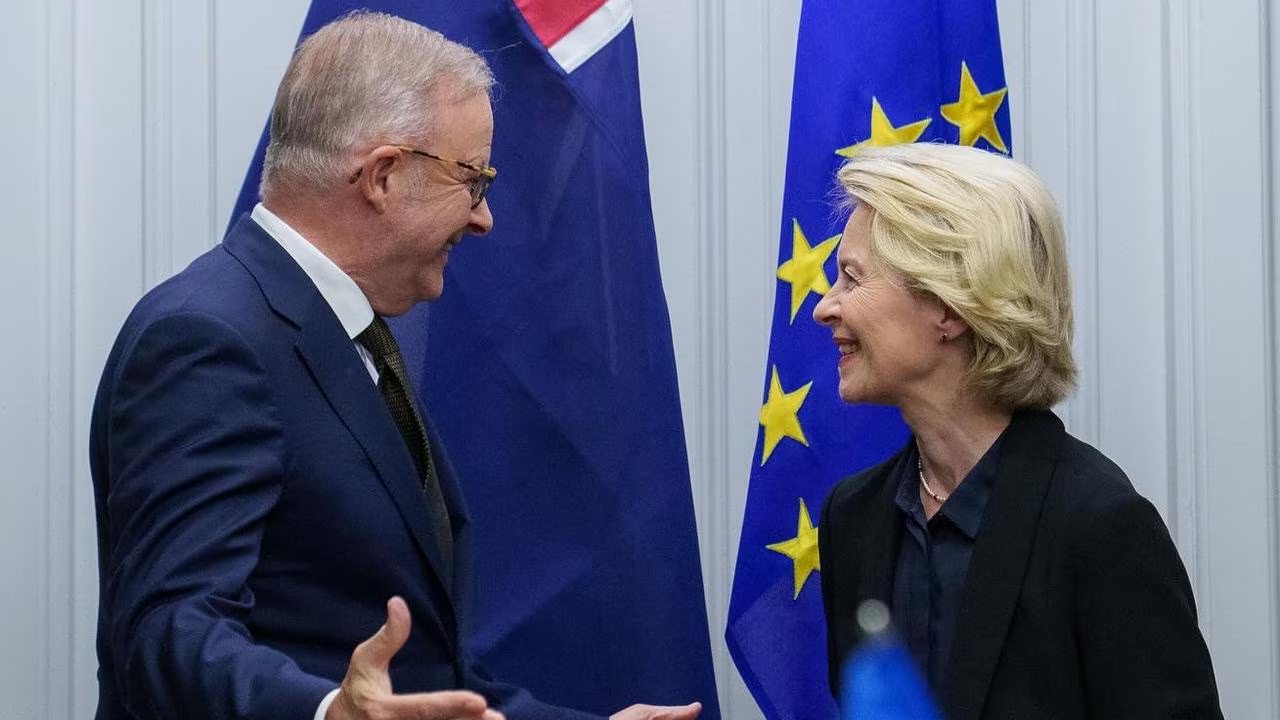
Australia and the European Union will sign a security and defence partnership to offer industry procurement opportunities and tangible economic benefits for Australia. Though non-binding, the partnership will contribute to middle-power coalition efforts and bolster regional security, upholding international law amid global rivalry and instability.
EU security partnerships are bilateral arrangements with non-EU Member States that form part of the EU Common Security and Defence Policy. These agreements are tailored to each partner and cover a broad range of security-related issues, including conflict prevention and crisis management, defence initiatives and capabilities, maritime and climate security, and the Women, Peace and Security agenda.
The EU has so far signed ten such partnerships with NATO Member States (UK, Canada, Norway, and Iceland), EU candidates and aspiring members (Albania, Moldova, and North Macedonia), and Indo-Pacific nations (Japan, South Korea, and India).
In March 2026, the EU High Representative for Foreign Affairs and Security Policy, Kaja Kallas, announced the conclusion of partnerships with Ghana (signalling expansion of these partnerships to Africa) and Australia.
A Security and Defence Partnership (SDP) would be part of a broader cooperation framework between the EU and Australia, which was formalised in the 2017 Framework Agreement and a much-anticipated free trade agreement, estimated to contribute AUD 10 billion annually to the Australian economy.
Why a Security Partnership Between the EU and Australia?
While security and defence remain primarily the responsibility of individual EU Member States, the EU complements and amplifies these national efforts through its Common Foreign and Security Policy. The EU’s strategy for security and defence is outlined in its Strategic Compass, adopted shortly after Russia’s full-scale invasion of Ukraine in 2022. The Strategic Compass treats SDPs as “indispensable” to the EU’s efforts to promote peace and security in Europe and across the world.
The EU’s interests in the Indo-Pacific, centred on its 2021 Indo-Pacific Strategy and Global Gateway initiative, are tied to the region’s importance to EU trade and supply chains, with 40 per cent of EU trade originating from the Indo-Pacific.
Links between security and trade have been amplified amid rising geopolitical tensions and competition, not only through trade spats between major economic powers but also through regional conflicts, most recently seen in the Middle East, where offensives triggered a global energy crisis. In this context, Australia is positioning itself as a reliable and like-minded partner with whom the EU shares both values and an interest in maintaining the international rules-based order.
Australia’s National Defence Strategy, which acknowledges Australia’s deteriorating strategic environment and the need for collective security in the Indo-Pacific, also emphasises Australia’s strengths as an influential middle power with enduring democratic values and a history of safeguarding international rules.
Australia views partnerships as critical to protecting Australia’s economic connection to the world and for supporting the global rules-based order. As a member of the coalition of the willing, which has been providing significant defence support to Ukraine, Australia has also recognised that European security has implications for the Indo-Pacific region and Australia’s national security.
What Are the Benefits?
The Australia-EU SDP will not be a conventional defence alliance or direct military engagement. Instead, it will support cooperation in the domains of maritime security, foreign information manipulation and interference, cyber protection, counterterrorism, and space security priorities. The EU and Australia are already investing significant efforts in these areas.
The SDP will provide a framework for cooperation in areas such as the defence industry and supply chains, complementing existing arrangements with individual EU member states and NATO.
The partnership will also provide tangible economic benefits through enhanced defence industry procurement. Australian companies will be eligible to participate in common procurements with EU Member States, supported with financial assistance from the EU’s Security Action for Europe (SAFE) instrument, in the form of loans worth up to 150 billion EUR.
Will It Be Effective?
As non-legally binding instruments, SDPs do not confer any legal obligations on the parties and can be very difficult to enforce; however, these aspects can also provide advantages.
The EU is increasingly using soft-law arrangements in its external relations with third States to circumvent the complexity of concluding traditional treaties. These shifts from ‘hard’ to ‘soft’ law can be seen in fast-developing areas, such as critical minerals, migration, energy cooperation (etc.), where flexibility and responsiveness are essential.
The relative speed at which the Australia-EU security partnership can be implemented is an obvious advantage in a rapidly changing geopolitical climate. By contrast, it took almost eight years to complete negotiations for the Australia-EU FTA, which now must be approved by qualified majority voting in the Council of Ministers and ratified by the European and Australian Parliaments to enter into force.
While soft law instruments, EU security partnerships are closely linked to hard law, in particular the EU’s SAFE regulation, which is applied in overseeing defence procurement compliance. The Australia-EU SDP could deepen the legally binding commitments outlined in Article 2 and the cooperation dialogue on foreign policy and security matters detailed in Title II of the Framework Agreement, thereby strengthening implementation of this hard-law instrument.
Supporting International Law-Based Order in the Indo-Pacific
Soft law instruments have been on the rise not only in EU external relations but also in international law. The global order in place since the end of World War II, often referred to as the ‘rules-based order’, is fundamentally changing and has been undermined by great power rivalry.
A collapse of the current rules-based order does not necessarily mean the demise of an international law-based order, which can still offer an alternative to the ‘might-is-right’ approach to international relations.
For middle powers such as Australia and many European nations, the merits of upholding an international order based on law are key to securing economic prosperity and political stability. By forming coalitions, these middle powers can effect change in building a ‘better, stronger and more just’ global order, as recently suggested by Canadian Prime Minister Mark Carney.
The Australia-EU security partnership can draw on both international relations and international law to implement a timely and flexible cooperative framework that delivers practical benefits to Australia’s and the EU’s defence and security strategies. Additionally, it also presents an opportunity for Australia to strengthen its influence and leadership in bolstering national, regional and global security.
This research is part of the Erasmus+ Programme of the European Commission: Project 101239183 – EUOzWorld – ERASMUS-JMO-2025-HEI-TECH-RSCH at the University of Canberra. The views expressed are solely those of the authors and are independent of sources providing support.
Amanda McCue is a Churchill Trust Fellow completing a Bachelor of Laws at the University of Canberra.
Dr Ivana Damjanovic is Associate Professor of Law at the University of Canberra and Jean Monnet Research Fellow at the ANU Centre for European Studies.
This article is published under a Creative Commons License and may be republished with attribution.