On Tuesday 31 March 2026, Dr Nina Markovic addressed AIIA NSW at Glover Cottages on the complex interplay between Chinese, Russian and EU influence in the Balkan region. A political scientist with a Doctorate and Master’s from the Australian National University and Bachelor’s degree with first class honours from the University of Western Australia, Dr Markovic’s talk blended academic and personal insight to reframe outdated perceptions of the Balkans as an undifferentiated region dominated by the competition of larger powers: its diverse states are balancing numerous global actors. Economic influence in the region, she noted, is rarely neutral, often carrying strategic and political implications which will exert long-lasting, unpredictable consequences for governments and the rich Balkan diaspora. Amid an unprecedented challenge to the international rules-based order, understanding global actors within the Balkans and its web of pressures, opportunity and historical legacies is of paramount importance.
Dr Markovic opened by describing her constructivist perspective, analyzing the influence in international relations of social factors, norms and identities rather than solely material power. Much of Australian and Western analysis more broadly, she argues, still leans on outdated binaries of Eastern Europe vs Western Europe, the EU vs Russia or democracy vs authoritarian influences instead of actively engaging with fluctuating social realities within nations. In reality, Western Balkan governments are increasingly pursuing multi-vector foreign policies that balance the influence of multiple global actors, often simultaneously leveraging Washington, Moscow and Beijing for strategic gain.
Why does this region matter for Australia? Dr Markovic reflected on the long historical association between the Balkans and Australia often mediated through partners like the UK and the EU. With over 60 years of diplomatic relations between Belgrade as the centre of Yugoslavia and Canberra, Australia has closely monitored the Eastern Block undergoing seismic changes. Constructing and maintaining their initial embassy has underlined Australia’s long-term diplomatic investment, and with a strong Balkan-Australian community it is more pertinent than ever to accurately interpret the region.
She acknowledged the enduring corruption that continues to plague the Western Balkans. In numerous post-communist systems, transformations have been non-linear and incredibly diverse across national borders. The region remains fragile and functions as a post-war conflict region with powerful top-down pressures. Political parties hold the primary power in decision-making in conjunction with cultural and overseas elites, influencing major foreign policy perspectives.
These perspectives are complicated by the diversity across the West Balkan nations. For Serbia in particular, military technology and defence has defined the majority of interactions with China and Russia. Many foreign actors look to Serbia to mass-produce, capitalising on its cheap labour and geopolitically-advantageous location bridging Asia, North Africa and Europe. Having acquired hypersonic military technology from China under the benefits of the China-Serbia FTA established in late 2023, the Chinese-Serbian military relationship has since strengthened significantly; even reaching a stage of national security integration to allow bi-directional exchange programs for Chinese and Serbian police officers. Major physical infrastructure projects also owe their successful completion to a synergy of Chinese foreign investment and EU supervision; an emerging blueprint touted for the future of Chinese involvement in the region.
Russia too enjoys a close relationship with the region, owning more than 50% of gas and oil. The Balkans have been viewed as a safe haven for Russians escaping the war and forced conscription, with both positive and negative consequences. Exported Russian workers and companies provide new opportunities for Balkan locals, but their commitment to lowered sanctions as opposed to the EU-wide mandate has furthered this divergence. The disintegration of relations with the second Trump administration, Dr Markovic commented, will damage democratization within the region as well as attitudes toward America.
One of Dr Markovic’s insights was her focus on external influence in the Balkans beyond tangible infrastructure and economic policy. Over the past 10 years, China has invested significantly in intellectual elites in the region, funding exchange programs with high schools and universities, establishing youth forums and exporting instruments of soft power to build bottom-up diplomatic capital within Balkan countries. In opposition to Russian and EU efforts to accumulate similar goodwill, many Chinese intellectual projects have been projected across 20-30 year timelines, planting early seeds of influence in Balkan youth and influential figures that will undoubtedly compound over time.
In discussion with the audience, Dr Markovic was able to reflect on a personal level as an Australian member of the Balkan diaspora. Asked whether she saw a tangible path forward for Balkan cooperation in the face of lingering corruption and ethnic conflicts, she underscored the resilience and adaptability of Balkan people. Diaspora communities are no longer merely legacies of past migration and refugee waves, but have rather engaged actively in economic, political and social movements that strengthen bonds between their countries of origin and their chosen destinations. She reflected that “diaspora is not peripheral”, but rather an active part of the Balkans’ geopolitical and economic fabric. Many migrants are even contributing to a form of brain gain, bringing skills, investments and global connections back to the Balkans while balancing careers across two countries.
Report by Jemma Tan, AIIA NSW intern
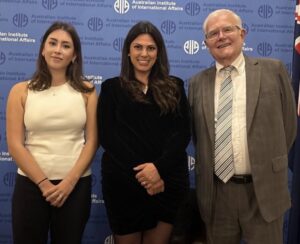
Nina Markovic (centre), AIIA NSW president Ian Lincoln (right) and Jemma Tan (left)