On 19 May 2026, Professor Shirley Scott FAIIA, Professor of International Law and International Relations at UNSW Canberra, addressed AIIA NSW on the history and uncertain future of international law. Drawing on decades of scholarship, she argued that the United States may well have now passed a tipping point in its relationship with international law, and that the consequences are probably irreversible.
Professor Scott opened with a journey through the origins of contemporary international law, tracing the ideal of an international rule of law to its roots in the peace movement of the early 19th century. She highlighted the pivotal role of American anti-war activist William Ladd, whose 1828 essay proposed a Congress of Nations to codify international law and establish a permanent court. From Ladd’s time onward, she argued, international law has always been a “rolling experiment” rather than a fixed system, and the United States was central to realising much of that vision, making the current moment all the more striking. The post-World War II treaty system was durable and largely effective, even if unequal: the veto power of the permanent 5 members on the United Nations Security Council and the Nuclear Non-Proliferation Treaty’s double standard on nuclear weapons were features of an order that prioritised stability, as a quality with perceived benefits for everyone, over equality.
Over time, decolonisation expanded participation in international law, and the Global South began using the system to push back, with revisionist treaties including the UNFCCC climate regime reflecting new ambitions to reshape rather than merely reinforce power relations. As the number of countries in the international system expanded, the US became disenchanted with challenges to its influence while it continued to provide the bulk of the funding for key international institutions.
Professor Scott traced a long arc of American concern, accelerating this century through to the introduction of the now frequently heard phrase “rules-based international order”, a term that Professor Mary-Ellen O’Connell has interpreted as an attempt to invoke the prestige of international law without being bound by its specifics. The same logic explained Washington’s blocking of World Trade Organisation appellate appointments and its hostility toward the International Criminal Court.
In discussion with the audience, Professor Scott was asked whether the Trump administration represents a temporary aberration or a permanent rupture. Professor Scott suggested that, when viewed in this historical context, the latter was probably a more convincing interpretation. In contrast to the Iraq era, when the US still felt compelled to offer a legal justification for its actions, the current administration has almost abandoned such efforts. She noted that the normative ideal of international law has not disappeared, with China and the Global South now positioning themselves as its champions.
The session ended with discussion of what American violations of international law mean for Australia as a supporter of the international order. Professor Scott noted that Australia already distinguishes itself from the US in subtle ways, pointing to its practice of publicly affirming support for the ICC as an institution even when Washington attacks specifics of its actions or decisions. She expected this careful differentiation to deepen, with Australia positioning itself as a genuine supporter of the international system as a whole.
Report by Mehnaaz Hossain, AIIA NSW intern
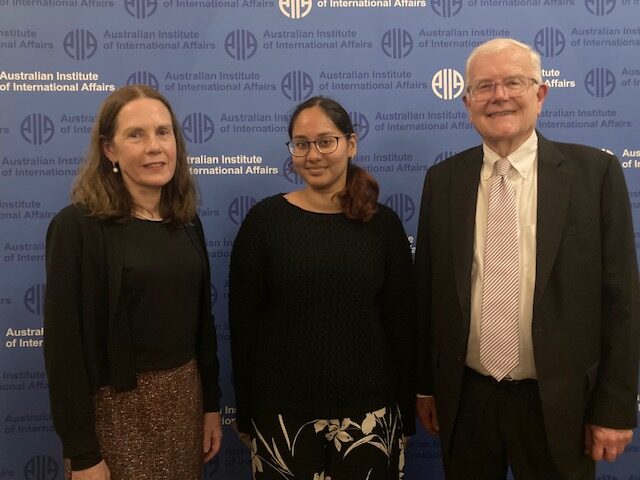
Professor Shirley Scott left, AIIA NSW President Ian Lincoln right and AIIA NSW intern Mehnaaz Hossain centre.