On 30 June 2026, Michael Mann AO, former diplomat and university administrator, addressed the Institute on the question of foreign students and Australian universities, and how their roles have evolved.
Mr Mann reported that he had searched in vain for comprehensive information on what foreign students had thought of Australian education over the decades. Such relevant research as there was largely served a promotional, rather than credible purpose. He presented an overview of foreign student populations in Australia over the course of 75 years. In 2025, 545,000 overseas students were residing in Australia compared to under 1,000 in 1950. The high fees paid by foreign students have become essential to Australian universities, so the numbers are not likely to change much.
He reflected on the “brain drain” problem for students’ countries of origin. Bhutan, as an example, was experiencing an on-going exodus of talent, to its economic detriment. More than 10% of its skilled population emigrated in 2022; 40,000 of its total population of 800,00 are now living in Australia. Many overseas students remain here at the end of their studies. Accepting this reality, Australia had begun since 2006 to process international students in accordance with migration criteria: if they intend to reside here for over 16 months, they are now assessed for their suitability as migrants. This means that they can face heightened expectations with their families and long processing times.
Australian Bureau of Statistics figures showed that Australia gained $53.6 billion from foreign students in 2024-25. Universities earned $12.3 billion from international student fees in 2024, 27.3% of all their revenue (42.6% in the case of Sydney University) compared to 17.6% in 2010. Mr Mann described Australia’s “paradox of export” – the more foreign students study in Australia, the greater our income from other countries, while at the same time we gain a substantial work force which contributes to our domestic and export economy.
With increasing numbers, the value of an Australian degree was seen overseas as declining. At the same time, study in Australia is becoming less attractive as a result of mounting living costs and fees (from $45,000 to $60,000 at the Group of Eight universities) and the increased competitiveness of foreign universities. Using China as an example, Mr. Mann noted that an Australian degree does not give the same “leg up in employment” as it did 20 years ago, especially with the spread of generative AI which enables students to cheat their way through university.
Mr. Mann’s address ended with the observation that Australian universities have become hostage to their own success in attracting foreign students. Although the path forward is unclear, that path must not be bogged down by regulation. Australian universities must become more “intentional” with their numbers and talent. Caps and visa fees merely treat the symptom. The cause is a university funding model that has leaned on foreign fees as government’s share of costs fell from about 80% in 1990. A re-think means funding universities properly, valuing quality over volume, and diversifying who and where students come from, not just capping numbers.
Question time began with an inquiry on the business model of the Colombo Plan, which Mr. Mann highlighted as being completely funded by the Australian government.
Asked about the reaction of overseas governments to brain drain, Mr. Mann said that officials were often frustrated by the phenomenon and recognised its inequity and the economic contradictions underlying it, including lower economic growth and slower improvements in living standards than if students with the increased skills gained in Australian returned to their countries to apply them.
He commented that brain drain will take several generations to overcome. The process is complicated by the lack of policy around monitoring foreign students’ work rights and the human rights issues that arise with pressing students settled in the Australian community to return to countries where conditions and prospects would be reduced for themselves and their families.
In short, the rising presence of foreign students certainly has many attractions at first glance for both Australia and the students’ countries of origins, yet there is more to the situation, economically, politically and socially, than meets the eye.
Report by Kimmy Kwok, AIIA NSW intern
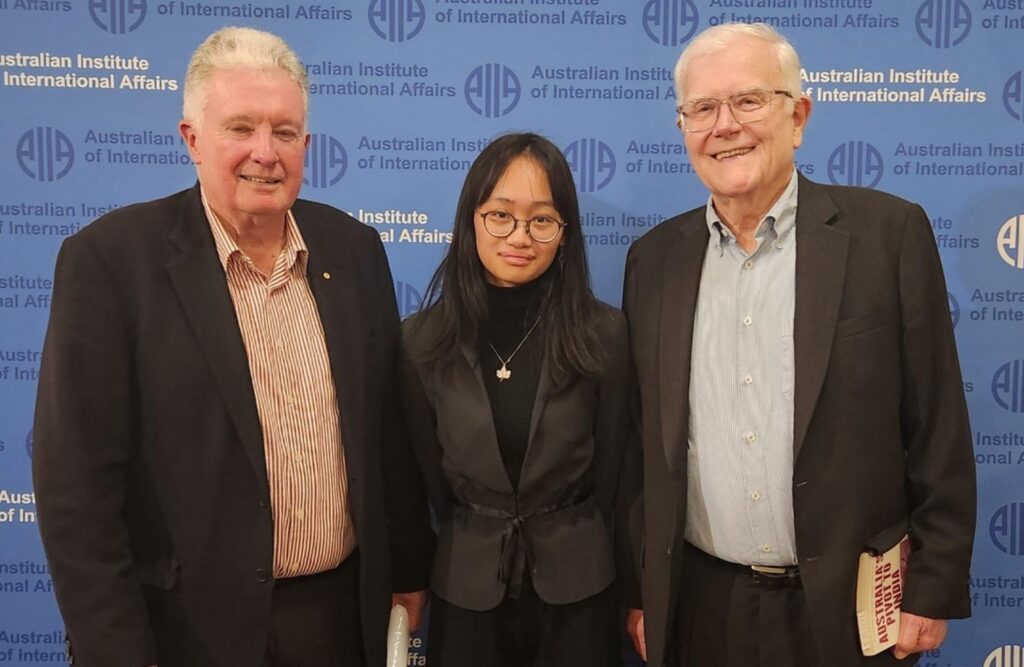
Michael Mann left, AIIA NSW president Ian LIncoln right, and AIIA NSW intern Kimmy Kwok centre.