On 2 June 2026, Bakar Mohamad, political communications strategist with secular Lebanese political party National Bloc, addressed AIIA NSW in conversation with council member Matthew Vasic. Having moved to Beirut in May 2024 as a journalist before transitioning into political work, Bakar offered a ground-level account of Lebanon’s fractured politics, Hezbollah’s position, and the question of whether peace with Israel is both necessary and possible.
Bakar opened with Lebanon’s origins as a post-Ottoman state built around the unwritten 1943 National Pact, under which Christians agreed to forgo alignment with France while Muslims agreed to relinquish the pan-Arab cause. In the 1960s, Sunni communities reneged on that arrangement, embracing the Palestinian cause and facilitating the 1969 Cairo Agreement which had permitted Palestinian factions to attack Israel from Lebanese soil. The civil war of 1975 was a direct consequence. Today, he sees the same pattern in Hezbollah’s alignment with Iran – a different sect and patron, but the same failure in which a Lebanese faction places a transnational cause above the interests of the Lebanese state.
Bakar rejected the framing, popularised after October 7, that Hezbollah is a resistance movement against Israeli occupation. Iran’s 1979 decision to export the Shiite revolution had produced Hezbollah-like structures across Lebanon, Bahrain, and Yemen, none of which had faced Israeli occupation. When Israel withdrew from southern Lebanon in 2000, Hezbollah did not disarm, instead reclassifying the Shebaa Farms (disputed territory along the borders of Lebanon, Israel, and Syria) as Lebanese territory in order to justify its continued armed existence. Its posture, he argued, has always reflected the interests of Iran rather than the defensive needs of Lebanon.
On Hezbollah’s current standing, Bakar was candid. The group has suffered significant losses, with its leadership decimated and its Syrian supply corridor severed. Yet he cautioned against underestimating its residual support, recounting a friend who, despite opposing Hezbollah, said he would vote for them after the war, feeling that the Shia community had no protector except Hezbollah: having an abusive father was still preferable to being an orphan. Hezbollah’s continued real power within Lebanese institutions was illustrated by the Speaker of Parliament ordering an independent minister not to attend a cabinet session scheduled merely to vote on the first page of a ceasefire agreement.
Bakar’s most challenging points concerned the prospects for peace. He argued that Lebanon must come to the negotiating table with Israel, not because it wants to, but because it has no better option. Lebanon had the opportunity to sign a peace agreement with Israel in 1983, but the Speaker of Parliament vetoed it, a decision Bakar argued has come at a steep cost. Today, with over 500 square kilometres of Lebanese territory under Israeli occupation, Lebanon is in a far more difficult negotiating position than four decades ago. He accepted that what Israel is doing in Gaza constitutes a genocide but argued that Lebanon cannot continue sacrificing itself for a Palestinian cause that Lebanese sacrifice has done nothing to advance.
In discussion with the audience, a number of threads were drawn out. One audience member raised the possibility that Israel’s days as a viable state may be numbered, pointing to ruptures in US-Israeli relations. Bakar acknowledged the deterioration, including leaked reports of a hostile phone call between Trump and Netanyahu, but argued that Lebanon must negotiate on the basis of the reality of today, not what the balance of power might look like in ten or twenty years.
Another audience member challenged his characterisation of Hezbollah, noting that Israel occupied Lebanese territory five years before Hezbollah was founded. Bakar conceded resistance forces existed before Hezbollah, but argued its founding intention was always broader, pointing to the televised declaration by Hassan Nasrallah, Hezbollah’s former Secretary-General, that the organisation serves the interests of the Iranian ayatollah.
The question of what peace with Israel would actually look like generated the liveliest exchange. One audience member argued that the Egypt and Jordan models represent not peace but submission, noting that Egypt cannot deploy forces in Sinai without Israeli permission. Bakar agreed the analogy was uncomfortable but insisted that it was the relevant one. He emphasised that when one loses a war, one must negotiate from that position. As World War II ended Germany and Japan did not set their own conditions before surrendering, and Lebanon needs to reach the same reality.
The session concluded with Bakar’s assessment that the choice Lebanon faces is not between a good outcome and a dignified refusal, but between a managed settlement and the continuation of the destruction already unfolding.
Report by Federico Canas Velasco, AIIA NSW intern
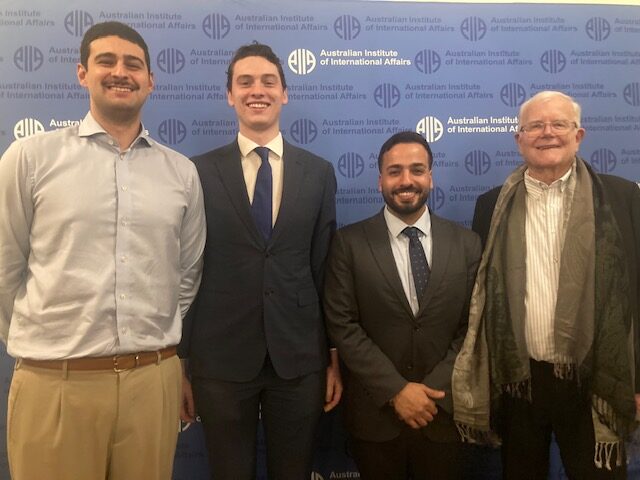
From left to right: AIIA NSW intern Federico Canas Velasco, AIIA NSW councillor Matthew Vasic, speaker Bakar Mohamad and AIIA NSW president Ian Lincoln.