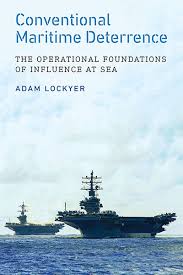
On Tuesday 23 June 2026, AIIA NSW hosted the launch of Adam Lockyer’s new book, Conventional Maritime Deterrence: the Operational Foundations of Influence at Sea. Adam Lockyer is Associate Professor of Strategic Studies at Macquarie University. He was previously a Research Fellow in Defence Studies at the University of New South Wales, and held the 2015 Fulbright Scholarship in US-Australian Alliance Studies at Georgetown University.
Drawing on a career researching Australian defence strategy, US foreign policy, post-conflict reconstruction, and insurgency, along with a four-year term in the Australian army, Professor Lockyer addressed the current strategic competition between the United States and China across the seas, islands, archipelagos, and peninsulas of the Indo-Pacific region. He sees maritime deterrence – creating and displaying naval power to discourage an attack – as essential for maintaining international peace and stability. He stressed that defence at sea differs from its land counterpart, especially in the ways maritime units, tankers and other craft interact with each other.
Taking the US approach to Libya during the 1980s as a key example, Professor Lockyer reflected on the maritime deterrence strategies of both the Libyan military and the American forces. While Ronald Reagan was most famous for his political opposition to the Soviet Union, his early presidential years also focused on Libya, deploying battle groups as a show of force and of US ability to deter the Palestine Liberation Organisation support. But the Americans had underestimated the defensive posture of the Libyans in the Gulf of Sidra, leaving Gulf carriers vulnerable to fighter jets. This example demonstrated divergent maritime strategies: offensive sea control enacted by the Americans (blockades, air strikes, bombardments); defensive sea control (barrier maritime defences, sensors, units); and sea denial (guerilla warfare at sea, offensive submarines, raiding and mine attacks) enacted by the Libyans.
Professor Lockyer observed that Gulf conflicts since 1991 have shaped the maritime strategies of America, Russia and China, inspiring the concept of “image manipulation”. He suggested that this concept is most evident in the maritime exercises carried out by great military powers such as China, which conducts regular maritime sparring, raids and tactical drills in the South China Sea. By demonstrating their maritime capabilities on a global stage, countries are able to project strength and utilise maritime diplomacy as a political tool to intimidate, influence and attract the attention of major global decision makers.
China’s maritime activities were a particular focus for Professor Lockyer. He reflected on shifts in China’s image manipulation strategies following the visit of (then) House Speaker Nancy Pelosi to Taiwan in 2022: in response, Chinese maritime strategies and naval exercises escalated in intensity and regularity, and their methods changed drastically. While previous exercises performed a run-through of a potential navy blockade of Taiwan, the Chinese navy began trialling a more covert quarantine-style boat seizure initiative, which simulated random takeovers of successive “Taiwanese” vessels that would gradually increase until the Strait of Taiwan was controlled.
Although Chinese and other national naval exercises are closely watched by various foreign governments and navies, there remains less urgency in reactions compared to land offences. The government of the Philippines has long reported Chinese transgressions into their waters and the escalation of aggressive maritime interactions, but this receives little or no international media attention. Sea clashes are easier to enact and conceal, posing a great threat in future global conflicts.
In the question and discussion period, a number of audience members gave their own assessments of the broad changes over time in international relations in regard to maritime strategy.
Asked for his opinion on the future success of AUKUS amid its many controversies and roadblocks, Professor Lockyer stressed that the partnership’s longevity will be determined by the political will of individual US administrations at the time. He observed that it would be open for the US to provide some or all of its promised submarines to Australia ahead of the completion of the full complement intended for the US. He expected little from the UK as a strategic naval partner given the increasingly complex maritime situation in the Indo-Pacific.
Asked whether the international Law of the Sea still holds much sway in maritime conflicts, particularly as the US-Israel war on Iran continues to ravage the Strait of Hormuz, Professor Lockyer noted that the US navy – despite the US not having ratified the Law of the Sea Convention – has acted in accordance with its provisions. He suggested that both Oman and Iran will be likely to act in line with international law; US action was less predictable.
Report by Jemma Tan, AIIA NSW intern
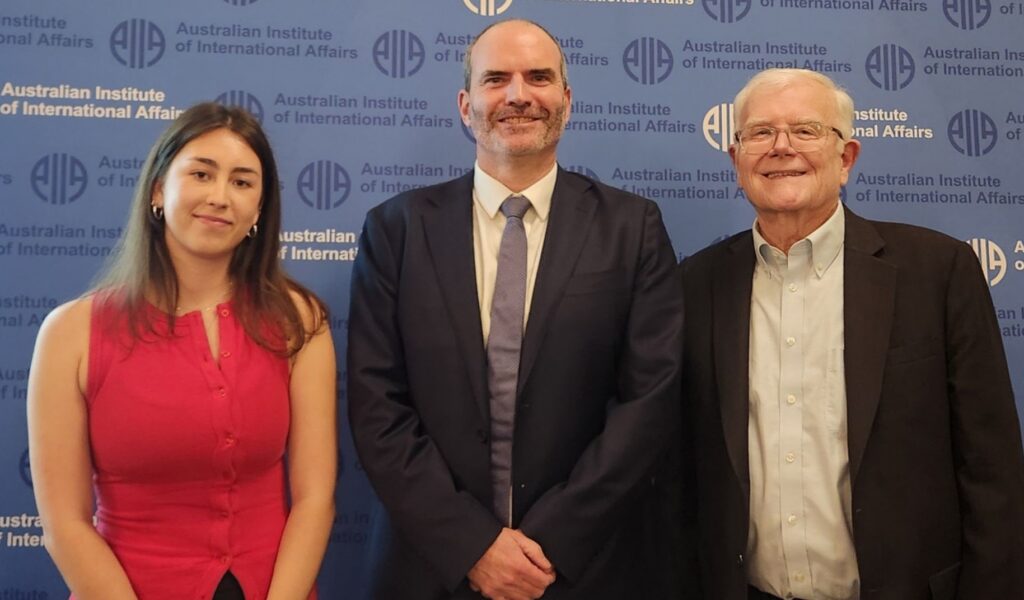
Professor Adam Lockyer centre, AIIA NSW president Ian Lincoln right and AIIA NSW intern Jemma Tan left.