On 13 May 2026, the Institute welcomed Amitav Acharya, Professor of International Relations at the American University, Washington, to speak on his thought-provoking publication: “The Once and Future World Order: Why Global Civilisation Will Survive The Decline of the West”.
Professor Acharya began with a general overview of the book. Describing it as a “big picture” publication that takes on every major civilisation over 5000 years of human history, he identified two themes that emerge centre stage: history and the world order. On the former, the book inquires what history can tell us about contemporary affairs. Rather than subscribing to the conventional explanation that history repeats itself, Professor Acharya suggests it is rather a way for humanity to understand its past mistakes and misunderstandings. It therefore reveals possibilities and pathways in imagining a future world order, particularly one rejecting the assumption that a Western, liberal world order is permanent.
His book proposes that world order has been and will always be a “shared creation”, not a monopoly owned by any particular civilisation or region. Examining Chinese, Roman and Islamic civilisations, Professor Acharya observed that many foundational ideas about world order were developed by independent innovation of similar ideas augmented through their diffusion and extension.
Applying this theory to contemporary politics, he assessed that world leaders are accepting that the international order is now changing before our eyes. His book rejects the perception of hegemonic stability brought about by the US as necessarily a benefit – a perception drawing on the flawed logic that a global hegemon is an essential feature of world order. Rather, an examination of history reveals that world orders have historically been regional: global hegemony is a rare occurrence. Professor Acharya proposes that the West could not be what it is today without borrowing ideas from other civilisations.
His presentation concluded with the compelling perception that Western dominance is “a blip in history”, and that a shift away from American hegemony requires acceptance and need not be perceived negatively.
During questions and discussion a number of speakers expressed their own assessments of the broad changes over time in international relations. Asked whether a post-Western order is possible given the long-lasting structural impacts of colonialisation on epistemology, Professor Acharya responded that realising that the current dominance of Western attitudes is not permanent encourages intellectual and cultural shifts which serve as catalysts for re-assessments (including by American-led academia).
Asked what a future world order would look like, Professor Acharya drew a careful distinction between multi-polarity and multi-plexity. While the former still sees the dominance of big players on the world stage with smaller players playing a minimal role, the latter envisages a “more diffused” arrangement focused more on ideas than nation states: multi-plexity takes account of small powers in a more equitable manner in the problem-solving processes.
Asked whether current economic institutions such as the World Trade Organisation have a role to play, Professor Acharya acknowledged that their integration in the future will not be easy; they will need to be supplemented and reformed to adjust to changing economic dynamics.
Asked whether the world is moving away from democracy and becoming more autocratic, Professor Acharya raised the interesting concept of “neo-monarchy”, suggesting that figures like Xi Jinping, Donald Trump and Kim Jong Un demonstrate that elements of monarchy have evolved to fit into modern forms of governance.
Report by Kimmy Kwok, AIIA NSW intern
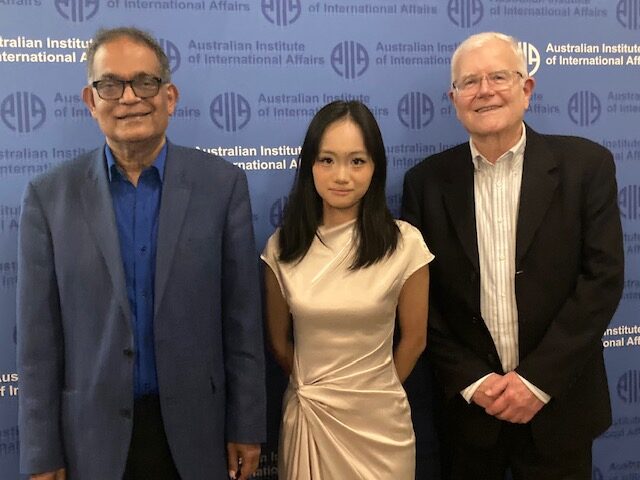
Professor Acharya left, AIIA NSW president Ian Lincoln right and AIIA NSW intern Kimmy Kwok centre