On 21 April 2026, the Honourable Michael Kirby AC CMG, a past Justice of the High Court of Australia, updated AIIA NSW about outcomes of the Report of the Commission of Inquiry on Human Rights in the Democratic People’s Republic of Korea (North Korea), which he conducted for the United Nations Human Rights Council in 2013.
Mr Kirby recounted his UN journey in detail. He began by recounting the grave human rights violations and crimes against humanity that the Commission found and publicised. He noted that North Korea’s non-cooperation throughout the UN investigation was a key obstacle, culminating in their unwillingness to implement any of the recommendations put forward in the report: North Korea’s only measure to implement the report was to address the state’s poor treatment of disabled people and finally allow for their involvement in public activities in Pyongyang. Kirby described his profound experiences with North Korean defectors, explaining that they were often surprisingly willing to identify themselves and speak on-record, giving credible and moving testimonies for the Commission.
On the minutiae of the Commission’s UN processes, Kirby recounted an attempt by North Korea to prevent the matter from reaching the UN General Assembly. The UNGA’s rejection of that attempt and its endorsement of the report led to a great deal of interest from the UN Security Council. However, when it came time for the UNSC to permanently support the work of the Commission of Inquiry, the report – disappointingly – was not put into action.
One of the most salient aspects of Kirby’s address was his explanation of the necessity for international, and primarily South Korean, cooperation in enforcing human rights legislation. He spoke of the fact that a North Korean Human Rights Act was instituted by South Korean President Park Guen-hye in 2016, but did not have enough bipartisan support to be implemented later by President Moon Jae-in, who declined to appoint commissioners to the commission which the act established. Kirby made the interesting point that left-wing parties in South Korea remain insistent about caution towards cooperation with or for North Korea. He made the important observation that human rights advances cannot be made without bridging the gap between institutions in the two Koreas.
Discussing his return to South Korea in March 2026, Kirby emphasised the importance of South Korea’s involvement in North Korea Human Rights Act and called on the South Korean Minister for Unification to “join the rest of the democratic world” in holding North Korea to account.
Audience members were curious about mechanisms for enforcing human rights law in North Korea. When asked about the efficacy of sanctions against North Korea, given the disproportionate impacts sanctions have on civilians, Kirby responded that essentially this is an unfortunate necessity. He emphasised that, in the absence of other powers, the UN is obliged in pursuing cooperation and punishing proved misconduct against the principles of universal principles to impose sanctions, after due consideration, as the most practical way to proceed.
An audience member proposed the intriguing notion that perhaps international efforts could be reoriented towards a punishment of the more wealthy or powerful in North Korea by bringing in multilateral bodies to focus on the foreign exchange they earned by smuggling and internet crime. Kirby’s response was that, despite uncertainty about its potential efficacy, the cooperation of left-wing administrations in South Korea is a vital requirement.
The final question of the night asked whether, given that the heyday of the UN and a rules-based international order seems to be over, there is a growing place for bilateral moves in responding to human rights violations. Kirby’s answer was that the UN is still a necessary vehicle as an alternative to hostilities and as guardians of peace. An example was the threat of nuclear war. Kirby views this as one of the most pressing issues of our times, with major world leaders such as Presidents Trump and Putin constantly threatening to use nuclear weapons. In this unstable political climate, he sees the UN’s function as prompting the international community to lessen the risk of international violence – including nuclear war – through education and humanitarian aid along with dialogue, negotiation and compromise.
To conclude, Kirby stressed the importance of Australia working within multilateral institutions, and in particular trying to encourage the South Korean government to cooperate with the international community on protecting human rights in North Korea. The government of the ROK has repeatedly made the point that UN and Western countries making hostile denunciations have got us nowhere. Disapproval can be made known in gentler ways; whilst at the same time being insistent on change in the conduct of North Korea.
Report by Mehnaaz Hossain, AIIA NSW intern
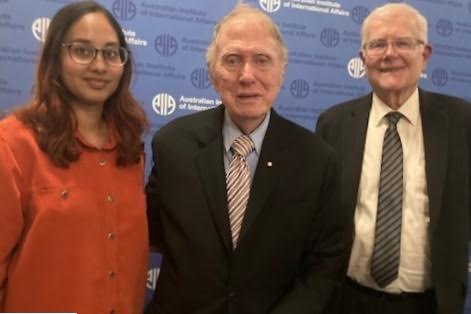
Michael Kirby AC CMG centre, AIIA NSW president Ian Lincoln right and Mehnaaz Hossain left.