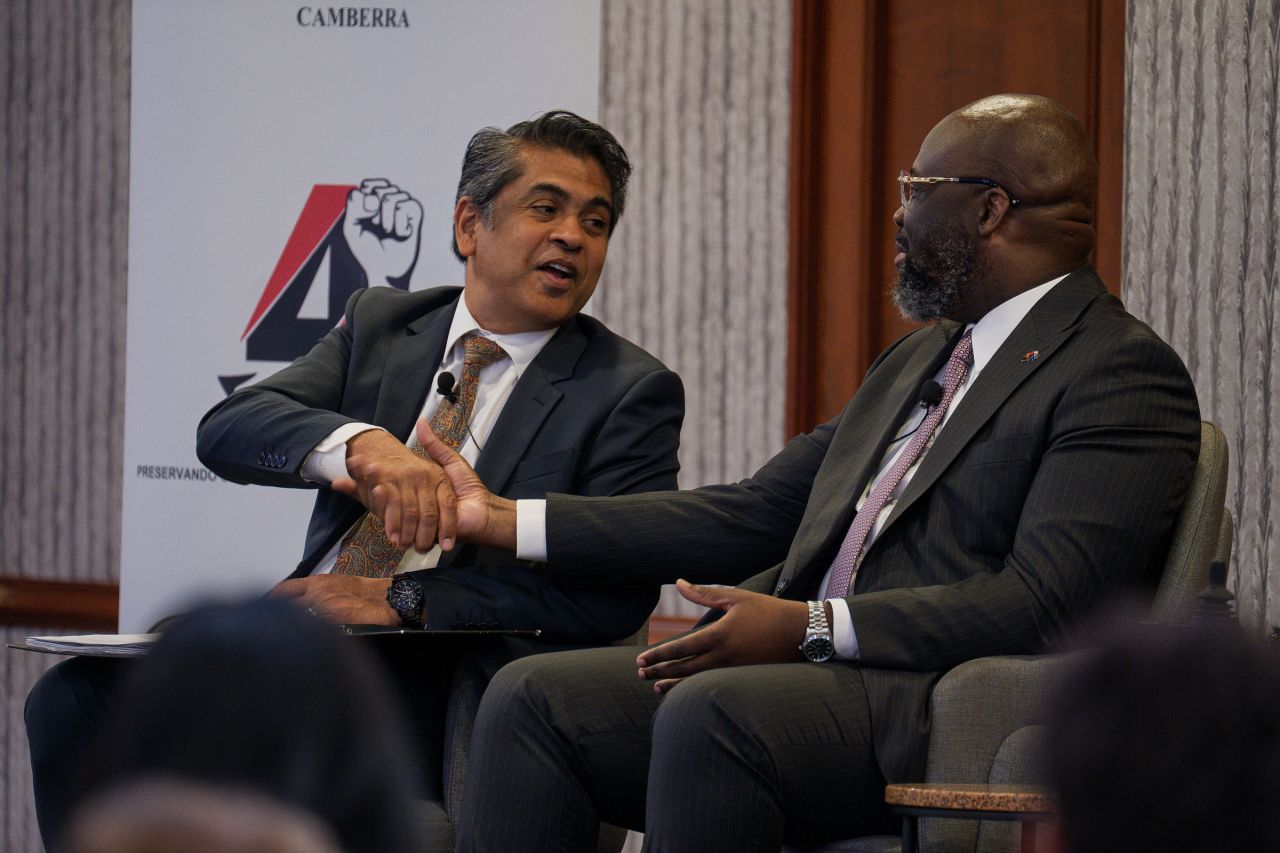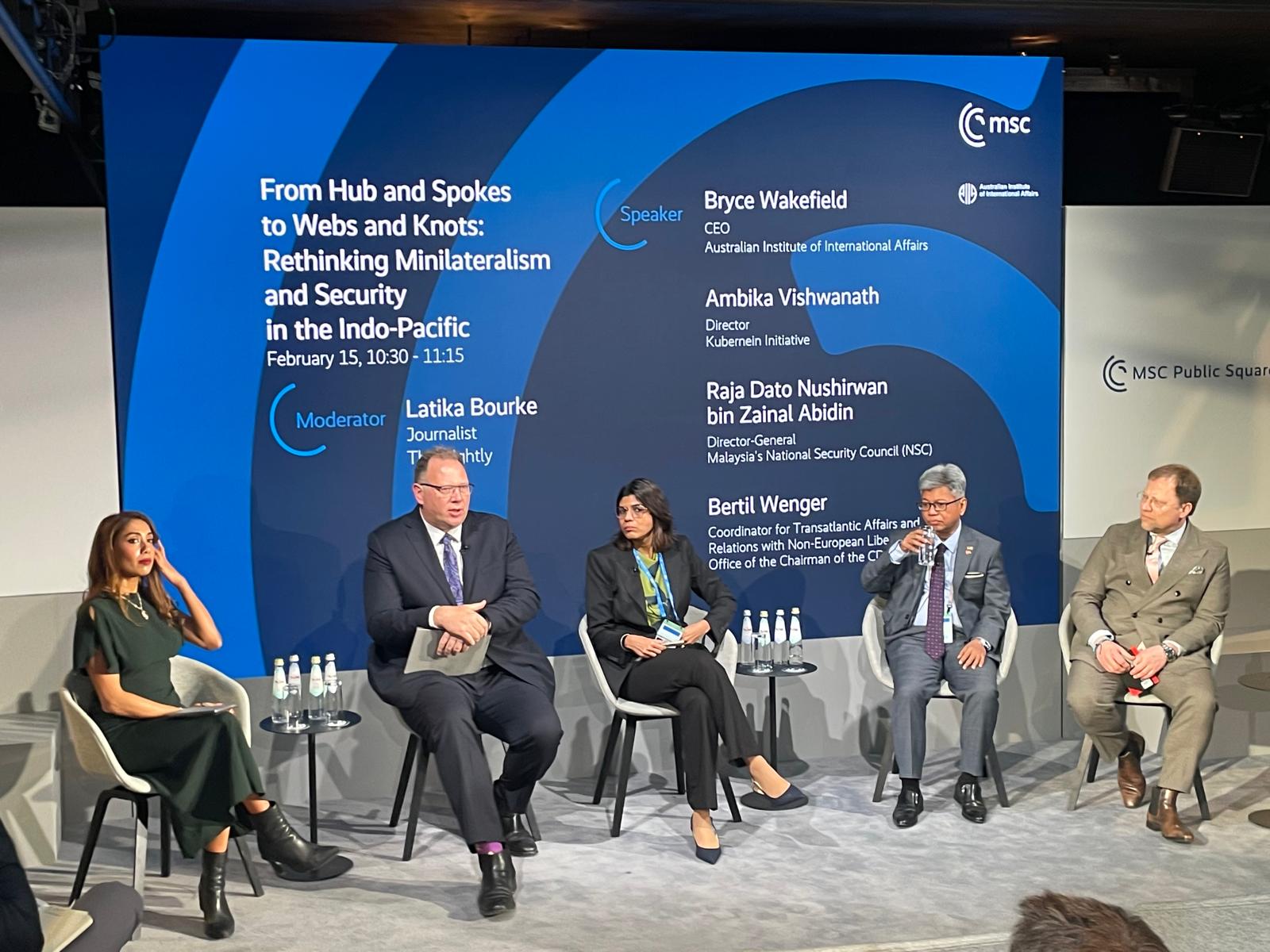
MUNICH – The Australian Institute of International Affairs (AIIA) partnered with the Munich Security Conference (MSC) to host a panel on “Minilateralism and Security in the Indo-Pacific” at the Public Square in the Hotel Bayerischer Hof. The discussion was one of a number of events at this year’s conference to focus on the Indo-Pacific, within a gathering otherwise primarily centred on the transatlantic relationship.
Opening the panel, AIIA National Executive Director Dr Bryce Wakefield set the strategic context from an Australian perspective, emphasising the growing importance of flexible, issue-based “minilateral” arrangements in responding to shared security challenges. His remarks followed an article he had published days earlier in Neue Zürcher Zeitung.
On the panel, Dr Wakefield noted that while debate in Munich centred heavily on strains in US–Europe relations, “the rift in trans-Atlantic relations was not quite the situation on our side of the world.” Stressing the difference between typical Euro-Atlantic and Indo-Pacific security frameworks, he underscored that the latter remain grounded in practical cooperation between middle powers whose foreign policies differ greatly, even amid intensifying geopolitical competition between larger countries.
Dr Wakefield was joined by Ambika Vishwanath (Kubernein Initiative and La Trobe University), who highlighted the environmental dimensions of security and India’s expanding engagement in the South Pacific; Malaysia’s National Security Advisor, Raja Dato’ Nushirwan Bin Zainal Abidin, who provided a Southeast Asian perspective; and Bertil Wenger (CDU), who offered a German response. The panel was moderated by Latika M Bourke of The Nightly.
Engagement Across the Conference
Reflecting on his first attendance at MSC, Dr Wakefield described it as “a very stimulating experience,” observing that “everyone’s experience at this conference is unique.” He characterised the conference as operating across “three main layers—the main speeches that are widely broadcast around the world, a dazzling smorgasbord of side events of all shapes and sizes, and separate bilateral meetings that you put together yourself.”
He added that beyond the formal program, “the opportunity to engage with key decision makers and the chance meetings in hallways” were among the most valuable aspects of the event, allowing him to connect with both new counterparts and longstanding colleagues.
Dr Wakefield also participated in the 20th Transatlantic Forum of the Christian Social Union (CSU), which featured European Commission President Ursula von der Leyen, Bavarian Minister-President Dr Markus Söder, NATO Secretary General Mark Rutte, Swedish Prime Minister Ulf Kristersson, German Foreign Minister Johann Wadephul, and senior US lawmakers. He recently examined Minister Wadephul’s visit to the Pacific in an article for the Frankfurter Allgemeine Zeitung.
Discussions on the margins of the conference included informal discussions with Chair of the European Parliament’s Foreign Affairs Committee David McAllister and EU Rapporteur on Australia Željana Zovko on Australian foreign policy and EU–Australia relations, as well as a brief hallway exchange on EU-Australia relations with President von der Leyen.
Transatlantic Debate in Focus
Debate over the future of US–Europe relations featured prominently at MSC. While some participants said they felt reassured by US Secretary of State Marco Rubio’s address, Dr Wakefield observed that others “felt it was the same content as JD Vance’s criticism in a softer tone,” adding, “I tend to agree with the latter view.”
He suggested that “history will likely find” German opposition leader Friedrich Merz’s speech—emphasising the rift between the US and Europe and calling on Europe to recognise the new reality—more consequential. He similarly pointed to von der Leyen’s stress on the European Union’s common defence mechanism as significant.
Dr Wakefield also highlighted California Governor Gavin Newsom’s “continued clarity of the need for world leaders to call out the deficiencies of the Trump administration,” and described French President Emmanuel Macron’s remarks as among the strongest delivered at the conference, even if “typically Macron,” for their insistence on Europe standing up for itself.
Indo-Pacific leaders contributed to the discussion as well. Dr Wakefield welcomed Australia’s Deputy Prime Minister Richard Marles’ pushback “on the notion that rules are no longer observed in this world” and his indication that he was “comfortable” with the US administration’s Indo-Pacific approach. He also noted Japan’s Shinjirō Koizumi’s reassertion of the strength of the US–Japan alliance.
Looking Ahead
In addition to conference activities, Dr Wakefield visited the Bavarian Finance Ministry and held further meetings with German counterparts.
AIIA’s participation at the Munich Security Conference reflects its ongoing commitment to fostering dialogue between Australia, Europe and the Indo-Pacific at a time of significant geopolitical change.