Will the US-Iran ‘peace talks succeed or fail? Given the mix of personalities and national interests involved, we just don’t know.
Success would likely be a short-term, mutually face-saving compromise, leaving many major bilateral and regional issues still to be resolved. Failure is likely to lead to a US-initiated war with chaotic outcomes and perhaps no real winners.
What does President Donald Trump want? In the short term, he wants a “peace deal” comprising multiple components. While not all details are public, the first and foremost goal is nuclear. Iran must not have the capability to make a nuclear weapon. While some reports suggest the US demands that Iran close down its whole nuclear program, most reporting claims US demands are limited to Iran ceasing the production of and giving up all enriched uranium beyond that needed for its domestic nuclear energy needs. US demands also include Iranian agreement to International Atomic Energy Agency (IAEA) inspections to verify they comply with this commitment.
Other demands include limiting the range of all ballistic missiles to some 500 km (compared to some 2000 km at present), the cessation of all hostilities toward both regional countries, and support for other nations or proxies engaged in such hostilities. These terms would put all of Israel out of range and discourage further attacks from Iran on Israel, despite the term “hostilities” being left vague. It is difficult to see Iran agreeing to the former. A deal on the latter might be possible. One formula could be through recognising Israel’s right to exit (as does the Palestine Authority -PA) and ceasing hostilities and support to proxies in the context of progress towards a two-state solution.
Trump’s aim is ‘maximum pressure’, precipitating ‘regime change’—that is, the end of Iran’s conservative mullah-led autocracy and its military guardians, the Islamic Revolutionary Guard Corps (IRGC). This is a longer-term goal, but one he would pursue opportunistically in the short term if circumstances permit, such as in the event of an outbreak of war.”
Denials and Tricky Negotiations
Iran has always denied its intention to develop nuclear weapons; most recently, this week, by the Iranian Foreign Minister, Abbas Araghchi. The international community generally believes Iran knows how to make a nuclear weapon and would do so if it could; however, Iran won’t because it could not hide the process, and external intervention in response could be horrendous. Therefore, Iran is willing to negotiate the nuclear issue. It did so before, as part of negotiations between Iran and the US, resulting in the signing of the Joint Comprehensive Plan of Action (JCPOA) in 2015 during the presidency of Barack Obama.
The difference between Obama and Trump is that Obama understood the subtleties of negotiating with Iran, i.e. build trust through the JCPOA before moving on to missiles and issues of regional hostilities. Trump 1.0 trashed the JCPOA in 2018, remarking it was “the worst deal in history.” Although Iran continued to comply with its conditions for a further 12 months. President Joe Biden dropped the ball on this issue, and Trump 2.0, upon re-election, continued where he left off in 2021.
The Iranians are certainly not easy to negotiate with. Relevant “subtilties” include being a proud, fiercely independent, well-educated people who seek to own/control their own resources (e.g., oil) and, to the extent possible, be self-sufficient. They do not like being bullied, and trust is a key part of relationships.
They claim Trump has consistently bullied them with his threats and actions, and all trust has long gone, dating back to Trump 1.0. Iranian officials have argued privately that the policies and actions of both Trump 1.0 and Biden, including the heavy economic sanctions, forced Iran into the “axis of evil” for basic survival reasons. They claim they want their independence, and have no particular affinity for the Russians, Chinese and North Koreans. One conclusion from that any negotiations with the US will occur in an atmosphere of tension and distrust. So, who does Iran trust?
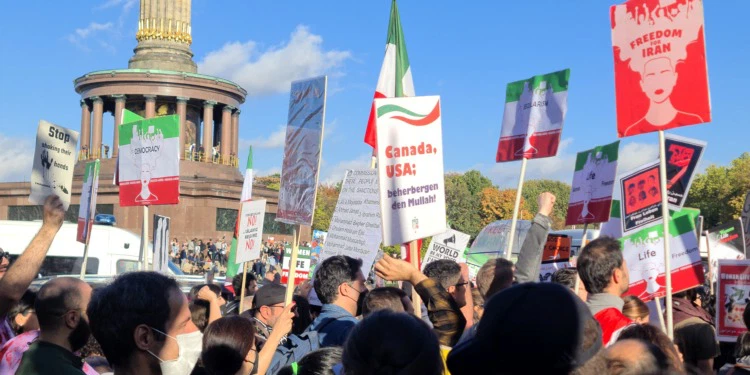
Violence on the Streets of Tehran: Regime Change and Civil Unrest
There are four basic criteria for the successful change of any regime: leadership, the reason for change, the will of the majority of the people, and the support of a significant element of the armed forces and security forces to facilitate and sustain change
Discontent with the Iranian government has been evident among different groups in the country for some time. Mostly, this has been political, but this time the driver was economic, driven principally by the hard squeeze of external sanctions, coupled with mismanagement and corruption. The outreach of hardship and dissent was much broader than before. And despite targeted input from outside Iran, the regime did not topple. Demonstrators were strongly suppressed by the government, and Trump’s threat to help demonstrators did not eventuate. Would his military intervention have been the tipping point? We can only guess. But here was no apparent split within the armed or security forces – given their deep involvement in the economy, there were strong self-interest motives not to – and no leadership figure, civilian or military, emerged.
Attempts to promote Reza Pahlavi, the Shah’s son, who was deposed in 1979, as a rallying figure, if only temporarily, failed. I doubt he has much appeal in-country due to the heavy suppression and corruption of his father.
But the message was loud: there is disaffection, political and especially economic, which could ignite if the fuse is right.
What to Expect
Will Trump be tempted to use military force to try to facilitate regime change if he doesn’t get his way at the next round of nuclear negotiations, now due to be held in Oman late this week? He has the fleet in place, and comprehensive planning will be well underway, building on lessons learned from the Israeli-US 12-day war last June and recently in Venezuela. The planning focuses on key kinetic and non-kinetic targets, especially those requiring a preemptive strike. Israel will be part of this, with its own targets, which presumably will include key leadership, military and other persons.
Iran will have done its planning also around its own lessons learned. Iranian early warning of an attack, even if measured in only minutes, will be critical in determining how quickly events unfold within and outside Iran, and how devastating they are. However, if this does force regime change, who will take over? Without the mullahs and lacking any civilian opposition infrastructure, the military (minus the IRGC?) would have to be the backbone of any new government. Civilian leadership is an unknown, though talented politicians and technocrats exist. Iran could become very fragmented and unstable as it sorts itself out.”
Ian Dudgeon is a former president of AIIA’s ACT Branch
This article is published under a Creative Commons License and may be republished with attribution.