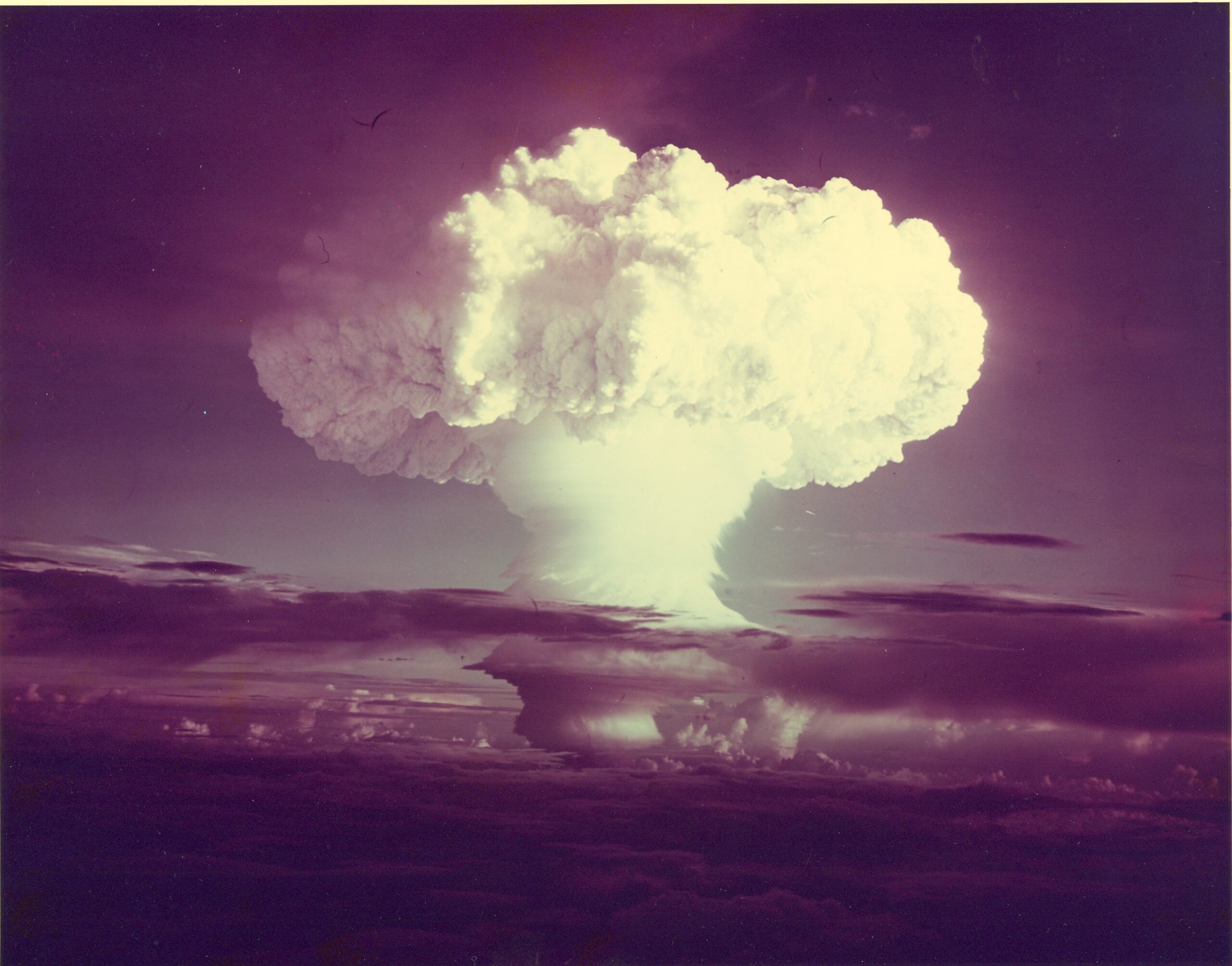
Newly declassified British documents expose how radioactive clouds from nuclear tests in Australia took days—not hours—to clear, contaminating vast areas in the lead-up to the 1956 Melbourne Olympics. While UK veterans finally force transparency, thousands of Australian government records on these toxic tests remain mysteriously locked away, unread for four decades.
Seventy-five years ago, the UK began preparing for its first atomic bomb test in Australia at the Monte Bellos. Operations Hurricane, Totem, Mosaic, Buffalo and Antler took place on Australian territory throughout the 1950s, together with a series of what were termed Minor Trials, mainly testing components of triggering systems for the UK hydrogen bomb eventually detonated off Christmas Island, now Kiritimati, in the Pacific in 1958.
I have reported how all the post-Hurricane detonations in Australia were part of a ‘coherent programme’ to take UK nuclear weapons to thermonuclear level as the official UK historian of the tests finally acknowledged in 2006 in Britain, Australia and the Bomb. This was despite repeated British public promises not to go beyond atomic fission to thermonuclear fusion testing in Australia, as I documented in Making the British Bomb in Australia: From the Monte Bellos to the 1956 Melbourne Olympics. And it was done with the collusion of Prime Minister Robert Menzies, to the extent that he became alarmed that Australia would be subjected to monitoring under the Geneva guidelines of the early 1960s.
In 1984-85 the Australian Royal Commission into British Nuclear (sic) Tests in Australia took evidence around Australia and in London. Whilst extensive documentation submitted to and produced by the Royal Commission is held in the National Archives of Australia, much of which is available for download, around a third of the items listed in the NAA catalogue are still closed, marked ‘Not yet Examined’. No Australian government has got around to releasing them, probably not even to reading them, for 40 years. How was that allowed to happen?
It will put a jolt into Australia’s national amnesia about the levels of toxicity of the major and minor tests that the UK government is starting to release online, thousands of documents in the Merlin database through the UK National Archives.
According to the UK NA ‘The Merlin Database was created and compiled between 2006 and 2008, by AWE at the request of the MOD, to enable its Veteran’s Policy Unit (subsequently the Armed Forces Compensation Team), the Deputy Chief of Defence Staff, Personnel and Training, and the Treasury Solicitor (subsequently the Government Legal Department)’ to ‘quickly identify relevant factual documentary evidence/records about the nuclear testing programme’ relevant to class action litigation brought by more than a thousand of the 22,500 British veterans of the test.
The litigants’ lawyers had set out 12 areas in which the MOD (and its predecessors) were alleged to have been negligent. The database was designed to compile relevant records on those 12 areas.’
They include the effects of participation in testing; exposure to ionising radiation; knowledge of the MOD during the 1950s-1960s in respect of the impact of participation including effects of ionising radiation; the risks of participation, including risk assessments; provision of protective equipment against risks; guidelines on the use of protective equipment, and whether such equipment was mandatory; guidelines relating to safe distances, during or in the aftermath of detonation; details of distances that individuals were positioned during or after detonations; warnings given to participants prior to participation as to potential health risks; guidance given to participants before and after participation as to damage likely to result, and guidance to minimise or alleviate that damage; monitoring of health, safety and well-being of participants during and after tests and programmes; medical Studies conducted by MOD or any other organisation pre-1950s to date, which prove or disprove a link between exposure to ionising radiation or participation in nuclear tests and experimental programmes.
Estimated to total at least 40,000 pages, this tranche of information relates not only to the hazards faced by the 22,500 UK participants but also to the estimated 16,000 Australian, New Zealand, and Fijian servicemen and scientists, and of course, the indigenous and settler populations of Australia. The AWE has held these documents for 20 years, a small number of which have leaked out into the publicly accessible records held by the UK National Archives.
Six weeks before it was voted out of office in July 2024, the UK Tory government released online 151 records held by the Ministry of Defence and the Atomic Weapons Establishment. These records were reported by the then Parliamentary Under Secretary of State and Minister for Defence People and Families, Dr Andrew Murrison, in a written statement to the House of Commons on May 21 2024, stating that they came from the Merlin Database, which contains over 28,000 records held and maintained by the AWE. 135 of the 151 records released in May 2024 are listed in a Freedom of Information application. A month late,r most of those records totalling 4033 pages were released.
In the years leading up to its return to office in July 2024, several Labour candidates who have since held prominent portfolios in Prime Minister Starmer’s Cabinet spoke out strongly in support of the UK nuclear veterans. A 10-minute YouTube video of clips of these commitments has been viewed more than 10 million times – mostly by UK viewers – since it was first aired in May 2025. That is a fair slice of the British electorate.
The then Minister of the UK Armed Forces, Luke Pollard, conceded in a BBC radio interview during Armed Forces Week on June 25, 2025:
‘We know the consequences for many of those people participating in the tests are carried, not just by individuals, but by their family members. That’s why we want to work out what we can declassify and share, and get to the heart of trying to get justice for those individuals.”
Which is to say he had conceded the central points that several high-profile court cases had lost over the past thirty-five years.
There are important documents within the Merlin database that should give Australians pause for thought seventy-five years on.
In August 1952, ten weeks before the Hurricane detonation, the Australian Prime Minister’s Department and the Acting U.K. High Commissioner in Australia were informed that at future detonations, ‘The main problem is likely to be health safety and health safety (at 100 to 500 miles distance) needs careful study.’
In October 1953, a TOP SECRET message from Scientific Director William Penney to London reported that at the first attempt at TOTEM detonation at Emu Field
‘RAIN STOPPED PLAY. UNSEASONABLE WEATHER CONTINUES TO PROVIDE EASTERLY WINDS WHICH ENDANGER CAMP.’ Nonetheless, the ‘minor trials’ called KITTENS took place – Penney concluded this message: ‘THREE KITTENS EXPLODED WITH GRATIFYING RESULTS.’
Three years later, half way through the four tests of the Buffalo series, the Scientific Director Dr W.G. Penney wrote to Professor Martin, the Australian scientist he had recruited on to the Australian Safety Committee, that ‘At future Maralinga trials, the United Kingdom….shall plan first on making local measurements of gamma dose contours and second on particle size and gamma dose contours up to 100-200 miles in the downwind directions.’
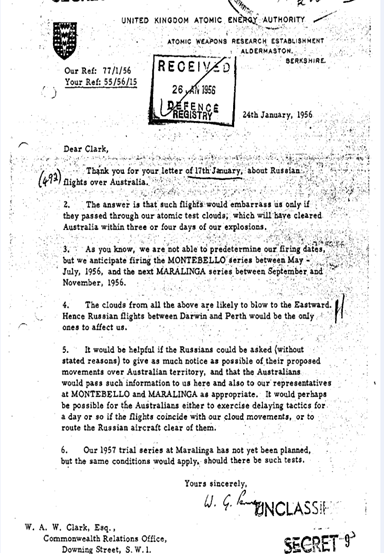
Scientific Director William Penney wrote to the UK Commonwealth Relations Office in January 1956 about Russian flights over Australia.
Warning ‘such flights would embarrass us only if they passed through our atomic test clouds, which will have cleared within three or four days of our explosions.’ Three or four days – not hours – in which radioactive fallout could contaminate vast stretches of the Australian hinterland. But not only the hinterland. Penney notes in advance of the detonations of Mosaic and Buffalo, ‘The clouds from above are likely to blow to the Eastward.’ Six full detonations took place in 1956 alone until a month before the opening of the 1956 Olympics downwind in Melbourne.
The release of the Merlin documents is the result of sustained pressure by the UK veterans’ organisation LABRATS over recent years. Their leadership have strong digital and media skills and is negotiating funding to download, store and analyse the documents in collaboration with a university legal clinic. The bulk of the documents relate to the Australian tests. Will Australian governments prefer to continue to forget the ‘unexamined’ documents in the National Archives of Australia?
Sue Rabbitt Roff studied and taught at Melbourne and Monash Universities. She researched and taught at Dundee University Medical School, offering modules on the health effects of UK nuclear tests. Her publications are collated at the The Rabbitt Review including presentations to AIIA Victoria in 2022 and a seminar series convened by the Chief Historian of the UK Foreign and Commonwealth Office in 2024.
This article is published under Creative Commons License and may be republished with attribution.