The latest Quad Foreign Ministers’ Meeting in New Delhi marks an important strategic moment for the Indo-Pacific. After months of uncertainty in India–U.S. relations triggered by tariff tensions, leadership-level friction, and the cancellation of last year’s Quad Leaders’ Summit, the grouping has returned with renewed purpose and practical ambition.
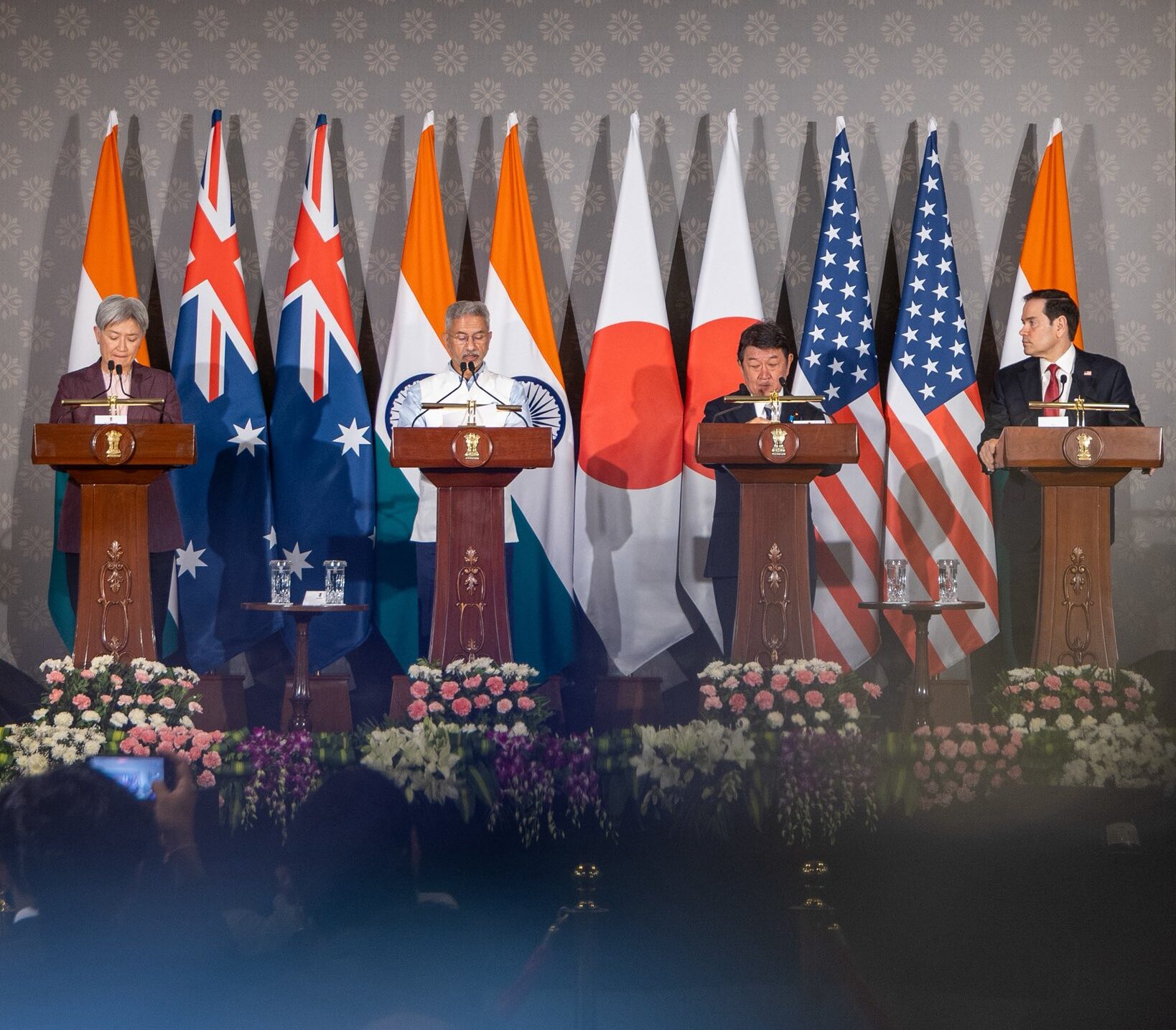
The presence of U.S. Secretary of State Marco Rubio in New Delhi alongside India’s Subrahmanyam Jaishankar, Australia’s Penny Wong, and Japan’s Toshimitsu Motegi demonstrated that despite tactical differences, the Quad remains central to the evolving balance of power in the Indo-Pacific.
Rubio’s separate meeting with Prime Minister Narendra Modi was especially significant. It reflected Washington’s attempt to stabilise and strategically reset ties with India after a period in which Trump-era trade policies had generated unease in New Delhi. Yet even during that diplomatic slowdown, the Quad never truly disappeared. The annual Malabar Exercise continued uninterrupted, maritime interoperability deepened, and defence coordination quietly expanded.
The New Delhi Quad meeting was intended to “inject fresh energy” into the group after concerns about its faltering momentum.
For Australia, this matters enormously. Canberra increasingly sees the Quad not merely as a diplomatic arrangement, but as a practical mechanism for sustaining a stable regional order amid intensifying geopolitical competition.
The Quad’s Shift from Dialogue to Delivery
The most striking feature of the New Delhi meeting was the Quad’s transition from strategic rhetoric to operational delivery.
Unlike earlier meetings dominated by broad political messaging, this gathering produced concrete initiatives across infrastructure, maritime security, energy resilience, supply chains, critical minerals, semiconductor cooperation, port development, and Indo-Pacific connectivity, underscoring a more action-oriented agenda.
This reflects a broader strategic evolution within the Quad. While the grouping has long promoted both security cooperation and economic resilience in response to China’s growing influence in the Indo-Pacific, its early focus was largely centred on maritime security and strategic coordination. In recent years, however, the Quad has increasingly broadened its agenda to encompass geoeconomic and technological resilience across the Indo-Pacific.
Australia’s Department of Foreign Affairs and Trade has consistently described the Quad as a partnership aimed at supporting a “peaceful, stable and prosperous Indo-Pacific”. What emerged in New Delhi suggests that the grouping is now operationalising that vision.
Importantly, the ministers avoided overtly confrontational language toward China. Yet references to coercion, maritime security, and supply chain resilience unmistakably reflected shared anxieties about Beijing’s expanding strategic influence.
Critical Minerals and Semiconductors: The New Strategic Frontier
Perhaps the most consequential outcome of the meeting was the launch of a new Quad framework on critical minerals and strategic supply chains.
The initiative seeks cooperation in mining, processing, recycling, and strategic investment coordination for rare earths and other essential minerals vital to semiconductors, electric vehicles, defence production, and emerging technologies.
This development is particularly important for Australia. As one of the world’s leading producers of lithium and rare earth resources, Australia sits at the centre of global efforts to diversify supply chains away from excessive dependence on China.
The Quad’s minerals initiative aligns closely with Australia’s broader strategic and economic priorities, particularly its emphasis on securing trusted supply chains, reducing dependence on China-dominated processing networks, and deepening cooperation on critical minerals and emerging technologies with India, Japan, and the United States. Canberra has consistently prioritised building resilient, transparent, and diversified supply chains as part of its wider Indo-Pacific economic security strategy.
The New Delhi meeting also underscored the growing strategic linkage between semiconductors, artificial intelligence, and national security. The Quad’s emerging technology agenda increasingly reflects recognition that future geopolitical competition will be shaped as much by technological ecosystems as by military capability.
Consistent with this broader agenda, India and the United States also signed a bilateral framework on critical minerals during Rubio’s visit, further reinforcing New Delhi’s expanding role in trusted manufacturing and advanced technology supply chains.
Ports, Connectivity and the Maritime Indo-Pacific
Another major breakthrough was the Quad’s decision to jointly support port infrastructure development in Fiji — the group’s first collective infrastructure project in the Pacific Islands.
The significance of this move extends well beyond infrastructure. Pacific Island nations have become increasingly important theatres of strategic competition between China and Western-aligned powers. By jointly investing in maritime infrastructure, the Quad is signalling that it intends to offer practical alternatives grounded in transparency, sustainability, and strategic trust.
The ministers also launched a new Indo-Pacific Maritime Surveillance Collaboration initiative aimed at integrating surveillance systems and enhancing real-time maritime data sharing.
For Australia, a maritime trading nation heavily dependent on open sea lanes, these initiatives are strategically vital. The Indo-Pacific’s future stability will increasingly depend on protecting maritime commerce, monitoring coercive activities, and securing critical chokepoints stretching from the Indian Ocean to the Pacific.
The meeting also reflected growing concern over regional instability following tensions in West Asia and threats to shipping routes around the Strait of Hormuz. Energy security and supply chain resilience therefore featured prominently in Quad discussions.
India’s Rising Strategic Centrality
The New Delhi meeting reaffirmed India’s central role within the Indo-Pacific strategic architecture.
India has steadily transformed from a cautious participant in the Quad into one of its principal strategic anchors. Under Modi and Jaishankar, New Delhi has managed to deepen security cooperation with the United States, Australia, and Japan while still maintaining its traditional emphasis on strategic autonomy.
That balancing act is particularly important for Australia. Canberra increasingly views India not only as a security partner, but also as a long-term economic, technological, and maritime partner capable of contributing to regional equilibrium.
The continuation of the Malabar naval exercises during periods of diplomatic turbulence demonstrated that the Quad’s operational foundations remained resilient even when summit-level politics became uncertain.
The Quad’s Second Phase
The New Delhi meeting suggests that the Quad is entering a second and more consequential phase.
Its future may not lie in dramatic summit declarations or formal alliance structures. In fact, the Quad seems to be increasingly deriving its strength from practical cooperation in areas that will shape the twenty-first century strategic order: semiconductors, critical minerals, maritime security, resilient supply chains, clean energy, and infrastructure connectivity.
For Australia, this evolution is welcome. It enables the Quad to move beyond perceptions of being merely an anti-China coalition and instead become a durable framework for regional stability and strategic resilience.
The broader message from New Delhi was unmistakable: despite periodic political drift, the India–U.S. strategic partnership has regained direction, and the Quad remains one of the Indo-Pacific’s most important mechanisms for shaping the regional balance of power in an increasingly uncertain world.
Dr Ashok Sharma is a Visiting Fellow at the University of New South Wales Canberra at the Australian Defence Force Academy and an Academic Fellow of the Australia-India Institute at the University of Melbourne.
This article is published under a Creative Commons license and may be republished with attribution.