Eighty years after its founding, the United Nations’ highest office has never been led by a woman. As calls for a Madame Secretary-General grow louder amidst heightened financial and political pressures, the next appointment will test whether the UN is committed to breaking glass ceilings or if women are still expected to lead only in times of crisis.
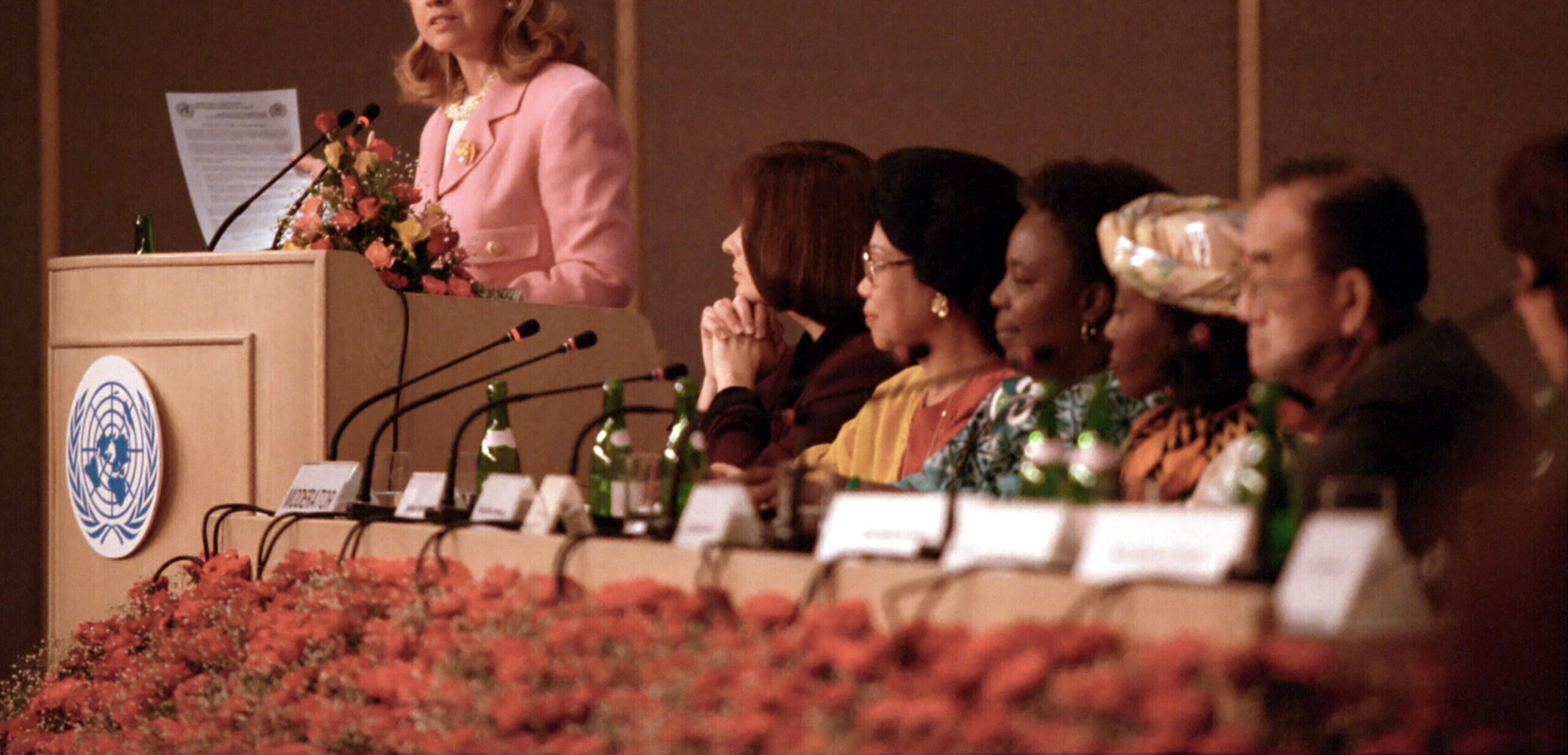
From the 9th until the 19th of March, The United Nations (UN) in New York City hosted the 70th session on the Commission on the Status of Women (CSW). In the UN’s eighty-year history, a woman has never served as Secretary General.
In her address on the final day of CSW 70, UN Women Executive Director, Sima Sami Bahous said, “all of us at UN Women and in this room, would be proud to open [CSW 71] with a Madame, Secretary General,” concluding a fortnight of growing voices who are similarly eager to see a woman in the top job for the time.
The UN is facing major restructuring amid ongoing funding cuts, with its power and influence increasingly in question. In this context, would the first Madame Secretary General be a win for gender equality, or another case of the glass cliff phenomenon that will be discussed later in the article?
CSW is not just another meeting, it is a test of political will, with the end goal being consensus among Member States on agreed conclusions to accelerate progress and promote women’s and girls’ rights as related to the key themes for that year. Traditionally, these agreements have been negotiated over the CSW fortnight, however, this year due to increasing fiscal pressure on the UN, much of the work was completed by government and civil society representatives in the weeks prior. On day one of CSW there was no consensus on adoption of the agreed conclusions by member states. This saw the agreed conclusions pass via a vote for the first time in 70 years, with only the USA voting against and a handful of other nations abstaining.
CSW consists of a 45-Member State commission elected to four-year terms. Australia is not currently on the commission but had an opportunity to address the other Member States via a national statement. Delivered by Padma Raman, Executive Director of the Office for Women, the national statement reaffirmed Australia’s commitment to the UN multilateral system, including CSW and the ‘Commission’s mandate to actively work towards achieving gender equality and the empowerment of all women and girls.
The priority theme for CSW 70 was access to justice. President of the United Nations General Assembly, Annalenna Berbock told the commission that ‘justice in practice will never be delivered without justice in power’. In the face of an increasingly organised pushback at gender equality and regression of women’s rights, justice in power refers to who holds it. With momentum building for the first Madame Secretary General, this would be an example of justice in power.
2026 marks the end of António Guterres’ time as Secretary General and at this point, five of the seven candidates for his succession are women, including:
- Michele Bachelet, former president of Chile
- Rebecca Grynspan, secretary-general of the UN Conference on Trade and Development
- Virginia Gamba, Argentine diplomat and former UN special representative for children and armed conflict
- Carolyn Rodrigues Birkett, former Minister of Foreign Affairs and International Cooperation of Guyana and;
- María Fernanda Espinosa Garcés, former President of the United Nations General Assembly.
First articulated in 2005 by Professor Michelle Ryan and Professor Alex Haslam, the ‘glass cliff’ describes a phenomenon where women, gender-diverse leaders, and other minority groups are disproportionately appointed to leadership positions during times of crisis. For example, when a company is struggling, a political storm is brewing, or a financial crash is unfolding – the new leader is set up to fail and left peering over the edge of the glass cliff.
As gender equality activists across the globe are forced into defensive postures to protect existing rights, and a proposal is under review to absorb UN Women into the UNFPA, the first Madame Secretary General would come into the top job at a time of great uncertainty. While this may be an affirmation of the glass cliff phenomenon, the way forward for women in the UN is more optimistic. While this type of backlash is not new, and when faced with escalating political constraints, women have long relied on the relative strength and reach of longstanding networks to respond.
Jahna Cedar, a Nyiyaparli woman from the Pilbara region of Western Australia, echoed this when she told a packed CSW side session, ‘when I walk into a space, I don’t come alone. I walk in with all those women who didn’t wait for a title to lead beside me’. Women should not stay quiet or hide from the public eye only until the timing is right. There is safety in solidarity and for the first woman Secretary-General to succeed in leadership, she must be surrounded by strong alliances and stable institutions. CSW 70 proved that women are determined to protect their rights and lead the way forward. If this event showed anything, it is that a woman is ready for the top job.
At the same CSW side session the Honourable Ruth Cross Kwansing of Kiribati said, ‘justice cannot be a shared journey if half our people are treated as guests at the table, rather than joint leaders’. A Global Women Leaders Voices campaign says in total, 81 countries have now endorsed the principle of electing a woman Secretary-General in 2026. There is also strong civil society and public support. The rest is now up to Member States to actively back qualified women and push for an open, inclusive process that reflects the UN gender equality agenda.
Australia is already campaigning for a non-permanent Security Council seat for 2029–2030, which gives us a direct stake in the conversation surrounding the next Secretary-General. Global solidarity matters, and this is the moment to make the case, loudly, for a Madame Secretary-General.
Hannah Fearnside is a lawyer with almost a decade of practice and policy experience in family violence and family law. She is a Master of Public Policy student and research affiliate at the Global Institute for Women’s Leadership. Hannah is a participant in the Women in Strategic Policy (WISP) program run by the Strategic and Defence Studies Centre at ANU and Girls Run the World. A professional ‘yapper and tapper’, Hannah sits on the board of Voices of Influence and is passionate about access to justice, intersectional feminism and gender equality. She was a 2026 delegate to the Commission on the Status of Women at the United Nations in New York City and Women Deliver in Melbourne with The Persephone Network.
This blog is part of a joint series between AIIA and WIIS-A, which aims to elevate the work of female and gender-diverse individuals in the field of international affairs.
This article is published under a Creative Commons License and may be republished with attribution.