Indonesia’s democracy is in a declining state. Day by day, it shows no signs of turning back to that of a state during the presidential terms of Habibie, Abdurrahman Wahid, or Susilo Bambang Yudhoyono.
A 2024 report by The Economic Intelligence Unit says Indonesia scored 6.44 on a 10-point scale, with 10 being the highest. This figure is lower than the previous year, making the country rank 59th among 167 countries, thus categorised as flawed democracy.
To make matters worse, the retrogression in democracy is also exacerbated by series of events; from the newly enactment of criminal code that restricts freedom of speech, the criminalisation of one of Indonesia’s stand-up comedians who criticised the government, the demise of civilians because of the violence committed by state’s apparatus, the arrest of pro-democracy activists, restricted freedom of speech under morality laws, to the conferral of the status of national hero to Indonesia’s authoritarian ruler, President Soeharto.
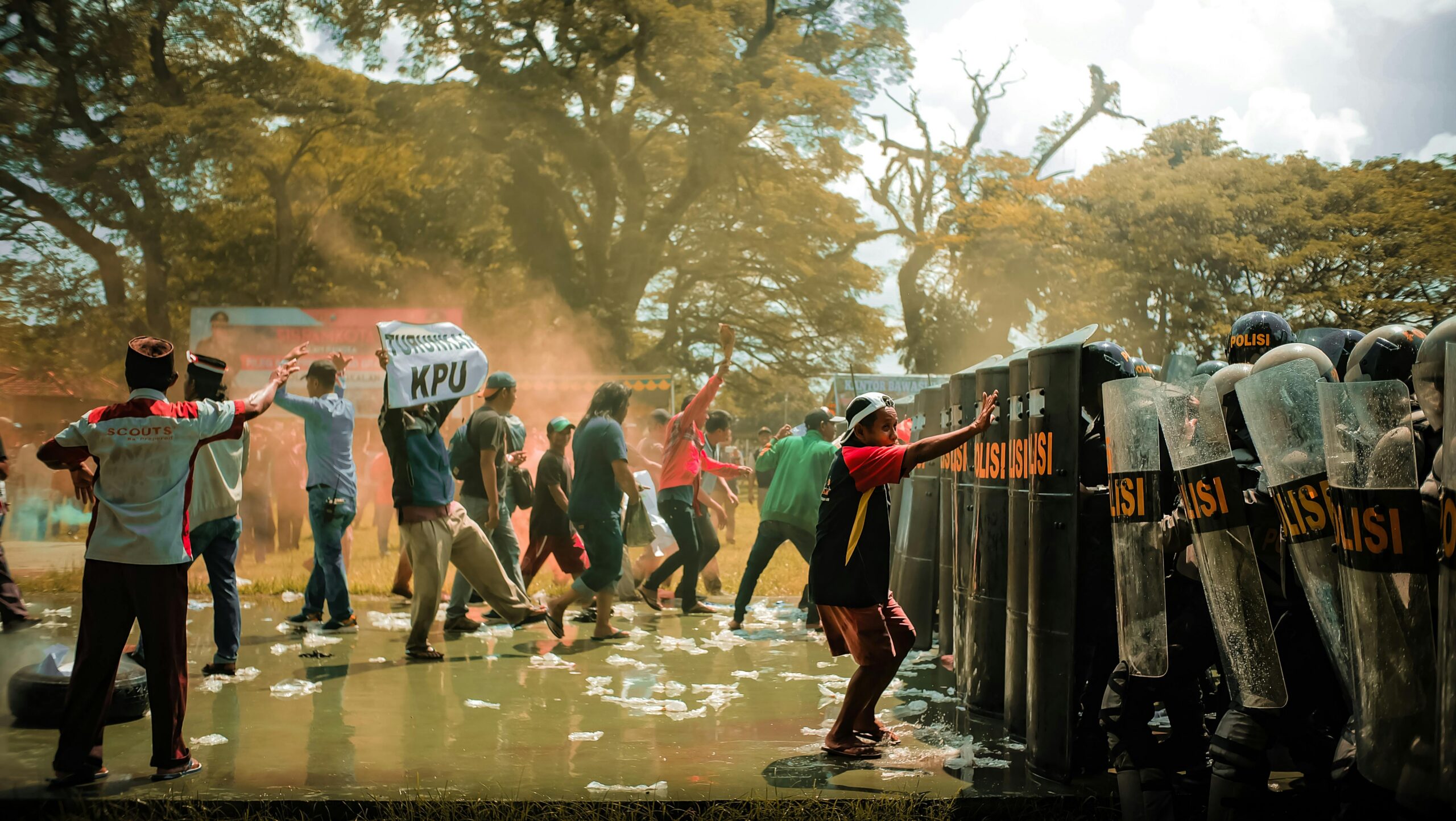
Having a democratic system means governing in ways to manage conflicts with institutionalisation and to diminish violence. Despite the diversity of views that exists amid society, differences must be managed—not banished with brutality—by the state. The Intensive use of aggressive barbarity by Indonesia’s state apparatus demonstrates how the domestic management of conflict is poor, thus showing how Indonesia’s democracy is sorely fragile.
Prabowo believes democracy is needed only if it is manifested with politeness, as he was confident of this type of democracy was the best fit for the country. In referring to this kind of paradigm, I may create a new neology of ‘democritarian’ – a portmanteau which is a sort of “[only] wanting to look (democ)ratic, yet in reality, the politics are exercised in an autho(ritarian) way”.
Inadequacy of Democracy
Although at first Prabowo praised the presidential election in 2024 as the evidence of democracy, and enjoyed an electoral victory through democratic mechanisms, democracy can only be functional if it is backed with a free and fair election alone(as the “butter and bread” of a nation state), as well as a successful process of institutionalising conflict in order to eradicate violence.
He falls short of this fundamental understanding. The worsening situation, such as the excessive use of violence by the state apparatus against ordinary civilians, reflects democratic backsliding where civil supremacy is neglected. This ignorance highlights the president’s limited grasp of what constitutes a functioning democracy—an essential foundation for sustainable economic growth. His background as a military officer partly explains his inability to fully appreciate democratic values. He has never received specialised training in civilian governance, nor an education emphasizing civil supremacy, human rights, and democratic principles.
Disappearance of Public Voice
Another pillar of democracy is meaningful public participation. Prabowo’s late father, Professor Sumitro, had exemplified the way to do politics as a social democrat. He once joined the Indonesian Socialist Party (PSI) with Sutan Sjahrir to realise his vision of a more inclusive macroeconomy as a path to democracy. He was accustomed to participating in parliamentary democracy to influence policy dialogue. It is evidenced by how he also became Indonesia’s minister of trade and industry under the premiership of Mohammad Natsir in the 1950s. Indeed, under a parliamentary democracy, every plan of strategic policy should be debated, communicated, and conveyed to the public because it is subject to parliament’s approval.
Paradoxically, President Prabowo often reiterated to the public that his economic policy was formulated mainly based on his father’s economic thought, even though it turns out to be the opposite and is more pragmatist-heavy than anchored on a solid ideological basis. It would appear Prabowo is fixated with realising his father’s dreams, though what he has done is not enough.
For instance, the establishment of a Sovereign Wealth Fund like Danantara – of which a huge national asset is at stake, public participation is nevertheless excluded from this decision from the outset, let alone public monitoring of its rollout. Such a decision does not comply with democratic principles of transparency, accountability, and public participation.
Unlike in Switzerland, for example, a decision about a Sovereign Wealth Fund is considered critical to the point of necessitating a national referendum before an action is takenupon it. This demonstrates how good governance is put in practice as a corollary of having a democratic system that seeks public legitimacy. In other words, the absence of good governance in such a case indicates that democracy becomes a buzzword rather than a guiding principle of the state.
What has been done to social inequality?
Prabowo often speaks about how democracy in Indonesia should be tailored in a way compatible with Pancasila (the country’s fundamental basis). Pancasila is the nation’s foundational philosophy and the basis of Indonesia’s legal system. In Indonesian politics, it functions as the normative compass—setting the values that guide the state, lawmaking, and political life. However, he seemingly stops here and takes no interest in fully realising it. While Pancasila is tied to social justice, his presidency has not adequately addressed the extreme socio-economic inequalities that have become a pressing challenge for the country.
Democracy, at this point, merely appears as a populist jargon and false hope. The Democratic system is more than just embellishing political rhetoric in an ameliorative way to outside observers while failing to implement institutionalisation on the inside. It is evident from the recent mass protest at the end of August that democracy is indeed in need of a total reset.
While the country was still in upheaval, Prabowo traveled to China. This only exacerbated the situation as it demonstrated that the president is devoid of empathy to his own people who were struggling in the midst of social unrest.
Moreover, during the same demonstration, Prabowo did little to pledge an improvement in democratic governance. His presidency failed to satisfactorily meet the demands of civil society. Instead, the public witnessed his administration‘s harsh crackdown on pro-democracy activists.
No Authoritarianism Survives Economic Crisis
The declining state of democracy leads to a worsening economy. Under a quasi-democracy regime or a Democritarian, industrialisation and innovation cannot thrive. This is due to the fact that, since civil supremacy is undermined, policymaking is not practised in a cooperative dialectical way. This is evident in the passage of a military bill that allows the military to occupy posts previously held by civilians. Thus, policy alternatives proposed by the public tend to not to be taken into consideration by public officials.
Democracy itself is irreversible. Once a country embraces democracy as its political path, it must deal with all of the “consequences” of democracy. I am trying to make a point that democracy is indeed irreversible; as it means that once democratic ideas take root, they permanently transform political expectations and legitimacy. Once people know that power can be limited and leaders can be replaced peacefully, alternative systems appear morally inferior and politically irrational and unacceptable. It is ludicrous to think that a nation can revert to an authoritarian style of governance once it has ushered in an era of democratisation.
Besides, authoritarianism always harms the economy for three reasons: it is uncritical and unaware of public suffering, neglects the aspirations of the people, and it cannot foresee imminent crises. The authoritarian regime is not interested in delivering social welfare. It is only concerned with the elites centrally managing national resources. Moreover, in populist politics—such as that demonstrated by President Prabowo—material wealth becomes concentrated in the hands of a small oligarchic circle.
Evidence suggests that no authoritarian state fares well in responding to crises. Such states often collapse due to their inability to navigate turbulent times and their reliance on the continuous use of force, as they are incapable of managing dissent and unprepared to be held accountable for their policies.
Febby R. Widjayanto is a faculty member and assistant professor at the Department of Politics, Faculty of Social and Political Sciences, Airlangga University in Indonesia. Her areas of research interest include political economy, development studies, and the politics of science and technology.
This article is published under a Creative Commons License and may be republished with attribution.