When Trump said he’d review America’s stance on the Falklands, he was not withdrawing recognition of British sovereignty, because the United States never extended it. But the ambiguity of his statements, over a position nobody had thought to question in 170 years, was precisely why they were enough to move a British defence budget in a day.
On 8 April 1982, in Downing Street, Margaret Thatcher pressed Ronald Reagan’s Secretary of State on why the White House kept describing itself as even-handed between Britain and the junta that had just seized British territory. US Secretary Alexander Haig gave her the answer that mattered: “We are not impartial.”
The formal American position was neutrality on who owned the Falkland Islands and had been since the mid-nineteenth century. What sat underneath it was the thing Britain actually banked; about 100 AIM-9L Sidewinder missiles at $48,600 each, KC-135 tankers freed up for the task force, ammunition, intelligence. Britain paid cash. The missiles were for sale. The certainty, however, was not.
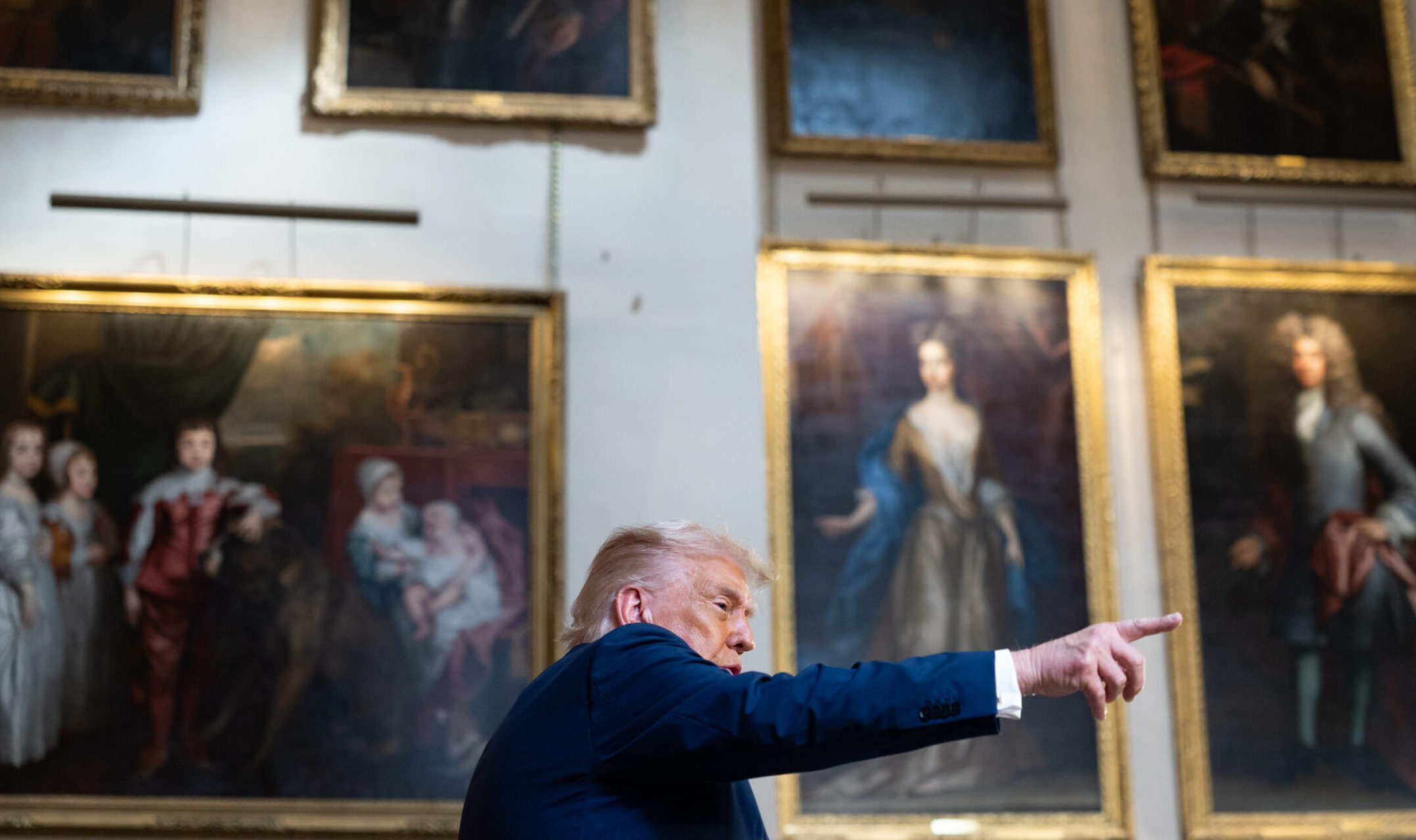
That is the distinction to hold on to when reading what happened in the Oval Office on 31 August. Asked whether Washington was reviewing its Falklands position, Trump said “I always review every position. That’s just one of many.” In the same exchange, asked about British defence budgets, he added that “The UK’s got some problems but they’ll get solved.” Four sentences, no policy, no announcement.
The obvious rebuttal arrived fast, and it is correct on its own terms. Morgan Murphy, former Press Secretary for US Department of War, put it plainly, “[w]e can’t ‘withdraw support’ for sovereignty of the Falklands that was never there.” A State Department spokesperson had already restated the line a few months prior in April, saying the government’s “position on the islands remains one of neutrality. We acknowledge that there are competing claims of sovereignty.” Nothing has changed on paper. Anyone claiming Trump revoked recognition of British sovereignty is describing a recognition the United States never extended.
Which is exactly why the remark works. The value of a 170-year-old formality is that nobody thinks to ask about it. Once a president says out loud that it sits in the review pile, alongside everything else, its stability becomes a variable someone has to price. Haig’s private assurance had force because the public neutrality was inert. Trump has animated the paperwork and left the assurance unspoken.
Watch what it bought, and how quickly.
On 28 August, three days before the Oval Office exchange, it was reported that the UK chancellor’s first Budget on 28 October would carry no commitment to 3 percent of GDP by 2030, deferring the question to a spending review with no date attached and leaving Britain on a path to roughly 2.7 percent. In July, Andy Burnham had waved the 2030 number away as a matter for “the Parliament after this one.” Britain spent about 2.3 percent of GDP on defence in 2024, against a NATO Hague pledge of 3.5 percent core spending plus 1.5 percent on wider security infrastructure by 2035.
On 1 September, one day after Trump spoke, John Healey told The Times he was “100 per cent” committed to 3 percent and floated a “refresh” of the special relationship, reciting the number of Britons employed by American firms as he went. This is a chancellor who resigned as defence secretary in June over the Treasury’s refusal to fund the department he ran, then took the Treasury and shelved his own target. Six days after shelving it, and forty-eight hours after an ambiguous sentence about a South Atlantic archipelago, he was back to 100 percent. Though Downing Street initially deferred setting a firm calendar date in the upcoming budget – pushing the timeline discussions toward the 2027 spending review – Healey’s insistence on a 2030 waypoint remains the baseline expectation for military planners, leaving his broader commitment to the 3 percent threshold ostensibly intact.
Downing Street, for its part, took until 2 September to respond at all, and did it through a spokesman rather than the Prime Minister. They stated that the islanders “have expressed their wish to remain a British overseas territory and our commitment to them is unwavering.” Unwavering British commitment was not the commitment in question.
There is precedent for the sequence. Keir Starmer’s government negotiated the transfer of the Chagos Archipelago to Mauritius while retaining Diego Garcia on a 99-year lease. On 20 January, Trump called it “an act of GREAT STUPIDITY”; on 18 February he wrote that “Leases are no good when it comes to Countries” and told Britain not to give the base away. Parliament let the enabling bill lapse, and the transfer remains paused. A sovereign British decision on British-administered territory did not survive a social media post.
The Falklands file carries more than symbolism now. Rockhopper and Navitas took final investment decision on the Sea Lion field in December 2025 – 319 million barrels of certified resources, peak output around 50,000 barrels a day, first oil targeted for the first half of 2028. In June, Argentina’s foreign ministry declared drilling in the disputed area unlawful under international and Argentine law and reserved the right to “fully exercise all available actions.” Three weeks later the UN decolonisation committee adopted by consensus another resolution urging both governments back to talks. None of that needed Trump. What his four sentences add is a financing question no lender had to ask in December, introducing a latent risk that could soon force credit committees to re-evaluate their exposure.
Javier Milei read the transaction immediately and described it in the vocabulary of a supplier, not a claimant. Earlier in August, he positioned his government as the region’s anchor, declaring that Washington “needs a reliable ally in the South Atlantic and we are one.” That strategic overture laid the groundwork for his subsequent reaction to Trump’s latest moves.” Argentina has spent six decades collecting UN resolutions on this. Milei is betting that being useful to one president is worth more than all of them.
He may be wrong about the payoff, but he is not wrong about the mechanism, and that is the part London has not answered. The islanders settled their own view in the 2013 referendum – 99.8 percent for remaining British, with a 92 percent turnout – and Britain’s legal position is undisturbed. What has moved is the price of American silence.
Two dates now sit nine days apart. Healey delivers his Budget on 28 October. Pete Hegseth is due four options on American force posture in Europe – troop numbers, basing, timelines, and costs – by 6 November. The Pentagon memo leaked in April, the one that floated the Falklands as leverage over allies and that Marco Rubio dismissed as a minor internal matter, was drafted for a system that thinks in exactly those terms.
In 1982 Britain paid for the missiles and secured American backing, even if that support was laced with Washington’s quiet pressure for a negotiated compromise. Today, however, the invoice has been reissued, and total strategic alignment is the primary line item.
Imran Khalid is a geostrategic analyst and a senior fellow at Foreign Policy In Focus (USA). As a prolific columnist on international affairs, his work has been featured regularly in publications across the world since 2001. Including The Atlantic, Newsweek, Nikkei Asia, MS NOW, The Hill, Blaze Media, The Diplomat, Brussels Morning, South China Morning Post, Japan Times, Mail & Guardian (South Africa), TAZ (Germany), Brussels Morning, the Jakarta Post and European Business Review, and World Financial Review.
This article is published under a Creative Commons License and may be republished with attribution.