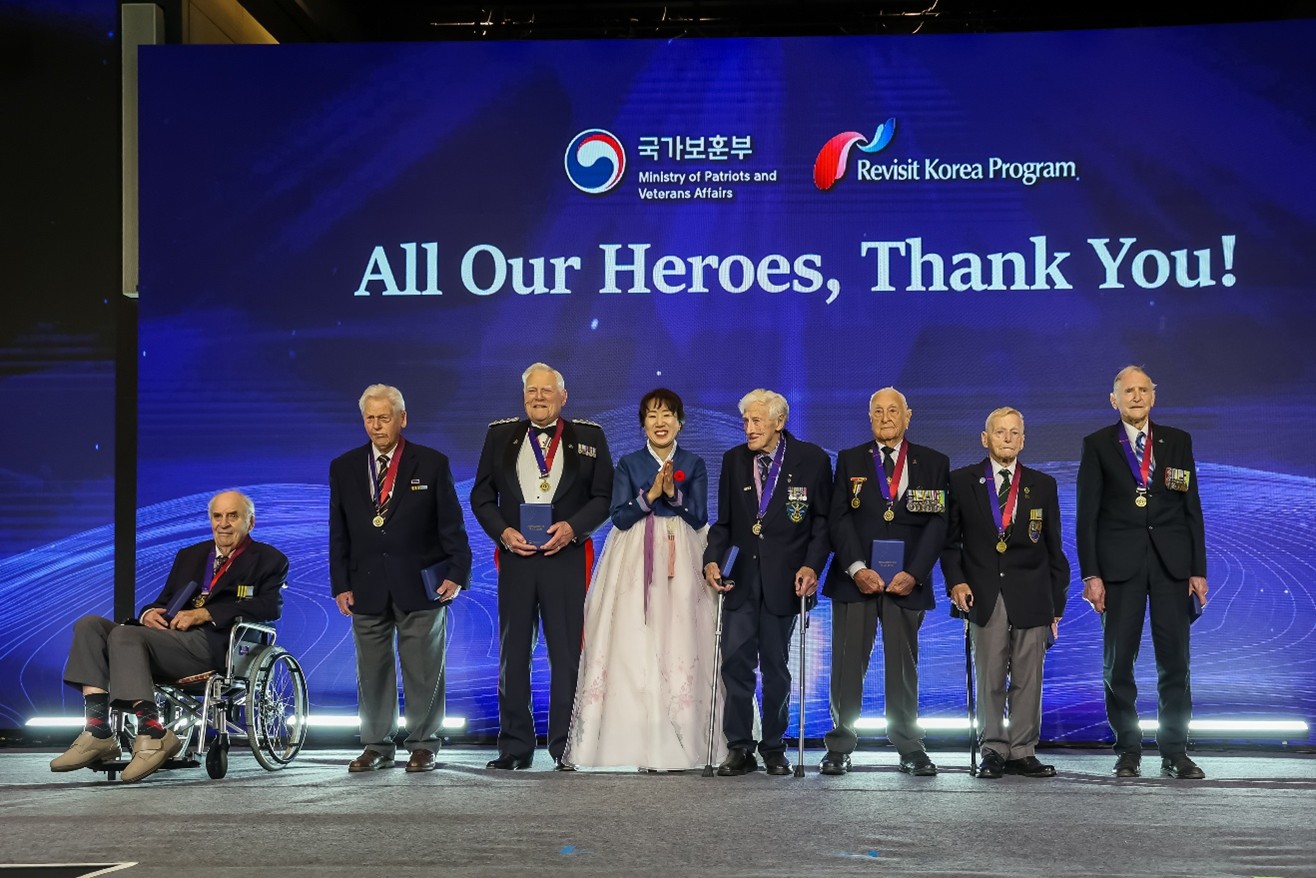
As the Korean War revisit program reaches the end of its natural life, South Korea and its UN allies need to once again reimagining the war’s legacy. Rather than sacrifice and gratitude, they are gravitating towards one centred on partnerships, friendship, and a commitment to liberal democratic values.
In late April 2026, a small group of veterans of the Korean War – from Australia, New Zealand, the United Kingdom, and Canada – took part in what is likely to be the last-ever round of ‘revisit’ programs.
The Korean government has organised these revisits since the 1970s, playing host to tens of thousands of veterans from the 25 countries which contributed to the United Nations forces which intervened on the side of South Korea in 1950. The revisits tend to coincide with significant battles featuring the UN forces, such as the one at Gapyeong (Kapyong), whose 75th anniversary was marked in April. The Commonwealth contingent played a crucial role in halting the Chinese ‘spring offensive’ of 1951 at Gapyeong. It proved to be a key turning point in the war: At a ceremony to commemorate the battle on April 24, Kim Mi Seong (Deputy Mayor of Gapyeong County) said ‘Korea exists thanks to the sacrifices of Commonwealth veterans. We will ensure that we never fail to honour and forever remember their dedication.’
For some veterans, such as Richard de Villeneuve Kidwell (94), an artillery officer who served with the British Army in Korea, the visit in 2026 was the first they had made since the end of the war. Colin Hallett (94)*, a sailor in the Royal New Zealand Navy during the war, said his first opportunity to set foot on Korean soil was memorable: ‘It’s been a terrific experience… I never expected anything like this, to be treated like this. I feel like royalty’. Raymond Rogers (97)*, a British Army veteran who later migrated to Australia, had visited Korea before, but said this visit would be ‘the last time for me, and I wanted to say goodbye to comrades that are no longer here’.
Despite the impending end to the revisits, connections remain between the Commonwealth veterans and Gapyeong. Since 1976, the veterans have pooled their pensions to provide scholarships to local middle and high schools, which are awarded during the annual commemoration ceremonies. And the name of the battle and the county lives on through two of the Commonwealth units which fought there: the 2nd Battalion, Princess Patricia’s Canadian Light Infantry, which named its barracks in Edmonton after Kapyong, and the 3rd Battalion, Royal Australian Regiment, which according to an Australian military officer serving in Korea*, ‘is battle group Kapyong… that’s their name when in a battle group’.
These interconnections between the veterans, Korea, and the UN ‘sending states’ vividly illustrate how nations can imaginatively ‘reuse’ the past for contemporary purposes. Benedict Anderson talks about nations as ‘imagined communities’, through which they can create and retell stories about themselves, including their positive contributions in world affairs, to generate a cohesive sense of self. These contributions, which can include military deployments such as the ones made by the Commonwealth countries to Korea, can become a ‘usable past’: a retrospectively reconstructed story about prior events which can serve useful purposes in the present.
In recent decades, countries like Australia have been able to depict their role in the Korean War in somewhat similar terms as the world wars. In 2022, for instance, then-Ambassador Catherine Raper said that the Australia’s relations with Korean were ‘rooted in the spirit of having fought in the Korean War and contributed to the defense of the Republic of Korea’. As in ‘good wars’ such as World War II, which unlike some conflicts are said to be justifiable on moral grounds, there are inspiring elements to the story about Australia’s contributions to the war in Korea, such as its participation in significant battles (such as at Gapyeong) and its cooperation and cohesion with its allies.
Perhaps most importantly, these contributions have come to be seen as worthwhile thanks to the emergence of South Korea as a prosperous democracy and a newfound multifaceted ally in recent decades. The contemporary version of the story is far more positive than it had been previously, when the ‘forgotten war’ narrative dominated and many veterans had felt (and some continue to feel) that their service was disrespected, and the mass human tragedy was ignored. The narrative about Korea is now also far more positive and uplifting than most of the other postwar overseas deployments, such as those to Vietnam and Afghanistan, which resulted in withdrawal and defeat for Australia and its allies.
Reimagining the Korean War
With the imminent end of the revisit program, efforts are underway to again reimagine relations between Korea and the UN sending states. Rather than the onus being on Korean ‘gratitude’ for Commonwealth ‘sacrifice’, a more equitable narrative is being instilled in narratives about contemporary bilateral relations.
For instance, in 2022, Ambassador Catherine Raper said that Korean popular music (K-pop), among other things, was a binding force for the two countries: ‘There are many K-pop stars of Australian heritage, such as Danielle from NewJeans. Because Australia is a multicultural society, people there tend to view Korean culture not as something foreign, but as an integral part of their own society’. Korea and Australia, she said, have become ‘exceptionally close allies and partners.’
During the 2026 visit, meanwhile, Kang Yun Jin*, Vice Minister of Patriots and Veterans Affairs, said Korea would ‘carry forward the bonds forged through sacrifice and solidarity’ and ‘continue solidifying the enduring friendships built in blood with the nations that stood with us during the Korean War’. Ron Green (97, Royal Australian Navy)*, who participated in that visit, said that he felt closely connected to Korea: ‘they’re in the defense industry, at home and where we live and around Geelong and in Melbourne… there are quite a few Korean communities and families there and they’re in with our association for church services and reunions and things like that’.
Australia and South Korea were drawn into a partnership of sorts during the war due to a common commitment to liberal democratic values, albeit loosely defined ones. Their commitment to these values has been evident in their engagement with regional and global institutions, even in trying times. The friendships forged during the war and beyond offer a valuable starting point for seeding a future-oriented partnership at a time when the commitment of others to the liberal order is in question.
* The author took part in the April 2026 Revisit Program as a guest of the Ministry of Culture, Sport and Tourism (MCST), and all interviews cited above were conducted during that visit.
David Hundt is an Associate Professor of International Relations at Deakin University. His research focuses on the International Relations of Asia and the Indo–Pacific, and especially in relation to Australia’s economic and security relations with South Korea, the two countries’ ties with China, and Korean multiculturalism and migration. He is a former Editor-in-Chief of Asian Studies Review, the journal of the Asian Studies Association of Australia, and he has recently served as both Vice-President and President of the Association.
This article is published under Creative Commons License and may be republished with attribution.