While Nepal, Pakistan, Bangladesh, and Sri Lanka have erupted in Gen Z-led uprisings that toppled governments, India’s youth are choosing ballots over barricades. The striking contrast reveals why electoral legitimacy, economic aspiration, and civic space matter more than perfect governance in keeping young people invested in democracy.
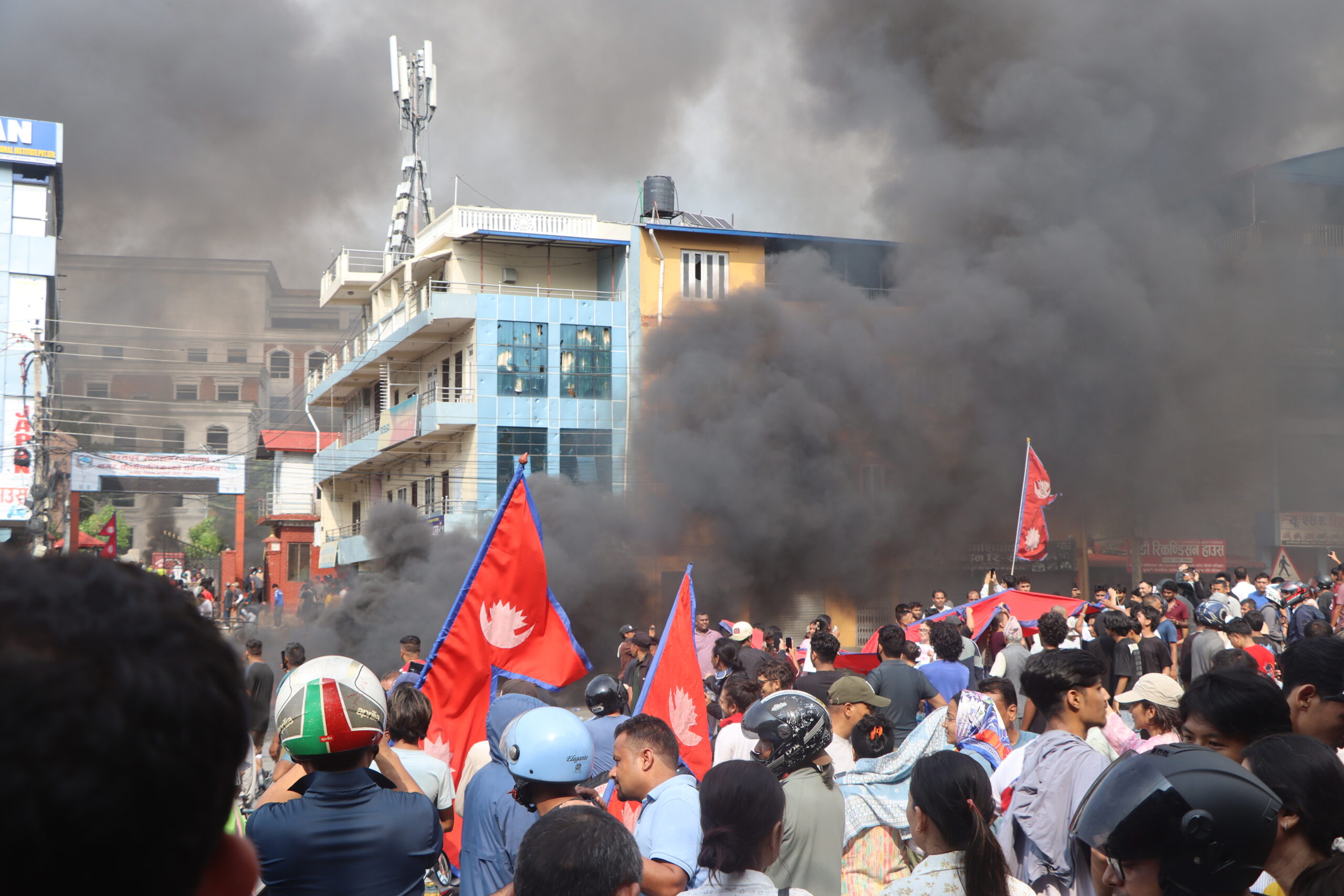
In a political development that underscores continuity rather than the turbulence unfolding across much of South Asia, the National Democratic Alliance (NDA) led by the Bharatiya Janata Party (BJP) in India has stormed the 2025 Bihar Assembly election, securing a commanding mandate that few pollsters anticipated. Across the border, however, the contrast could not be sharper. Just a couple of months earlier, in early September 2025, Nepal had erupted into its most intense political unrest in years after the then-government abruptly banned 26 major social media platforms under a new law requiring them to register locally or face shutdown. The ban sparked a youth-led revolt that escalated into nationwide violence, leaving 19 dead and forcing Prime Minister Oli to flee, turning Nepal’s long-disillusioned Gen Z toward direct confrontation with a distrusted ruling elite.
Nepal’s turmoil reflects a wider pattern across South Asia. Sri Lanka’s 2022 Aragalaya saw young protesters occupy government buildings and force President Gotabaya Rajapaksa to resign amid economic collapse. In Pakistan, the 2023 removal of Imran Khan sparked mass youth mobilisation against the military establishment; while Bangladesh’s student-led protests in 2024, fuelled by anger over authoritarian rule and censorship, ultimately compelled Prime Minister Sheikh Hasina to flee. Set against this wave of upheaval, India’s recent electoral cycle tells a markedly different story. The NDA’s return to power in the 2024 general election, followed by a string of state-level victories and now the emphatic sweep in Bihar, underscores a pattern of continuity and institutional stability. Even as sections of the opposition in the Bihar election campaign invoked Nepal’s example and urged Gen Z to mobilise similarly, Indian voters — especially the young — chose the ballot over the streets.
This contrast between youth-driven upheavals around India and the relative stability within its own borders prompts an intriguing inquiry: why has India, the foremost democracy in the region and a nation contending with numerous socioeconomic issues, remains comparatively shielded from such demonstrations? Although India has experienced significant mass mobilisations over the past decade, such as the demonstrations against the Citizenship Amendment Act from 2019 to 2020 and the farmers’ movement from 2020 to 2021, these movements were focused on specific issues and did not evolve into calls for an overthrow of regime by force.
One key reason for this divergence lies in India’s enduring electoral legitimacy. India’s elections continue to command substantial participation and perceived credibility. A recent India Today “Mood of the Nation” survey, conducted across 2,11,106 respondents, found that 64% of Indians believe elections are “free and fair”. For most young Indians, the ballot remains a meaningful tool for change. Gen Z voters, many of whom cast their first votes in the 2019 general election, have grown up within a functioning democratic system where government turnover is frequent at federal level, opposition voices persist, and political alternatives exist. This fosters a belief in incremental change through democratic means rather than extra-institutional upheaval.
Another important element is India’s broad and diverse political landscape, which offers several avenues for discontent. Unlike Pakistan’s and Bangladesh’s centralised power structures, India’s quasi-federal system and several regional parties provide young people with alternate means of political expression. Dissatisfaction with the union government often manifests itself in state-level politics, where voters might support regional leaders who question national narratives. This distribution of political power diminishes the prospect of widespread national rallies seeking regime change.
Moreover, India’s youth are deeply embedded in an aspirational economy, despite its challenges. While unemployment remains high and economic inequality is a growing concern, national optimism remains remarkably resilient: in the 2025 Ipsos What Worries the World survey, two in three Indians — 64% — said they believe the country is headed in the right direction, placing India fourth globally in optimism rankings. The expansion of the digital economy, a thriving start-up culture, and access to global platforms continue to foster a sense of agency among many Indian Gen Zs. Unlike neighbours battling shortages of food, fuel, or political stagnation, Indian youth are preoccupied with second-order challenges like tax rates, cleaner air, quality infrastructure, affordable housing, access to capital, and global opportunities. Their struggle is not for survival but for shaping prosperity, negotiating improvements within a functioning, if flawed, system.
The role of nationalism cannot be ignored either. In the last ten years, a nationalist political narrative has emerged in India, gaining support from a considerable portion of the youth population. This has resulted in a generation that is politically engaged, but more in alignment with state narratives than in opposition to them. Youth politics are increasingly characterised by economic progress, national security and cultural pride, leading to a diminished interest in radical regime change.
On the other hand, India’s civil society and media operate with a level of autonomy that surpasses all of its neighbouring countries, despite encountering occasional constraints. Gen Zs maintain access to relatively unrestricted digital environments, in which they participate, discuss, and critique. Dissent may face resistance; however, it is seldom suppressed. This serves as a mechanism for alleviating frustration, enabling the expression of grievances without escalating to full confrontation. Survey data reinforces this observation: a 2025 Pew Research Center study found that 74 per cent of Indians expressed satisfaction with the way democracy functions in the country, the second-highest level of satisfaction among 23 nations surveyed. Such high approval suggests that most Indians perceive their voices as having meaningful avenues of expression, whether through the ballot, independent media, or digital platforms. In contexts where civil society and media are tightly controlled, satisfaction with democracy tends to erode, as citizens feel silenced or excluded. India’s ranking, by contrast, indicates that despite periodic curbs, its civic and informational space remains sufficiently autonomous to sustain public trust. For Gen Z, in particular, the ability to critique authority online without fearing suppression underscores the resilience of this civil space, helping explain why democratic legitimacy in India appears stronger than in many peer societies.
Thus, in a region marked by democratic fragility, India’s political stability and absence of Gen Z-led regime change protests stand out as a counter-narrative. Far from turning their backs on institutions, young Indians remain invested in shaping it, critical yet patient, channelling their aspirations through ballots, innovation, and civic engagement. While challenges like unemployment and inequality persist, India’s resilient institutions, federal diversity, and vibrant political culture continue to anchor its youth within the democratic fold. Rather than seeking to upend the system, Gen Z is positioning itself to redefine and strengthen it, making India’s democratic experiment more enduring than its neighbours’.
For South Asia’s other democracies, the contrast with India highlights a simple but powerful lesson: young people remain constructive when they are given reasons to believe that change is possible. Electoral legitimacy, even if imperfect, creates faith that governments can be held accountable. Economic avenues, even if uneven, nurture optimism about the future. And civic spaces, even if contested, provide channels to voice frustration short of rebellion.
Nepal, Pakistan, Bangladesh, and Sri Lanka have all seen how quickly youth disillusionment can erupt into confrontation when these conditions collapse. India’s experience suggests that sustaining credibility, opportunity, and openness is enough to prevent anger from spilling into the streets. For the region, the message is clear: when youth feels that it has a stake in the system, it will push to reform rather than overthrow it.
Anubhav Shankar Goswami is a Doctoral Candidate of Politics and International Relations at the School of Humanities, Arts and Social Science, Murdoch University, Perth. His doctoral research is based on the field of nuclear strategy with a particular focus on nuclear brinkmanship. Anubhav is the author of the book, ‘Deterrence from Depth: SSBNs in India’s Nuclear Strategy’.
This article is published under a Creative Commons License and may be republished with attribution.