The recent success of Germany’s far-right party, Alternative für Deutschland, does not pose a direct challenge to Germany’s well-established institutions and alliances. It does, however, raise concerns over the gradual erosion of foreign policy consensus and the weakened priority of values-driven policy. With similar trends proliferating throughout Europe, this is a phenomenon that cannot be ignored.
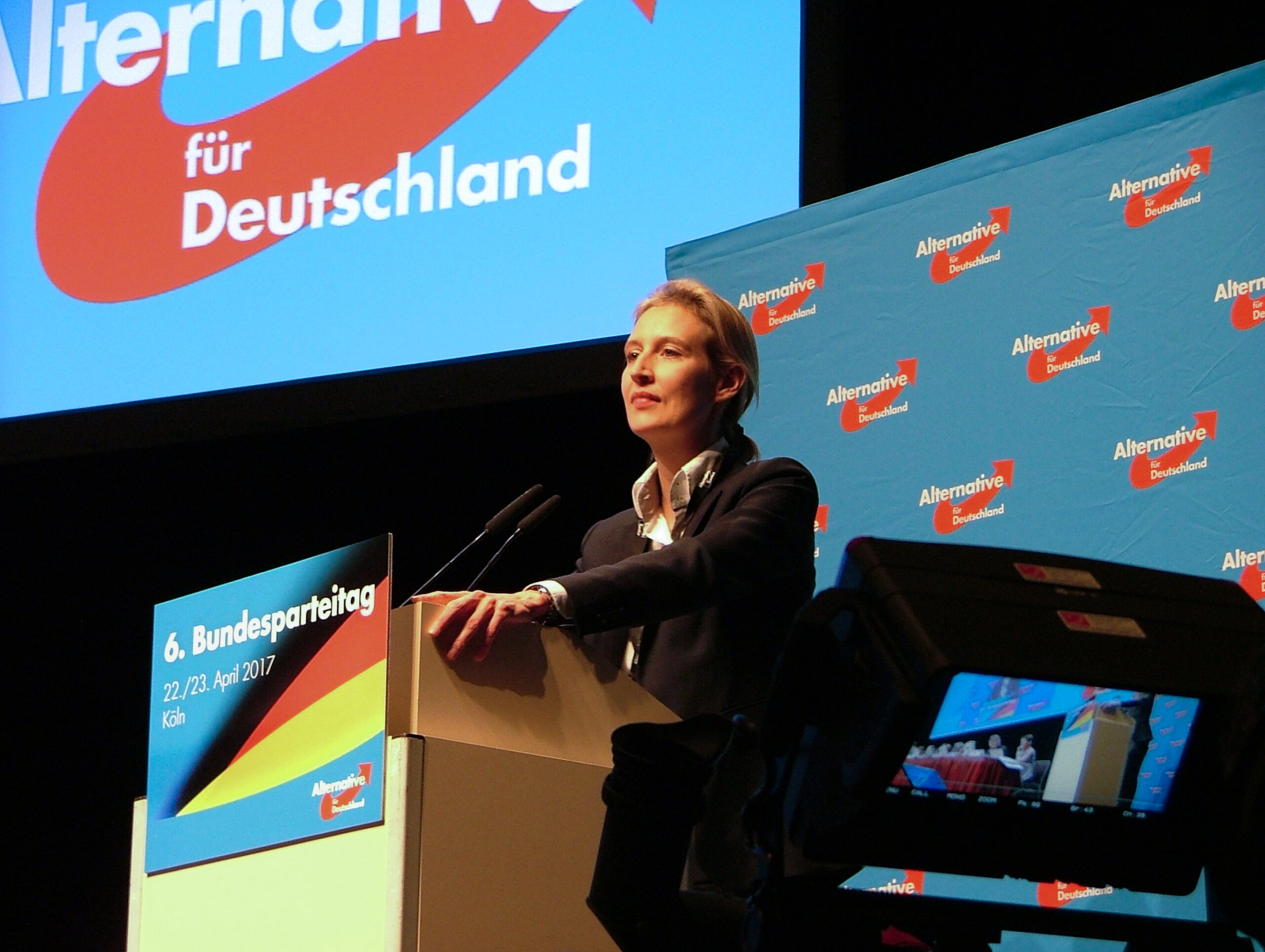
The prospect of right-wing populist parties assuming power in Europe’s core states is no longer a hypothetical scenario. That the Alternative für Deutschland (AfD) will eventually lead a government in one of Germany’s eastern states appears less a question of if than of when. In September 2026, Saxony-Anhalt and Mecklenburg-Western Pomerania will hold state elections, and in both cases the AfD is polling well ahead of all other parties – in Saxony-Anhalt it outpolls the next strongest party (the Christian Democrats) by 2:1, at over 40 percent.
These polls mirror the growing dissatisfaction in the German population at large with the perceived political output of the political centre. As voter shares of the parties of the political centre – the centre-right Christian Democrats, the centre-left Social Democrats, the left-wing Greens and the centre-right Liberal Democrats – keep diminishing, the result has been ever more complex and thus fragile coalition governments to keep the right-wing populists out. Usually, these coalition governments lack cohesion and a clear political vision – obscuring the differences between the political parties, reducing the effectiveness of policymaking, making structural reforms impossible, and creating an impression of “us vs. them”, irrespective of voter turnout or voter preferences. When the share of disgruntled voters reaches 40 percent or more, what started out as an output legitimation crisis morphs into a structural crisis that engulfs the legitimacy of the political system as a whole. Clearly, an AfD prime minister in one or two German states (out of a total of 16) will not break the national government. The constitutional order is not in danger. But this playbook – “a road to hell paved with good intentions” (Johann Jacob Rambach), as well-meaning actors of the political centre inadvertently help make the populists stronger by freezing them out of political power – is already playing out on the national level as well: Unsurprisingly, the Merz administration, itself complex and fragile, has not been able to “outgovern” the AfD. What makes the rise of the AfD an issue of international concern, especially for our allies around the world, is its important implications for foreign policy.
Not a Break in the System, But Not a Trajectory to Ignore
The rise of the AfD will not trigger a dramatic rupture with existing institutions, but it could gradually alter the assumptions and priorities that have guided German external relations since the end of the Second World War. At the core of post-war German foreign policy lies a broad consensus built around multilateralism, European integration, transatlantic cooperation, and support for a rules-based international order. Germany has traditionally sought security and influence not through unilateral action but through embedding itself in institutions such as the European Union, NATO, the United Nations, and the World Trade Organization. This “civilian power” approach reflects both historical experience and strategic calculation: as a middle power in the centre of Europe, Germany has generally benefited from stable institutions, open markets, and predictable international rules.
The AfD challenges important elements of this consensus. Firstly, although the party’s positions have evolved over time, it remains significantly more sceptical of European integration, supranational governance, and multilateral institutions than Germany’s mainstream parties. An AfD-led government, or even a coalition dependent on AfD support, would likely oppose further transfers of sovereignty to Brussels, resist deeper European defence integration, and question many initiatives aimed at strengthening the EU’s geopolitical role. Such positions could contribute to a renewed period of institutional paralysis within the Union, particularly if similar parties gain influence in other major member states such as France.
Secondly, while the party’s rhetoric has become somewhat more cautious since Russia’s full-scale invasion of Ukraine, significant parts of the AfD continue to advocate a rapid normalisation of relations with Moscow and oppose extensive military support for Kyiv. A German government influenced by such views could weaken Europe’s collective approach toward Russian aggression, undermine sanctions regimes, and create divisions within NATO and the EU. Given Germany’s central role in European diplomacy and economics, even modest policy shifts in Berlin would have consequences far beyond Germany itself.
Thirdly, the rise of the AfD could also affect Germany’s commitment to the liberal international order. Mainstream German foreign policy has traditionally linked national interests with the defence of human rights, international law, democracy promotion, and international development cooperation. The AfD generally places less emphasis on these objectives and instead prioritises sovereignty, border control, and narrowly defined national interests. This does not necessarily imply isolationism, but it would likely result in a more transactional and less value-driven foreign policy – similar in my view to Switzerland’s long-standing foreign policy posture that combines elements of “cooperative neutrality” with the maximisation of national economic interests .
This points to a contest between two visions of international order: Liberal-institutionalist internationalism, the dominant post-Cold War paradigm, the belief that security and prosperity are best achieved through cooperation, interdependence, and strong international institutions. The AfD represents national-conservative sovereigntism, a worldview that is less comfortable with supranational governance and globalist projects. Similar debates are taking place around the Rassemblement National in France, FPÖ in Austria, PVV in the Netherlands, Reform UK in Britain, or the Fratelli in Italy – as well as parts of the Republicans in America. Here, the fault line is not simply “pro-EU vs. anti-EU” or “internationalist vs. isolationist”, but between these two competing visions of international order.
A Less Geopolitical Europe?
So, the principal foreign-policy consequence of an AfD rise would not be a break with Germany’s alliances or institutions. Rather, a gradual transformation of priorities, threat perceptions, and strategic culture appear on the horizon – with corroding effects on the EU as well. Recent efforts in Brussels to become a more capable geopolitical actor depend heavily on consensus among its largest member states. If Germany were to become less supportive of these ambitions, the Union’s ability to act collectively would diminish. Enlargement toward Ukraine and the Western Balkans could stall, defence integration could slow, and common foreign policy positions could become harder to achieve. The EU’s strategic orientation could shift away from geopolitical ambition and normative statecraft and toward a more transactional model of cooperation focused primarily on economic interests. The EU would continue to exist, but the trajectory of European integration and Europe’s role in the world would change profoundly.
Germany could become a less reliable advocate of European integration, a less committed supporter of Ukraine, a more hesitant participant in collective security initiatives, and a less enthusiastic defender of the liberal international order. Taken together, these changes would reduce both Germany’s capacity and Europe’s capacity to respond to an increasingly fractured and unstable international environment.
Dr Christian E. Rieck is an Associate Professor of War Studies at the University of Potsdam and a Visiting Fellow at the Australian Institute of International Affairs in Canberra in 2025.
This article is published under a Creative Commons license and may be republished with attribution.