The elevation of bilateral ties between Japan and the Philippines positions Tokyo as Manila’s second-most important defence partner after Washington, anchoring the East Asian state in Manila’s maritime territorial row with Beijing.
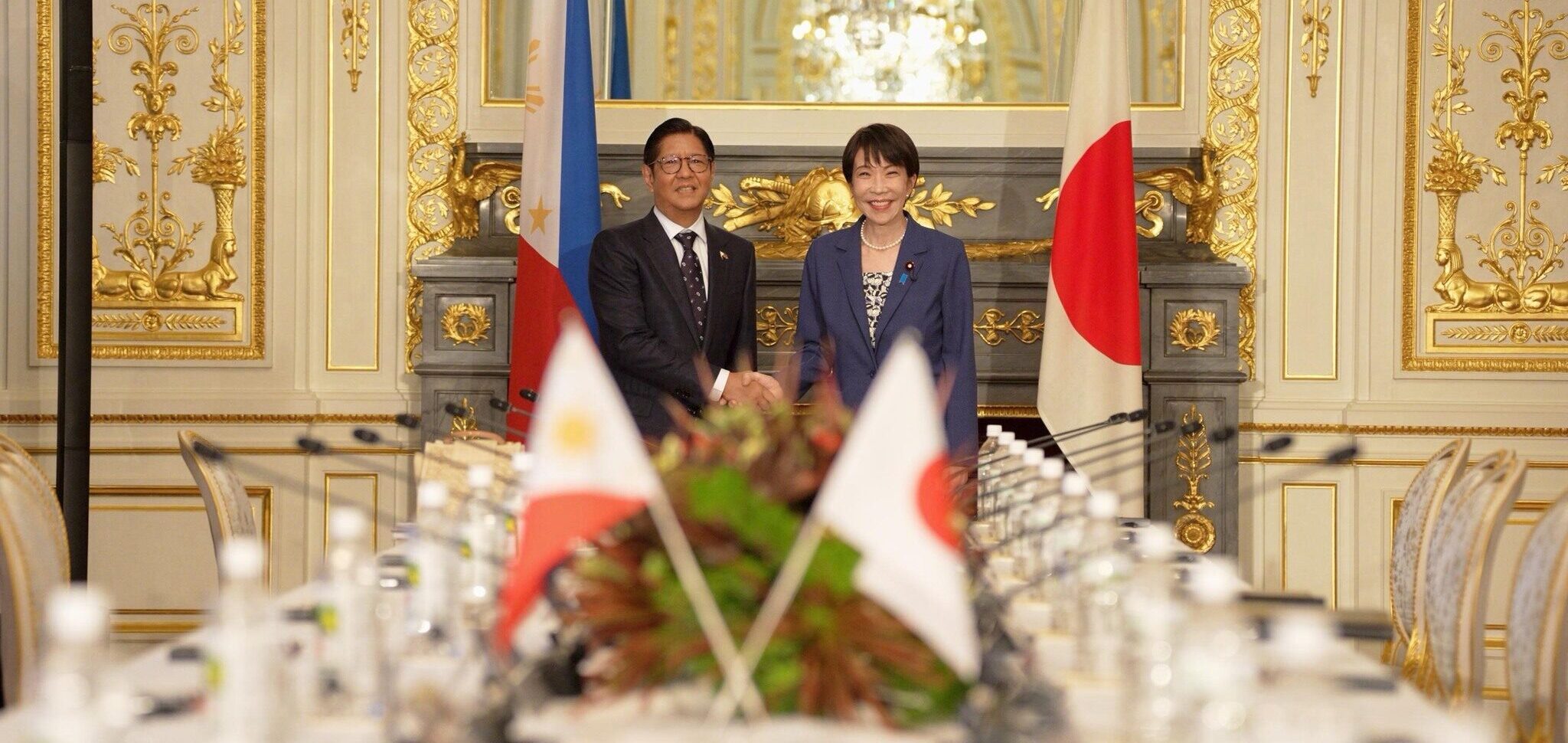
Following a meeting held in Tokyo on 28 May 2026, Philippine President Ferdinand Marcos Jr. and Japanese Prime Minister Takaichi Sanae announced the elevation of bilateral ties between Tokyo and Manila to a Comprehensive Strategic Partnership. Central to the joint statement published following the summit is the clear interest of both countries in strongly opposing ‘…any unilateral attempts to change the peacefully established status quo by force or coercion’ in the South and East China Sea – signalling increasing mutual concerns over China’s revisionism. The elevation of bilateral ties between the two countries positions Tokyo as Manila’s second-most important defence partner after Washington. Moreover, this development anchors the East Asian state in Manila’s maritime territorial row with Beijing and in the complex geopolitics of Southeast Asia.
Defence Assistance and Deepening Ties
The joint statement emphasises both countries’ intention to significantly enhance their security ties. The inclusion of security cooperation clauses in the 2011 strategic partnership framework has set forward Tokyo’s increasingly proactive engagement in assisting Manila’s capacity-building efforts in maritime and air defence. Japan has provided 12 Multi-Role Response Vessels to the Philippine Coast Guard, with five additional vessels scheduled for delivery in 2027, under the bilateral Maritime Safety Capability Improvement Project. Other defence-related transfers include the leasing of several TC-90 patrol aircraft and, more recently, the provision of advanced air and coastal radar systems. Discussions are underway to transfer several Abakuma-class destroyers to the Philippine Navy to improve Manila’s anti-submarine and anti-ship capabilities.
Japan and the Philippines have also made significant headway in developing security cooperation frameworks in recent years. On 11 September 2025, the Philippines-Japan Reciprocal Access Agreement (RAA) came into force. The agreement provides a streamlined legal framework for enhanced security cooperation and military access between the two countries. Mirroring Japan’s access agreements with the United Kingdom and Australia, the RAA provides Tokyo and Manila a direct channel for enhanced joint military training independent of the U.S.-sponsored Balikatan exercises. Recently, the two countries announced negotiations for a General Security of Military Information Agreement (GSOMIA), which would allow for the exchange of classified security information. If implemented, it will be the Philippines’ second bilateral intelligence exchange agreement, following the entry into force of its GSOMIA with the U.S. in 2024.
These developments epitomise the effectiveness of Japan’s Free and Open Indo-Pacific (FOIP) framework in engaging with neighbouring Southeast Asian states such as the Philippines. Officially announced in 2016 by then-Prime Minister Shinzo Abe, the FOIP encapsulates Japan’s strategic turn to counterbalance China’s growing influence in the Indo-Pacific. Despite nuanced changes introduced under successive administrations, the central tenet of the FOIP has remained consistent over the years – the promotion of a rules-based order and freedom of navigation.
Japan’s Southeast Asian Engagement
Japan’s consistent adherence to the FOIP provided a predictable framework for cooperation with Southeast Asian states, allowing for continuity and the gradual deepening of security ties. Although still incomparable to its security relations with other powers, such as Australia, the United Kingdom, India, and the U.S., Japan’s security engagement with Southeast Asia has consistently increased in recent years. Between 2014 and 2025, Japan has been actively engaged in 59 joint military exercises with Southeast Asian countries. Since 2023, Japan has also begun providing significant defence capacity-building support to its regional neighbours through its Official Security Assistance (OSA). Earlier this year, Prime Minister Takaichi’s cabinet announced the expansion of OSA and earmarked approximately USD 116 million for the 2026 fiscal year, with Laos, Cambodia, and Vietnam as priority recipients.
Despite these developments, Japan’s capacity to reshape the regional security balance remains significantly constrained. Firstly, the successful elevation of Philippine-Japanese security relations is not easily replicable with other Southeast Asian member states. The Philippines and Japan are part of Washington’s San Francisco System since the Cold War, and both maintain bilateral mutual defence treaties with the U.S. This shared legacy and decades-long comprehensive cooperation between the two Asian countries have laid the groundwork for the rapid maturation of deep security relations. These key factors are not necessarily present in other Southeast Asian countries, limiting Tokyo’s ability to develop deep security ties similar to its partnership with the Philippines.
Secondly, the divergent interests of ASEAN member states severely hinder Japan’s ability to deepen security engagement across the broader region. Despite obvious alignments between the FOIP and ASEAN’s 2019 Outlook on the Indo-Pacific (AOIP), member states are internally divided over key issues such as the South China Sea and have varying degrees of alignment with Beijing. Although Japan can continue to deepen its bilateral security relations with Southeast Asian countries, it must engage multilaterally with ASEAN in line with the latter’s centrality principle if it is to credibly position itself as a guarantor of a rules-based order.
The successful conclusion of the Japan-Philippine Comprehensive Strategic Partnership underscores the FOIP framework’s potential for deeper regional engagement. Whether Tokyo can replicate this success across other Southeast Asian states and significantly influence the regional security balance remains an open question.
Karl Ragas is an international strategic marketing consultant specialising in Southeast Asia and a graduate student in International Security and Development at Jagiellonian University in Kraków.
This article is published under a Creative Commons license and may be republished with attribution.