Recent climate change and urbanisation have increased the risk of more severe disasters. In particular, the Indo-Pacific is one of the most disaster-prone regions in the world, exposed to typhoons, floods, earthquakes and volcanic eruptions.
As a third-cohort fellow of the Indo-Pacific Cooperation Network (IPCN), which was organised by the Australian Institute of International Affairs and the Japan Foundation, I travelled to Fiji and New Zealand in June 2026 to learn about their disaster preparedness and response strategies. We visited government and regional agencies, local communities, and a humanitarian assistance and disaster relief camp. As a researcher and disaster medicine specialist based in Japan, I realised that Japan has something important to learn from its Pacific neighbours: treat disaster response capability not as a national asset, but as an asset shared across the region.
New Zealand: Diplomacy as the Front Door of Humanitarian Response
What struck me most in Wellington was the institutional arrangement that has no equivalent in Tokyo. The Ministry of Foreign Affairs and Trade (MFAT) of New Zealand formally serves as the lead agency for humanitarian response to disasters affecting its Pacific neighbours. Under the Officials Committee for Domestic and External Security Coordination (ODESC), when disaster strikes offshore, MFAT convenes and coordinates the nation’s assets to assist with disaster relief, drawing on the capabilities of New Zealand’s National Emergency Management Agency (NEMA), Fire and Emergency New Zealand (FENZ), the New Zealand Defence Force, the Ministry of Health (MoH) and the New Zealand Police. Moreover, under the FRANZ arrangement with Australia and France, the three partners coordinate their assets alongside affected communities to ensure disaster reponses are streamlined and as effective as possible. This example demonstrates that the designated assets and resources a country might have for its own disaster responses do not need to be kept solely for said country’s own emergencies; in fact, a country can share their own resources to support and strengthen relationships with its neighbours.
Fiji: Crisis Management with Regional Common Language and Asset
Humanitarian collaboration is common with neighbours in Fiji as well. At the National Disaster Management Office, Fiji’s incident management system had adopted PacIMS, the Pacific Incident Management System. Developed through the Pacific Community’s Pacific Islands Emergency Management Alliance (PIEMA), with funding from Australia’s Department of Foreign Affairs and Trade (DFAT) and New Zealand’s MFAT, PacIMS has become a common language not only across administrative levels within each country, but also among 14 Pacific nations.
Besides the common management system, Fiji and other Pacific countries also have a collaborative network named the Pacific Response Group (PRG). PRG, established under the South Pacific Defence Ministers’ Meeting in 2024, pools military personnel from Australia, Fiji, France, New Zealand, Papua New Guinea and Tonga into a standing unit that deploys on request to support civilian-led disaster responses.
These examples suggest that crisis management is built not within national silos but as a regional asset shared between neighbours.
Japan: the Architecture Needed to Share its Humanitarian Assets With the Indo-Pacific
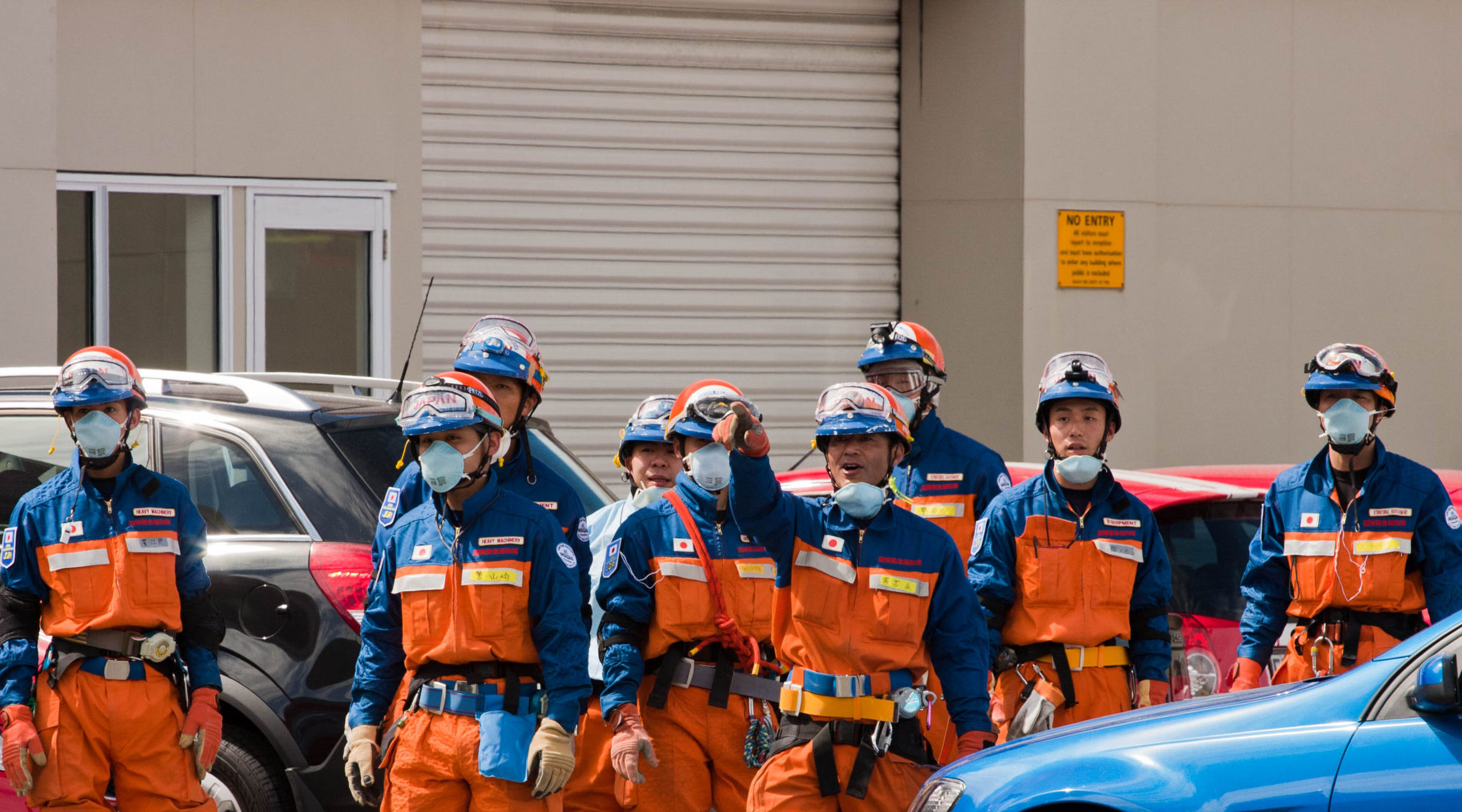
Japan has faced multiple earthquakes and other natural disasters, developing its humanitarian assets to deal with these crises. The Japan Disaster Relief Team (JDR), established under a 1987 law, has five components, search and rescue, medical, expert, infectious disease response, and Self-Defense Force units. The Minister for Foreign Affairs decides on and orders the dispatch, and JICA deploys the team. During the 2011 Christchurch earthquake in New Zealand, the JDR was dispatched and played an important role in search and rescue. Japan’s Disaster Medical Assistance Teams (DMAT), which belong to the Ministry of Health, Labour and Welfare (MHLW), is also an essential asset in Japan. DMAT has the capacity to mobilise in the acute phase of a disaster (within 48 hours), with more than 18,000 medical experts and logisticians are registered. The Self-Defense Forces are another asset that can be utilised for disaster response. For the 2011 Great East Japan Earthquake, they mobilised more than 100,000 personnel for search and rescue, transport, and lifeline restoration.
Yet these assets answer to different ministries and chains of command: JDR is under the Ministry of Foreign Affairs (MOFA) through JICA, DMAT belongs to the MHLW, and Self-Defense Force units are mobilised by the Ministry of Defense (MOD). Japan does not lack an outward-facing capacity, yet because these teams sit under separate chains of command, no single body coordinates how Japan mounts an offshore humanitarian response. What is missing is an architecture and command structure that binds multiple agencies into one coherent humanitarian response system for its neighbours, connected in peacetime to the region’s frameworks. This would enable stronger regional coordination to manage disasters in the Indo-Pacific.
Japan is now in the middle of a transformation of governmental structure for disaster risk management. Bosaicho (Disaster Management Agency — the official English name is still undecided) will be established in November 2026. This agency will sit directly under the Prime Minister with authority to direct other ministries. However, its mandate is limited domestically and the disasters in the region are out of scope. Japan can benefit significantly from directing these transformations through the lens of regional development and asset sharing.
From National Asset to Shared Regional Asset
At present, although Japan has unique disaster management capabilities and knowledge, it has no effective strategy for sharing its assets across the Indo-Pacific. Japan already possesses the experience, the people, and the equipment. What is needed is the perspective that treats these assets as contributions to Indo-Pacific resilience, not only as instruments of national self-protection.
To do so, an agency to lead and coordinate Japan’s humanitarian assets is essential, and this is not only a matter for policymakers. Practitioners should build peacetime relationships and shared procedures that make joint response possible. Researchers should generate evidence that can be applied not only domestically, but also in partner countries. Fellowship programs such as the IPCN play an important role in cultivating this mindset. Japan’s disaster expertise is too valuable to be used only within the country, and the Pacific has shown how to share it.
Dr Misa Tomono is a member of the 2026 Indo-Pacific Cooperation Network. She is a medical doctor and PhD candidate specialising in multi-sectoral preparedness and crisis coordination. With experience across disaster response, public health research, and international institutions, her work focuses on strengthening evidence-based, resilient systems for all-hazards emergency preparedness and response.
This article is published under a Creative Commons License and may be republished with attribution.