ASEAN’s renewed engagement with Myanmar may look like a pragmatic effort to revive dialogue, but it also exposes the limits of the bloc’s commitment to challenging member governments. The Myanmar crisis reveals how sovereignty and non-interference can constrain ASEAN’s ability to uphold its own democratic and human-rights commitments.
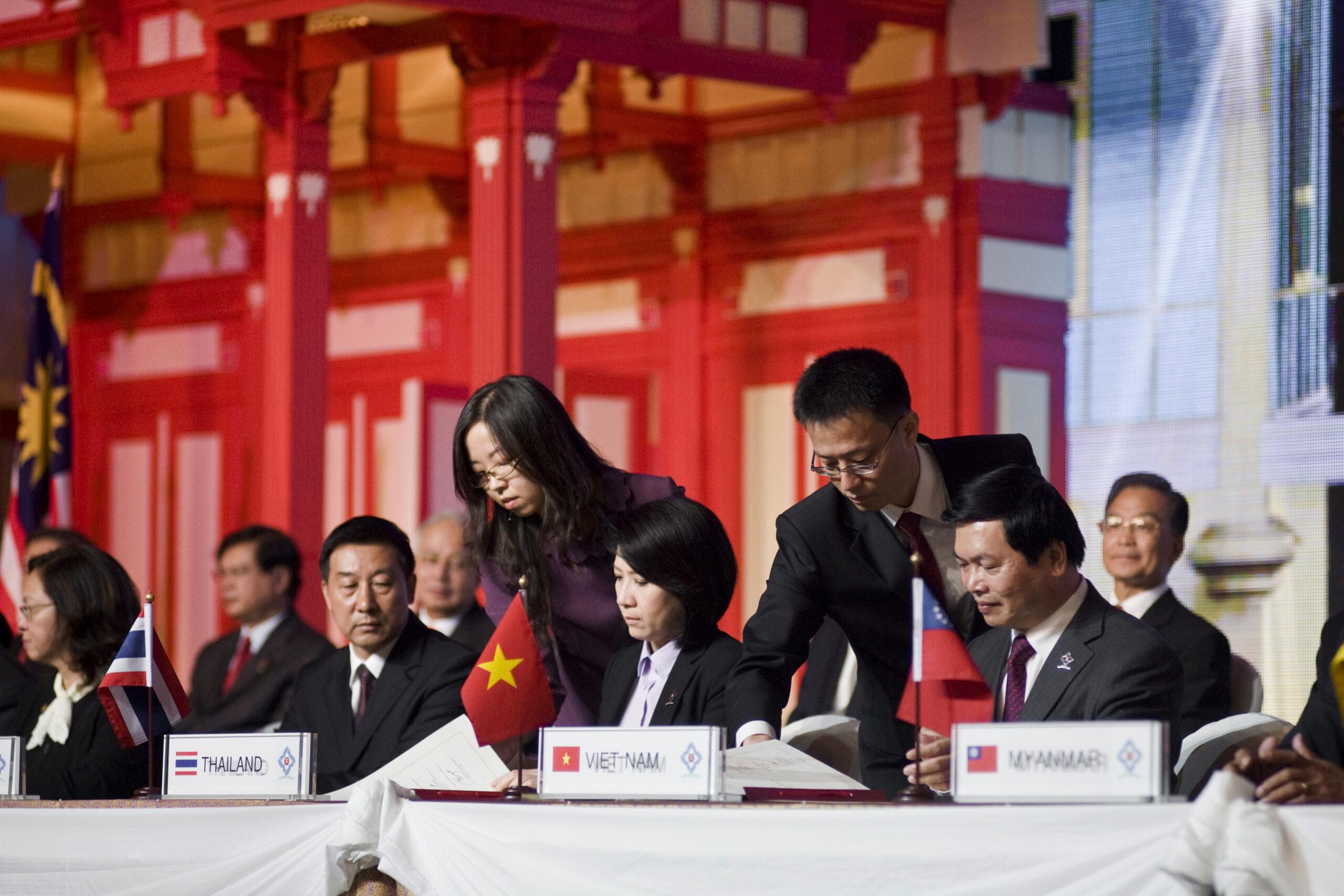
On 12 July 2026, ASEAN foreign ministers met Myanmar’s Foreign Minister in Bangkok. The meeting reopened a channel of communication that had remained severely restricted for several years. It was the first face-to-face meeting between the bloc’s foreign ministers and Myanmar’s top diplomat since ASEAN began keeping Myanmar’s military-backed authorities at political arm’s length following the February 2021 coup.
This renewed engagement does not mean, however, that relations with Myanmar have returned to normal. Myanmar’s political leaders remain excluded from ASEAN summits, and its political representatives have not resumed normal participation in the bloc’s high-level meetings. On 23 July, ASEAN’s special envoy said the return of Myanmar’s leaders to high-level meetings was still “far off”, with the organisation yet to see sufficient progress on the Five-Point Consensus.
Still, the Bangkok meeting raises an awkward question. Is it simply another attempt to break the deadlock in Myanmar, or does it expose ASEAN’s deeper instinct to protect the sovereign privileges of its member governments?
A Consensus Ignored
Since 2021, ASEAN’s response to Myanmar has relied on the Five-Point Consensus, or 5PC. The framework calls for an immediate end to violence, dialogue among all parties, the appointment of a special envoy, humanitarian assistance and access for the envoy to relevant stakeholders.
Five years later, its record is bleak. The Assistance Association for Political Prisoners has documented more than 8,100 deaths since the coup, and nearly 22,500 remain in detention. Meanwhile, UNHCR figures updated on 20 July 2026 recorded almost four million internally displaced people.
Myanmar’s military-backed government has not implemented the 5PC in the way ASEAN intended. In fact, the country’s pro-military-dominated parliament has gone a step further by passing a motion that rejected the consensus as interference in Myanmar’s domestic affairs.
ASEAN therefore finds itself reopening political contact with a government that has failed to carry out a regional agreement and objects to pressure aimed at securing compliance. This tension helps explain why the idea of a ‘sovereignty cartel’ might be useful for understanding the Myanmar crisis.
ASEAN as a Sovereignty Cartel
In The Sovereignty Cartel, J. Samuel Barkin argues that “sovereignty is built on state collusion—states work together to privilege sovereignty in global politics, because they benefit from sovereignty’s exclusivity”.
Barkin is not suggesting that governments are engaged in a secret conspiracy. The cartel is an analogy. States may compete over markets, territory and influence, but they also benefit from an international system that recognises them as the highest authorities within their own borders. Preserving that system is a shared interest.
ASEAN’s approach to Myanmar can be understood in these terms.
The ASEAN Charter affirms sovereignty and non-interference. At the same time, it also commits ASEAN to democracy, constitutional government, the rule of law and human rights. The crisis in Myanmar exposes a tension between these commitments. Protecting democracy and citizens’ rights would require committing to stronger pressure on a government that emerged from a coup and remains heavily influenced by the military. Stronger pressure, however, would also require ASEAN to scrutinise the domestic legitimacy and conduct of one of its members.
In practice, ASEAN has usually been more comfortable limiting a member government’s participation than questioning its authority. Its 2025 review of the 5PC, for example, reaffirmed that Myanmar remained “an integral part of ASEAN” while continuing its policy of non-political representation at ASEAN summits and foreign ministers’ meetings. The bloc has criticised Myanmar’s authorities, condemned violence and called for inclusive dialogue. But it has not attached consequences strong enough to change the government’s behaviour, nor has it seriously challenged the government’s claim to represent Myanmar.
Respect for sovereignty is not unique to ASEAN. Many regional and international organisations include sovereignty and non-interference among their founding principles. In ASEAN, however, these norms occupy an unusually prominent place. Consensus-based decision-making, informal diplomacy and a reluctance to confront members publicly give them additional weight. Together, these practices are commonly described as the “ASEAN Way”.
There are good historical reasons for this arrangement. It allowed Southeast Asian governments with different political systems and security concerns to cooperate without fearing constant interference from their neighbours. It also contributed to ASEAN’s survival for almost six decades.
Myanmar shows the price of that stability. A principle intended to make governments feel secure can restrict collective action when a government itself becomes the source of insecurity. The more ASEAN treats pressure as a threat to sovereignty, the harder it becomes to place the protection of citizens above the protection of the authorities governing them.
Non-interference then starts to function like political insurance. Member governments limit ASEAN’s ability to examine their domestic conduct and can expect similar restraint if their own legitimacy is questioned. The problem is not an absence of democratic or human-rights language in ASEAN documents. The main problem is the lack of an institutional mechanism for deciding when those commitments should outweigh deference to the government in power.
Beyond the Cartel
The African Union (AU) provides a useful comparison. The AU also recognises sovereignty and non-interference, but it sets clearer limits on both. Article 4(h) of the African Union’s Constitutive Act allows intervention in grave circumstances, including war crimes, genocide and crimes against humanity. Article 30 also permits governments that come to power through unconstitutional means to be excluded from the Union’s activities.
Of course, these provisions have not been applied consistently. The AU has suspended a number of states following military coups, but its responses have varied across cases, including in Niger and Chad. Nor have these measures enabled the AU to resolve every coup or episode of political violence, with several post-coup governments remaining in power despite suspension and continued engagement. Their value lies in establishing a normative boundary. Sovereignty does not automatically protect a government that seizes power unconstitutionally or commits grave violence against its population.
ASEAN has no equivalent threshold. When the principles in its Charter come into conflict, sovereignty and non-interference tend to carry greater institutional weight. Creating clearer exceptions would not magically end Myanmar’s conflict. However, they could give ASEAN a basis for restricting participation, imposing political consequences or taking collective action in the most serious cases.
The Bangkok meeting may have been a pragmatic attempt to restore dialogue. ASEAN governments differ sharply in their attitudes towards Myanmar’s military-backed authorities. Yet they share an interest in limiting ASEAN’s authority to judge the legitimacy of governments within its member states. That is what makes Barkin’s cartel analogy so relevant.
Unless ASEAN identifies circumstances in which non-interference may be set aside, the 5PC will remain a set of demands without meaningful consequences. Non-interference has a legitimate place in regional diplomacy. But if Myanmar’s crisis continues while the region’s principal organisation watches from the sidelines, “sovereignty cartel” will no longer sound like a provocative metaphor. It will describe ASEAN’s operating logic.
Early Nalvi Hoata Sahureka (Early NHS) is a lecturer in International Relations at Universitas Pembangunan Nasional “Veteran” Jakarta, Indonesia. His research and writing focus on global politics, public diplomacy, popular culture and world politics, and paradiplomacy.
This article is published under a Creative Commons License and may be republished with attribution.