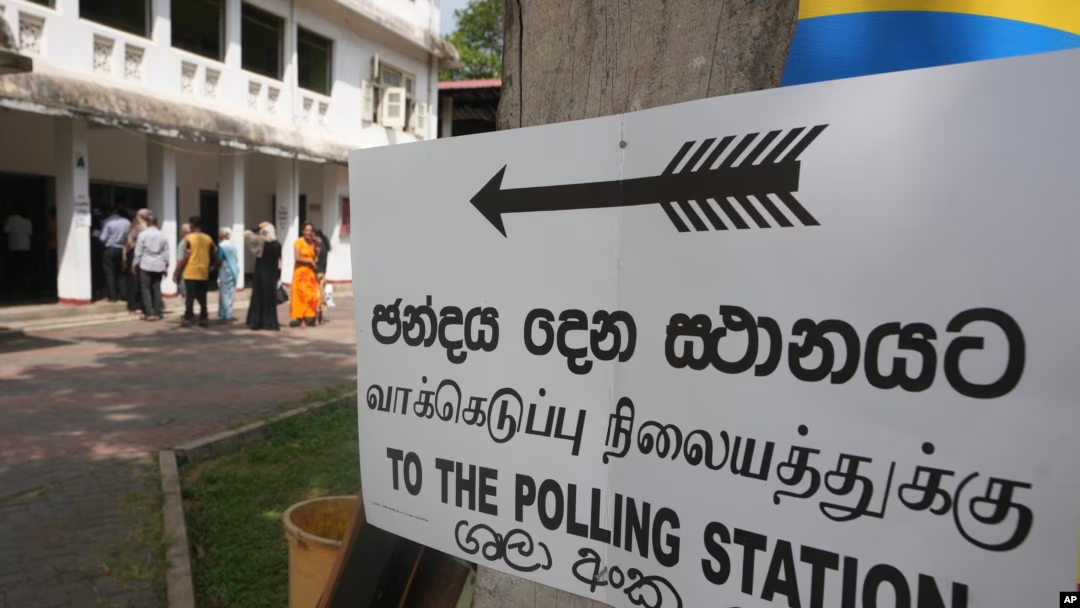
Following economic catastrophe and political turmoil, the 22-million nation astonished the world with a peaceful and democratic transition of power. Yet, amid US tariffs and a devastating cyclone, a road to full recovery seems complicated.
The year 2022 was likely the most dramatic in Sri Lanka’s history since the end of its nearly 26-year civil war in 2009. A popular tourist destination and the source of the world’s renowned Ceylon tea, the island-nation found itself on the brink of bankruptcy.
After years of political mismanagement and with its foreign currency reserves depleted, the state could no longer pay for imported goods. As a result, medicines disappeared from pharmacies, and residents queued for days to buy fuel. In the cities, people had nothing to cook with as gas cylinders — essential in urban kitchens — were nowhere to be found. All this came just after the turmoil of the COVID-19 pandemic, which had devastated Sri Lanka’s economy due to the collapse of tourism. Moreover, thousands of Sri Lankan workers in the Middle East — who used to send money back home — lost their jobs and could no longer support their families.
Frustrated by economic mismanagement and widespread corruption, islanders launched the Aragalaya (“Struggle”) protest movement. Their main slogan was “Gota Go Home,” which captured their demand that President Gotabaya Rajapaksa should resign. Under pressure, he finally stepped down and, according to a public secret, hid for a time on a small island under the protection of the Sri Lankan Navy.
In 2024, after two years of interim leadership, Sri Lankan voters elected “AKD,” the widely used acronym for Anura Kumara Dissanayake. In the previous presidential election, he had received barely 3% of the vote.
Two months later, in November 2024, the coalition led by his party — the JVP (Janatha Vimukthi Peramuna, People’s Liberation Front) — secured an impressive two-thirds majority in the parliamentary elections.
What does Sri Lanka look like today, one year after those dramatic yet transformative events?
From Zero to Hero
In the world of Sri Lankan politics — long dominated by powerful political dynasties — President Anura Kumara Dissanayake stands out as someone from outside the old establishment.
Following his victory, global media — from CNN to the New York Times — labelled him a “Marxist” or at least “Marxist-leaning.” Observing his current leadership and policies, however, these terms do not seem to be aptly representative of him or his party.
Indeed, the JVP does have socialist roots. Members still address each other as sahodaraya — “comrade.” Today, however, this “socialism” bears little resemblance to that of the former Soviet Union or the Eastern European version of the last century.
The JVP was born as a Marxist-Leninist party whose goal was to lead a revolutionary movement to establish a socialist state. The first attempt came in 1971; later, the JVP raised an insurrection in 1987 against the government. As a consequence, members experienced a wave of repression by state authorities, known as Bheeshanaya — “the terror.” It was recently depicted hauntingly in the Booker Prize–winning novel by Shehan Karunatilaka.
The very year the insurrection started, 19-year-old AKD joined the JVP, encouraged by his cousin. Soon, however, he fled the university where he studied and went into hiding. His cousin was less fortunate — he was captured and killed.
But that was almost 40 years ago. Over time, the JVP abandoned its armed, revolutionary ideas in favour of pursuing more moderate goals through peaceful — and, crucially, fully democratic — means.
Idealistic Socialism or Hard Pragmatism?
Using the logic of the American Republican Party — according to which universal access to free education and healthcare is “socialism” — then yes, in that sense, the JVP may be called a “socialist” party. In reality, its ideas of social justice and equitable distribution resemble those found in Canada or the Scandinavian countries.
At the heart of the party’s worldview lies the belief that social conflicts stem from material inequalities — not from ethnic or religious divides. In a country torn by civil war and recurring ethno-religious tensions, this is a profoundly transformative stance.
This is why the 2024 election results were so remarkable: AKD and the JVP-led coalition won support not only from Sinhala Buddhists — the majority — but also from Tamils, Muslims, and Christians, who are predominantly Catholic. The shared priority was clear: to rebuild the country after the economic collapse and years of divisive politics.
During my most recent visit to Sri Lanka, I asked people from very different backgrounds — civil servants, diplomats, hotel staff, restaurant workers — what they thought of the president one year into his term. Most, even the sceptics, agreed on one thing: his government has taken a serious, effective stand against corruption.
This may be connected to who entered the parliament. In the November 2024 parliamentary elections, the JVP fielded an entirely new team of candidates: people with no political background but a deep desire to rebuild their motherland — doctors, professors, engineers, teachers, and grassroots activists.
Of course, not everything went smoothly at the beginning. For example, the first speaker of the new parliament proudly claimed to have a doctorate from the prestigious Waseda University in Japan. When his educational background was questioned — with no diploma or any other proof to be found — public outrage forced him to resign. The new speaker is a practising medical doctor who specialises in treating rural patients in the Polonnaruwa district.
Between US Tariffs and National Debt
Bringing the island-nation back on track has been a highly challenging task. The most pressing matter was to begin repaying foreign debt under IMF conditions — a painful experience for ordinary Sri Lankans.
Still, the government managed to stabilise the economy. The country has so far secured 5% GDP growth and a record-high number of tourists.
However, this fragile recovery — or the pathway to “National Renaissance” — is now jeopardised by new external factors, including tariffs imposed by the US administration. Sri Lanka knows it cannot hope for zero tariffs; the realistic goal is to secure rates equal to those of competitors exporting similar goods (such as textiles) to the United States.
In the emerging norm of transactionalism in international politics, Sri Lanka’s main bargaining chip is its strategic location. The island is the key to controlling the Indian Ocean. With its own domestic struggles, it is indeed a challenge for Sri Lanka to balance relations with the three major powers — China, India, and the United States — without sacrificing its sovereignty or strategic assets.
Moreover, the new administration must address controversial decisions made by previous governments — such as leasing the Hambantota port to a Chinese company for 99 years or building the Mattala airport, which is infamously dubbed “the world’s emptiest airport.”
An Unexpected Blow — But Not a Defeat
In addition to all these challenges, the most unexpected — and most tangibly felt by the islanders so far — was the devastating Ditwah cyclone in late November and early December of 2025. With over 600 casualties, two million people affected, and an estimated recovery cost of US$ 7 billion, it was the most tragic natural disaster to strike the island since the 2004 tsunami.
As there is never a good time for natural disasters, this was perhaps the worst imaginable moment for Sri Lanka and its slow yet stable recovery after the de facto bankruptcy in 2022. The consequences of the damage to tea plantations, rice crops, and critical infrastructure will be felt for years to come, despite foreign aid (including assistance from Australia, China, India, Japan, and the United States) and emergency financial support from the IMF.
To ensure the effective and transparent management of the recovery process, the Sri Lankan government has established the “Rebuilding Sri Lanka” Fund — which welcomes both domestic and foreign donations — under a committee chaired by Dr Anil Jayantha Fernando, Minister of Labor and Deputy Minister of Finance and Planning. The committee comprises representatives from both the public and private sectors, reflecting a joint national effort to rebuild homes, reopen schools, and assist those who lost everything in the floods and landslides.
With over three years until the next presidential election, President AKD’s government faces a challenging road ahead. For a national renaissance, Sri Lanka now needs time, patience, and expertise more than anything else.
Dr Antonina Luszczykiewicz-Mendis is a visiting scholar at Oxford University in the United Kingdom and a former Fulbright senior scholar at Indiana University in the United States. She teaches at the Jagiellonian University in Krakow, Poland. You can find more of her work here.
This article is published under a Creative Commons License and may be republished with attribution.