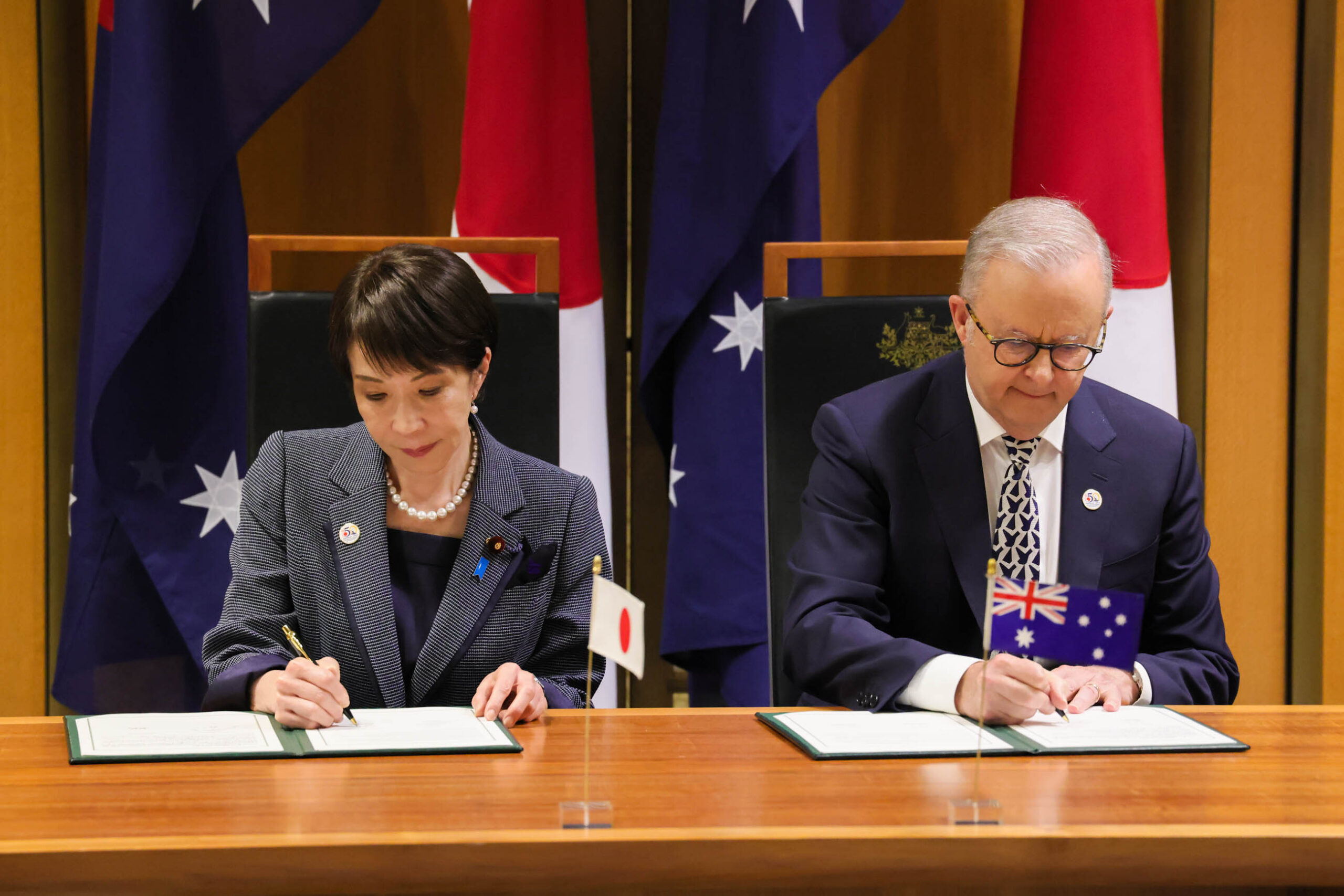
Australia and Japan have committed billions to critical minerals projects, but they are still assembling them deal by deal. A technical cooperation agreement between JOGMEC, JBIC, and Export Finance Australia could turn scattered investments into a coordinated system capable of withstanding Chinese coercion.
Understanding that supply chains once calibrated for cooperation are increasingly weaponised for coercion, Australia and Japan are rapidly establishing a partnership that systematically builds trusted alternatives. In May, the Joint Declaration on Economic Security Cooperation committed both governments to resist coercion by cooperating across critical minerals, energy, emerging technology, and economic resilience. The list is long, the objectives ambitious. Without a clear implementation plan, those ambitions risk remaining declarations rather than tangible economic security.
The Working Group on Economic Security and Comprehensive Supply Chain Cooperation, also announced in May, is ostensibly the vehicle to translate those aspirations into action. However, official statements stop short of defining the Working Group’s actual role, operational mandate, or technical scope.
Closed-door discussions between officials will not build the systemic resilience needed. The International Energy Agency puts China’s share of global refined magnet rare earths output at 91 per cent, and its share of permanent magnet production at 94 per cent. It has proven it is willing to maintain that dominance by using export controls and flooding the market to make competitors’ projects commercially unviable.
This means that public-private cooperation must be calibrated to withstand coercion over the long term. To achieve this, the Working Group should produce a transparent technical cooperation agreement that articulates for industry a consistent approach to project identification, financing, and offtake. This agreement would translate political agreements, down through agencies, and into commercially viable projects that firms can invest in.
Acknowledging the Successes
The partnership is uniquely placed to meet this challenge. Australia’s substantial reserves of critical minerals and mining technology paired with Japan’s capital are already building trusted alternative supply chains.
Each flagship project tells the same story of bilateral capital assembled deal by deal. Sojitz and the Japan Organization for Metals and Energy Security (JOGMEC) financed Lynas in 2011 to commence light rare earth production, then committed a further investment in 2023 to fund heavy rare earth separation. The first shipments reached Japan in 2025. The same two partners, with Alcoa and the governments of Australia and the United States, reached a final investment decision to establish a gallium plant in Western Australia in July. Sumitomo Metal Mining and Mitsubishi joined Kalgoorlie Nickel in 2024, which now carries up to $1 billion in non-binding letters of support from Export Finance Australia (EFA) and the US Export Import Bank (EXIM).
Across these projects, Australia is providing up to $1.3 billion through the Critical Minerals Facility and EFA, including non-binding letters of support. Japan has provided about $370 million through JOGMEC.
These are significant commitments. They are also individually negotiated, project-by-project arrangements.
The Coordination Gap
The Declaration explicitly names the institutions needed, calling for enhanced coordination between JOGMEC, Japan Bank for International Cooperation (JBIC), and EFA, recognising their role in promoting private investment as the two countries develop new projects and ensure stable operation of existing ones. It also recognises the value of Australia’s Critical Minerals Strategic Reserve (CMSR), which allocates $1 billion for offtake and price floor transactions, with another $150 million for selective stockpiling to shield rare earths, gallium, and antimony from market manipulation.
The political mandate is clear, and official-level engagement is now established through the new Working Group, but the operational architecture has not yet been articulated for industry.
Each financial institution operates on different mandates and at different scales, which appears misaligned but, in reality, could be mutually reinforcing. JOGMEC provides equity participation, loans, and debt guarantees for overseas resource development projects at the exploration, development, and production stages. Initial capital to support the speculative phases.
JBIC lends at the development and production stages, typically as majority lender in project finance for large-scale mining projects with relatively low technical risk, while EFA provides government-backed financing and guarantees to support Australian export industries. Significant capital to land the project.
Meanwhile, the CMSR will secure rights to minerals produced in Australia and on-sell those rights to meet like-minded partners’ demand. Offtake certainty that underpins project financing. Put simply, these institutions have the means to create a steady project pipeline from exploration to processing.
But, as current practice shows, bilateral critical minerals cooperation remains largely dependent on individual project champions navigating separate institutional processes. Australia and Japan cannot beat China’s centralised, concerted market manipulation through ad hoc investments or intermittent, opaque dialogues. The newly established Working Group must establish a disciplined, consistent approach that industry understands and can rely on.
Building the Architecture
The solution does not require new institutions or task forces. Rather, it requires a technical cooperation agreement between JOGMEC, JBIC, and EFA to serve as the operational engine for the Working Group. The agreement would outline a process that maintains a running project pipeline and coordinates offtake commitments, with key aspects being made public to support business planning. This treats the industry as a system, not individual projects.
Currently, industry approaches each institution against a different test. Critical Minerals Facility financing, managed by EFA, asks whether a project aligns with the Critical Minerals Strategy and is otherwise in Australia’s national interest. JOGMEC and JBIC ask whether a Japanese company is participating and whether the project secures resources of strategic importance for Japan, although Japan’s industry ministry proposed in August allowing JOGMEC to invest without a Japanese partner. An agreed framework would align these tests, publishing shared co-financing principles, eligible minerals, and assessment criteria.
This would mitigate duplication and allow developers to proactively undertake exploration that meets strategic objectives, and structure proposals to meet shared financing requirements. It would also complement the single point of entry EFA and US EXIM already operate for joint applications, enabling the US to identify when it should contribute.
But no construction financing is viable without certainty that there will be buyers. JOGMEC’s commercial arrangements and Japanese industry offtake agreements provide the end-market demand signal needed. At Kalgoorlie, the Japanese consortium holds 75 per cent of offtake, which Ardea identifies as key to securing favourable debt terms. However, where those offtake agreements are yet to be secured, EFA can use the CMSR to provide that certainty, giving JOGMEC, JBIC and EFA the confidence to commit to long-term investments. Together, the two countries can build the finance and offtake architecture that makes projects commercially viable.
Stabilising the Market
Once the pipeline has been identified and offtake secured, Australia and Japan need to guarantee a stable, enabling market for these projects. While needing to coordinate with proliferating like-minded stockpiles, JOGMEC and Australia’s CMSR can collectively contribute to this.
Japan’s national stockpiling system, managed through JOGMEC, targets holding a reserve of critical minerals with sufficient supply for anywhere between 60 and 180 days – although these may be under strain from the current Chinese export controls. Meanwhile, the CMSR is designed to provide a reliable price floor.
With agreed confidential triggers, the operational framework could outline when JOGMEC should release its reserves in concert with Australia increasing production to counter export restrictions. Each trigger should be defined and measurable, such as shipments from China falling below an agreed threshold for a set period, reserves dropping below Japan’s 60-day target, or prices breaching an agreed band, where a floor breach signals dumping and prompts CMSR purchases and a ceiling breach signals scarcity and prompts a JOGMEC release.
This is the long-term strategic logic of the architecture, built in three layers. Project financing creates supply. Coordinated offtake connects that supply to demand and fills like-minded partners’ reserves. Those reserves stabilise the market when coercion is applied. Each layer depends on the others, and nothing holds without the coordination the proposed framework provides.
Preparing for What Is to Come
The critical minerals relationship does not have the luxury of operating like a normal business venture. The window for developing diversified supply chains is narrowing and any attempt to do so will be met with fierce resistance from China. Australia and Japan can no longer think that they can overcome Beijing’s systematic approach with ad hoc investments.
The proposed technical cooperation agreement, serving as the engine of the new Working Group and built with existing tools, is how Australia and Japan capitalise on their advantages and rectify this imbalance.
David Saultry is an independent consultant specialising in economic security and critical minerals, previously advising on US-China strategic competition at the Australian Department of the Prime Minister and Cabinet and the Department of Foreign Affairs and Trade.
This article is published under a Creative Commons License and may be republished with attribution.