Decades of repressive ‘iron fist’ policing have left Guatemala’s institutions paralysed by corruption and unable to protect vulnerable rural communities. True territorial sovereignty can only be reclaimed by ending the systemic isolation of indigenous authorities and investing in grassroots social and educational infrastructure.
Today, Guatemala faces a crisis of fragmented sovereignty, where systemic corruption and civil war wounds have allowed formal institutions to collude with organized crime. At the heart of this challenge lies a weak judicial system that has entrenched a long-standing pattern of impunity (with convictions in less than 9 % of cases since 2018). More recently, the political offensive by the Attorney General against President Arévalo’s administration has further weaponised and derailed the justice system. This crisis has manifested through multiple judicial offensives, including repeated attempts to strip the President of his immunity, efforts to cancel his political party, and the arbitrary prosecution and exile of journalists, indigenous leaders and over 50 anti-corruption officials. From rural indigenous communities to urban centres, this institutional collapse has allowed cartels and gangs (maras) to control lucrative trafficking routes and institutionalise the forced recruitment and abuse of minors. However, this systemic collapse cannot be cured by the failed, militarised tactics of the past. Reclaiming Guatemala’s future requires a radical shift toward community governance, gender integration and the structural protection of its youth.
The Division of the Territory
This institutional collapse has mapped directly onto the country’s geography, creating a specialised criminal ecosystem that a purely military response cannot dismantle. Driven by U.S. naval pressure in the Caribbean, trafficking routes have pushed into the interior, turning Guatemala into a transit hub for up to 90% of U.S. bound cocaine. In urban centres, gangs like the MS-13 and Barrio 18 are increasingly active and contribute to growing rates of violence. Mexican cartels, such as Sinaloa and CJNG (Jalisco New Generation Cartel), control local logistics and domestic clans (Lorenzana, Mendoza, Los Huistas). Cartels also purchase chemical precursors from India, Turkey, Germany and Italy to manufacture fentanyl and methamphetamines, evading administrative controls.
In the North (Petén), the dense forests of the Maya Biosphere Reserve and Laguna del Tigre National Park conceal clandestine airstrips. Cartels seize land from farmers through arson, laundering capital into agribusiness and cattle ranching. To the West, along the Chiapas border, hundreds of illegal crossings called pasos ciegos (‘blind spots’ or ‘blind crossings’) facilitate human trafficking. In San Marcos, opium poppy cultivation covers over 2,000 hectares. To the East (Izabal, Zacapa, Chiquimula), the value of narcotics surges by 3,000% compared to Colombia. The Ipala Cartel manages cocaine and migrant networks, charging up to $10,000 per journey. Meanwhile, Colombian loan sharks launder money through the “gota a gota” predatory lending system into construction and gas stations. Severe environmental crimes, such as illegal jade extraction and pine deforestation, are also widespread.
This deep socio-economic grip proves that cartels are no longer external invaders, but integrated economic actors. Because top-down military crackdowns only scratch the surface of this entrenched system, true territorial sovereignty can only be reclaimed by providing communities with viable legal economies and local governance.
Criminal Welfare and the Trap of Child Exploitation
In areas under criminal control, illicit organisations replace civic institutions by financing schools, clinics and campaigns. The engine of this system is the forced recruitment of minors. Approximately one million minors (out of 18 million people) are trapped in child labour, with poverty rates nearing 80% within indigenous communities. While girls face domestic exploitation in tortillerías, boys work in agriculture or clandestine fireworks (cohetes) production. In Cerro La Granadilla, children work gruelling 12-hour shifts starting at age 4 or 5, handling gunpowder using baking pans and iron spikes. This workforce becomes the ideal recruitment pool for the maras. Regulatory vacuums allow urban gangs (maras) and cartels to institutionalise the recruitment and abuse of minors.
Gangs use social media or abductions along school routes. Children as young as six serve as lookouts (banderas) or couriers; by thirteen, they become hitmen. Barrio 18 deploys minors as scouts, while MS-13 integrates them into drug distribution and front companies. A deep legislative jungle protects this machinery: the penal code does not specifically criminalise minor recruitment by non-state armed groups, and the Labor Code allows exemptions under the age of 14 in extreme poverty. Crucially, the minimum working age is 14, but mandatory education ends at 15, creating a legal incentive to drop out that impacts half of middle school students.
This legislative vacuum exposes a fundamental flaw in the state’s approach: by failing to pass meaningful legislation to protect its most vulnerable populations, the government leaves a door wide open for criminal exploitation. True security cannot be achieved through militarised enforcement when the legal framework itself abandons children. Instead, safeguarding Guatemala’s future requires a foundational shift toward human rights and mandatory education, a challenge that becomes even more acute in the country’s marginalised rural peripheries.
Rural Guatemala: Official Justice Without Native Languages
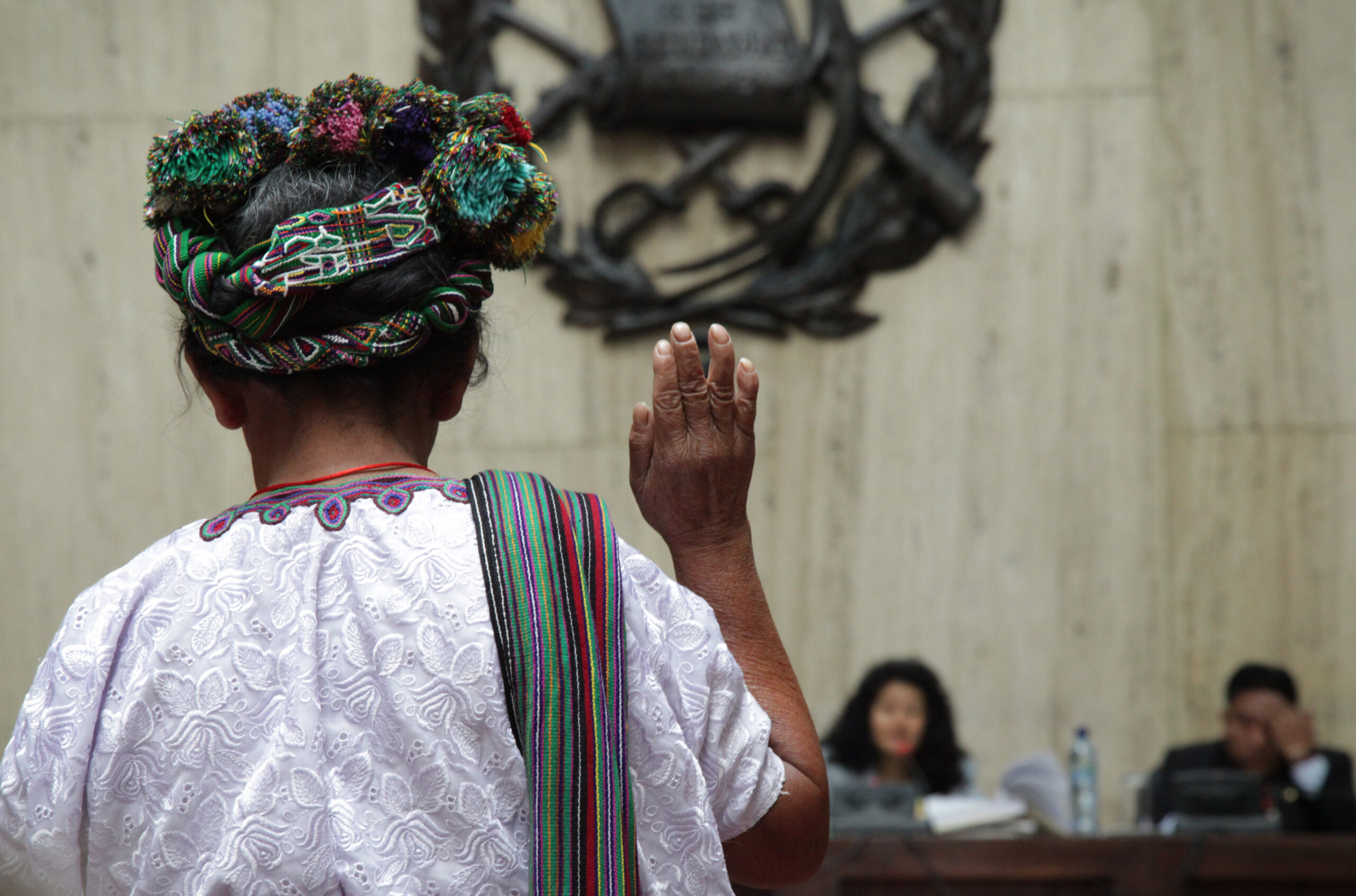
Rural areas populated by Maya, Garífuna, Xinka and Afro-descendant communities have become grey zones governed by armed clientelism. Here, over 70% of the Maya population lives in systemic isolation, worsened by USAID budget cuts. Elites deny legal recognition to ancestral authorities, such as the 48 Cantones of Totonicapán. Bill 5923 aims to privatize 2,724 sacred archaeological centers without securing Free, Prior, and Informed Consent (FPIC). The official judicial system suffers from severe underfunding; law enforcement officers and magistrates do not speak indigenous languages (Kaqchikel, Mam, Q’eqchi’, Q’anjob’al and Ixil), restricting all formal public services to Spanish.
Social stability is heavily undermined by rampant machismo, with impunity rates for femicide reaching a staggering 98%. “When a boy is born, a chicken is killed to celebrate; when a girl is born, nothing”, a local saying goes. Women face severe restrictions on freedom of movement and are excluded from economic decisions regarding the remittances sent home by husbands working in the United States. Local religious structures enforce female submission and reject the use of contraceptives. The state operates only eight shelters nationwide, forcing many women to endure pressure from criminal groups like Barrio 18, which leverages domestic violence as a psychological tool for the forced recruitment of their children.
From Militarisation to Governance: The Tactical Revolution of the WPS Agenda
The repressive “iron fist” programs of the 2000s, such as Guatemala’s Plan Escoba, proved to be total failures. The purely militarised approach merely displaced crime to unpatrolled areas, leaving homicide rates unchanged and vulnerable populations further at risk. Statistical drops in violence were actually tied to demographic growth projections (2.5% according to the INE institute) rather than the effectiveness of weapons. Joint police-military Task Forces collapsed due to internal rivalries and the lack of a unified command structure.
To break the link between social exclusion and crime, the solution lies in community governance and the integration of the Women, Peace, and Security (WPS) agenda, born from UN Resolution 1325. Integrating women into the Policía Comunitaria (Community Police) acts as a tactical force multiplier, significantly improving human intelligence (HUMINT) and early warning capabilities due to their unique access to informal networks and family dynamics.
The WPS agenda relies on five immediate management reforms. First, the performance of individual units is measured by their actual level of gender integration. Parallel to this, the strategy focuses on the professionalisation of gender advisors (GENAD) and the creation of structured partnerships with women’s organisations and indigenous ancestral authorities. To overcome internal resistance, the approach relies on strategic communication rooted in concrete data. Finally, the real impact on the ground and local trust levels are constantly monitored using disaggregated intelligence data.
Books in Hand, Not Gunpowder: The Cerro La Granadilla Model and Necessary Reforms
The failure of state welfare programs demonstrates that shallow palliatives cannot cure the deep infiltration of transnational cartels. Rebuilding territorial sovereignty requires three immediate actions. On the legal front, it is necessary to criminalize child recruitment, eliminate all labour exemptions under the age of 14, and align the minimum working age with the completion of mandatory education at age 15. In parallel, labour inspections must be boosted by tripling field staff, ensuring protective escorts, and providing bilingual skills to communicate with the communities. Finally, an industrial conversion is required to introduce a “child-labour-free” certification within the fireworks supply chain, financially support relocating family micro-businesses and fund protected shelters.
The most effective response comes from grassroots cooperation projects, peasant movements (CONIC and CODECA), and the application of the WPS agenda. The Italian association Sulla Strada OdV welcomes 350 students from kindergarten through middle school in Cerro La Granadilla, providing medical care and daily meals. Through the “Semillas de Esperanza” (Seeds of Hope) permaculture program, the socio-educational initiative “Books in Hand, Not Gunpowder”, and the Civil Peace Corps pathways for the economic autonomy of Maya women, the organisation challenges patriarchal structures and offers a concrete alternative to illegal labour.
Ultimately, the battle for Guatemala is fought between school desks and indigenous farm fields, not on military battlefields. Replacing gunpowder with books means stripping cartels of their workforce. When the state abdicates its role, true security cannot be imposed with weapons; it must be built by guaranteeing fundamental human rights.
Tommaso Franco is a geopolitical analyst from Rome and a member of the IISS and Chatham House. A regular contributor to Limes, The European Sting, and Notiziegeopolitiche.net, he holds an MA in International Relations (European Studies) from Luiss University. Specialising in Asian friction points and human rights, Tommaso combines strategic intelligence with a deep commitment to underreported social realities.
This article is published under a Creative Commons License and may be republished with attribution.