The Indo-Pacific has no shortage of maritime security initiatives, yet many of its most pressing challenges persist because regional cooperation remains rooted in voluntary commitments rather than shared obligations. However, the Bugis concept of pacce, preserved in La Galigo, might offers a normative foundation for reimagining maritime solidarity in the region.
In January 2026, Indonesian Foreign Minister Sugiono introduced a new foreign policy doctrine he called diplomasi ketahanan, or diplomacy of resilience. Analysts quickly noted that the doctrine amounted to risk management rather than strategy resilience without normative substance. Indonesia is not alone. Across the Asia-Pacific, regional actors possess a great deal of rhetoric about resilience and rules-based order yet lack a sufficiently robust norm of collective obligation to make that rhetoric operational. This is the paradox that defines the Indo-Pacific maritime security architecture today. The more mechanisms proliferate, the less binding obligation there is.
Failing Regional Security Mechanisms and the Need for Norms
Bradford and Emmers (2024) have demonstrated that even the Quad, the region’s most ambitious maritime security mechanism has failed to translate joint declarations into concrete action in the South China Sea, precisely because no binding obligation underpins its commitments. In 2025, China recorded a historically high 163 operations in the South China Sea, including live-fire exercises at an unprecedented scale. Meanwhile, Pacific Island states continue to absorb annual losses from illegal fishing estimated between USD 616 million and 2.2 billion dollars — the security threat they feel most directly, yet the one least likely to feature on regional security agendas. Existing mechanisms are designed to respond to the logic of great power competition, not to protect the smaller states whose vulnerability constitutes much of the region’s structural fragility.
Behind this institutional failure lies a more fundamental deficit, namely the absence of an internalised norm of collective obligation. Regional order, understood through a constructivist lens, does not rest solely on material capabilities or interest calculations, but on the degree to which certain norms have become embedded in the identities and practices of regional actors. Acharya (2004) showed that norms in Southeast Asian regionalism were not adopted through external pressure but through a process of norm localisation, that is, the reconstruction of norms to ensure alignment with pre-existing local identities and practices. The argument advanced here follows the same logic. What is needed is not a new institution with formal enforcement, but an obligation norm rooted in the region’s own maritime episteme.
The Concept of Pacce as a Guiding Principle for Indo-Pacific Solidarity
The Bugis normative tradition, preserved in the Indonesian epic, La Galigo, offers a historical precedent that collective maritime obligation can be normatively binding without formal enforcement. The concept of pacce essentialises the community’s obligation to respond to the vulnerability of its members regardless of the cost or benefit. This not simply a guideline for interpersonal relationships, but rather a core structural mechanism. The Bugis, whose trade routes stretched from Sulawesi to the southern Philippines and the coasts of Borneo, governed a complex maritime landscape for centuries because this norm was embedded as a collective identity rather than a negotiated agreement subject to revision when interests shifted. In the logic of pacce, obligation precedes negotiation.
Applied to the Indo-Pacific security architecture, the logic of pacce produces one specific argument, namely that major regional powers need to shift the basis of their contributions from a transactional framework toward a normative obligation framework. Since 2017, the United States has directed nearly USD 955 million through IMET and FMF programs toward maritime security capacity in East Asia and the Pacific Islands. The figure appears substantial, but it is structured as bilateral assistance that can be suspended at any moment. This is precisely what occurred when the Trump administration froze USAID in early 2025, immediately undermining fisheries monitoring and coastal community protection programs across Oceania. Contributions grounded in charity rather than obligation will always remain vulnerable to the shifting political winds of the donor’s domestic politics.
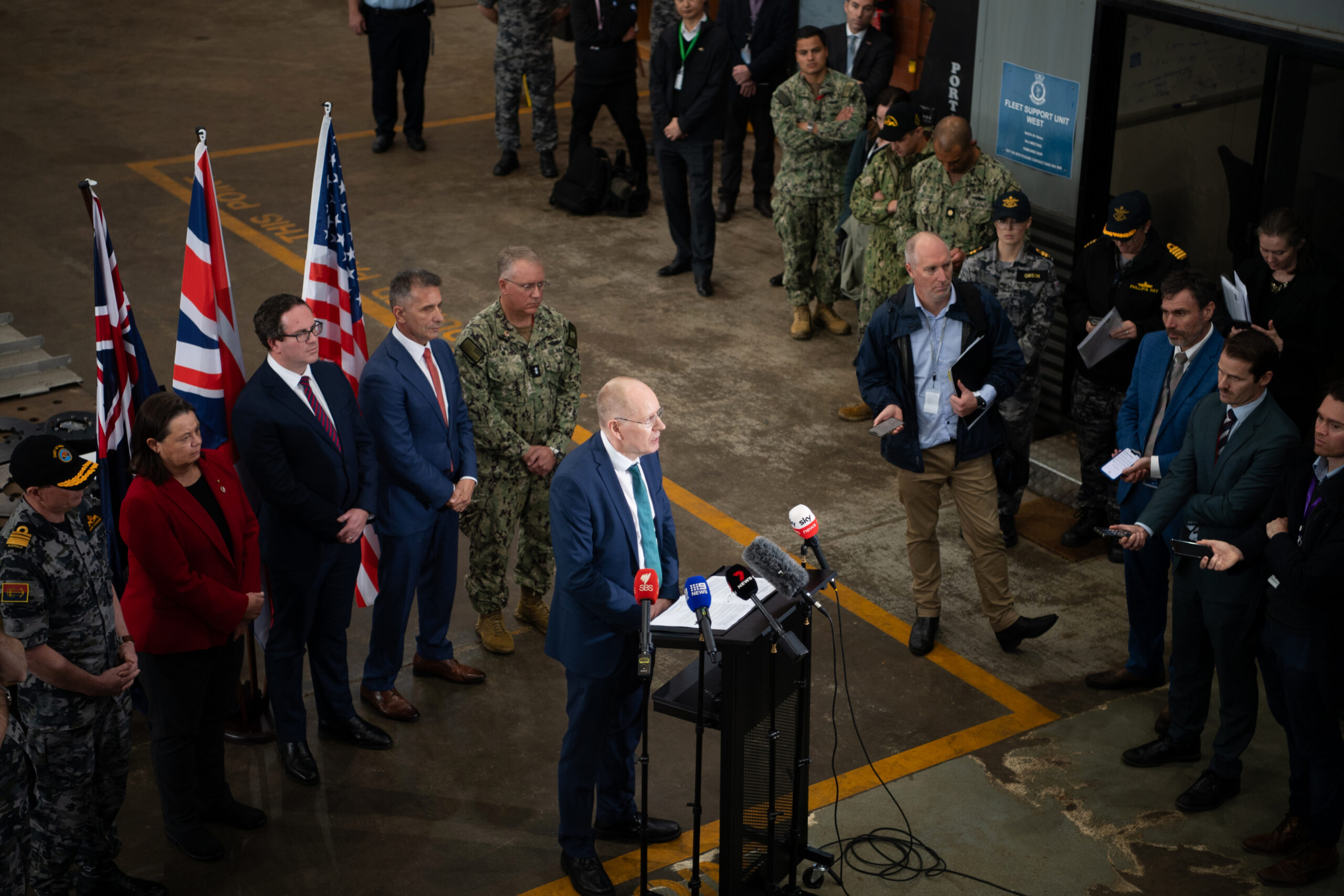
This argument carries direct implications for Australia. Canberra has committed a record AUD 2.157 billion in security and development assistance to the Pacific Islands in 2025, including the Pacific Maritime Security Program, a thirty-year AUD 5.9 billion commitment that has delivered 24 Guardian-class patrol boats to 16 Pacific partner nations. This constitutes evidence that a maritime solidarity mechanism grounded in capacity and obligation already functions under Australian stewardship, but its structure remains bilateral and voluntary. The problem is that China is actively filling the gaps left by this bilateral architecture. Where Australia negotiates case by case, Beijing offers access, infrastructure, and presence unconditioned on a Western security agenda. Converting Australia’s existing bilateral investments into part of a multilateral obligation framework would not only amplify their strategic impact. It would shift the narrative from charity to solidarity and from dependency to partnership, producing a regional relationship far more resistant to displacement by Beijing’s competition.
The objection that pacce logic is not able to function in an anarchic, interstate context rests on the assumption that the only norms capable of binding states are those formally codified in international law. The history of regional governance suggests otherwise. The ASEAN Outlook on the Indo-Pacific itself acknowledges the need for inclusivity and the protection of coastal communities as part of the maritime architecture, but without an obligation mechanism, that acknowledgement remains aspirational. Acharya (2024) has affirmed that the future of the Indo-Pacific depends on its capacity to become more inclusive, multilateral, and non-hegemonic. IMSF is the operational answer to that agenda.
Moving Towards a ‘Graduated Obligation’ Model
The concrete recommendation is to advance the formation of an Indo-Pacific Maritime Solidarity Framework, or IMSF, a non-treaty mechanism binding maritime ASEAN states, Australia, Japan, and India in a commitment of graduated obligation. The greater a state’s economic and military capacity, the greater its normative obligation to provide maritime assistance to smaller states facing threats from grey-zone operations or non-military threats such as illegal fishing and sea-level rise. The incentives are concrete. For Australia and Japan, IMSF would convert already substantial bilateral security expenditure into multilaterally recognised contributions, enhancing regional legitimacy while reducing the reputational costs of unilateral approaches. For smaller states, IMSF would provide a guarantee of assistance that cannot be frozen by a single cabinet decision in Washington or Canberra. The historical precedent already exists. Australia’s Pacific Maritime Security Program has demonstrated that a consistent maritime capacity-sharing framework can build cross-border trust over more than three decades. IMSF needs only to elevate that logic to a more binding level of normative obligation.
Emmers and Loke (2025) note that middle maritime powers across the region are actively seeking architectures that are more flexible and do not force alignment choices. Scholars have also called for an ‘ASEAN minus X’ formula to break the deadlock on Code of Conduct negotiations amid escalating Chinese grey-zone operations. The window of opportunity for IMSF is open precisely now, when key actors are actively searching for normative substance to fill their rhetorical frameworks and when Australia’s bilateral investments in the region are already substantial enough to serve as the foundation for a more binding mechanism.
The Indo-Pacific is not merely a strategic geography contested by great powers. It is a civilisational space that for centuries was governed by maritime communities operating under normative systems that placed collective obligation above individual calculation. La Galigo is not a romanticisation of the past, but rather an epistemic precedent demonstrating that obligation norms, when rooted in community identity, can govern maritime complexity without formal enforcement. In an Indo-Pacific increasingly polarised between great power logic and ASEAN inertia, pacce as a principle of graduated obligation is both relevant and the answer to questions that regional policymakers have long left open; Namely, what obligation should bind the actors of this region, where that obligation comes from, and why states that have already invested heavily in the region stand to gain the most from a norm that transforms their investment from charity into solidarity.
Boby Purba is an undergraduate student of International Relations at Universitas Kristen Indonesia, and currently serves as an East Asia Analyst at World Order Lab. His research interests focus on global governance, international political economy, and the structural dynamics of power within multilateral institutions. Boby writes on issues concerning the Global South, institutional reform, democratic accountability, and East Asian geopolitical developments in contemporary international politics.
This article is published under a Creative Commons license and may be republished with attribution.