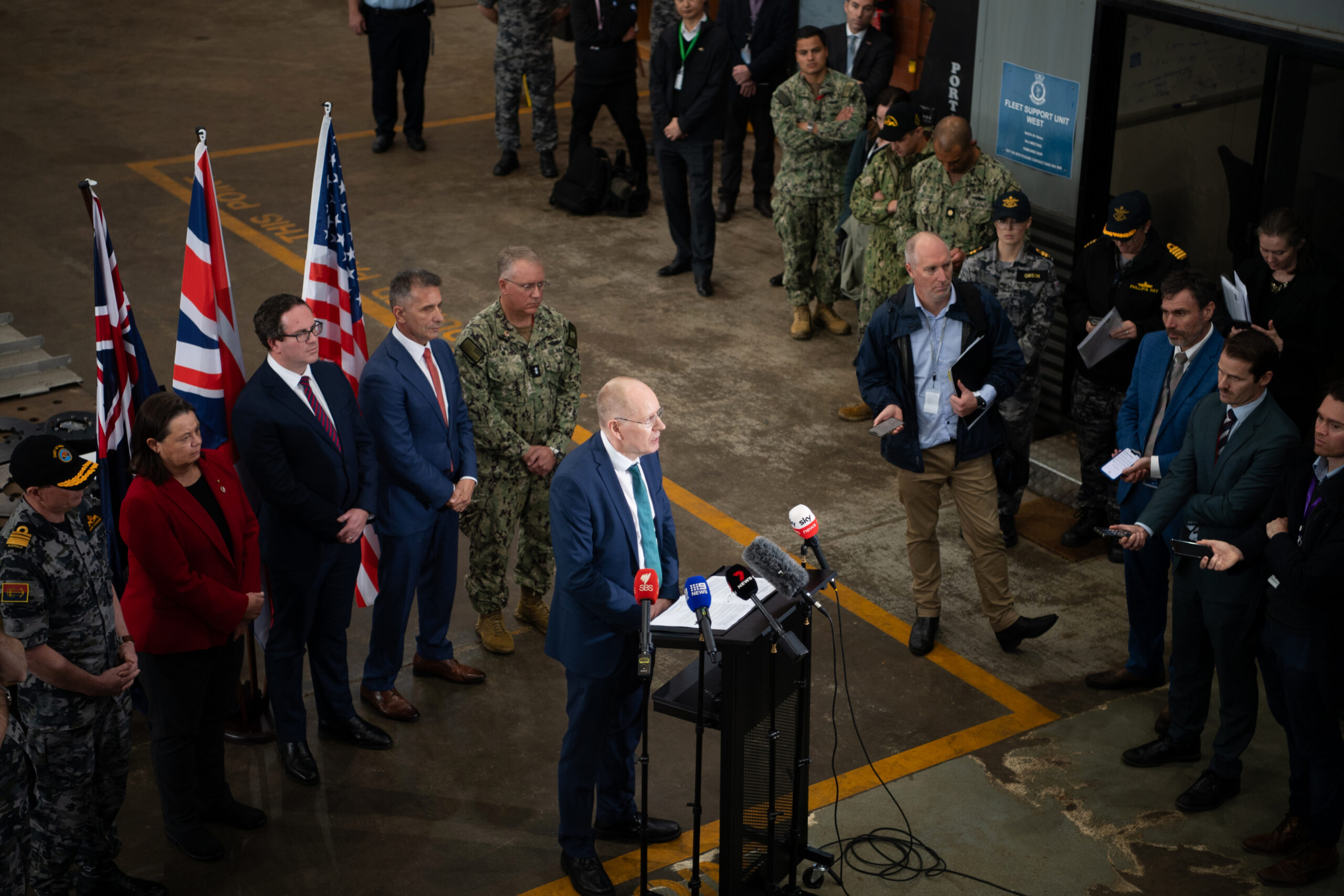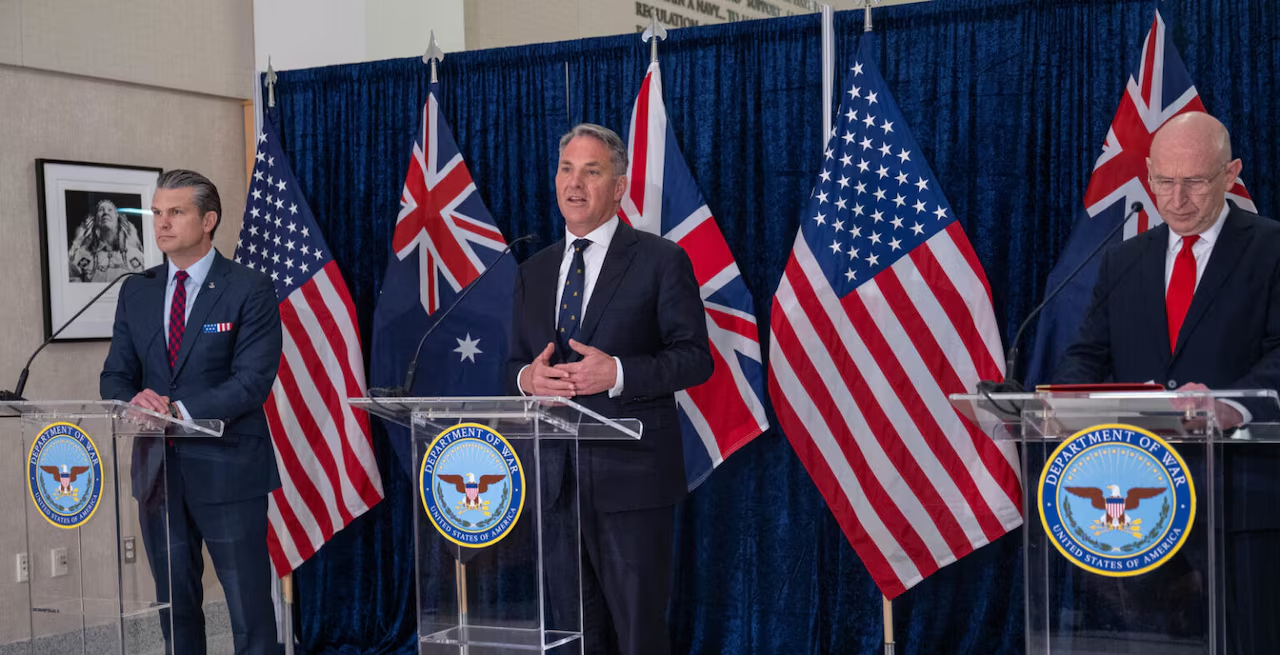
The decision by Australia, the United Kingdom and the United States to designate AI-enabled payloads (mission equipment that performs the main task) for Uncrewed Undersea Vehicles as the first signature project under AUKUS Pillar II marks a significant step towards building and deploying AI-enabled autonomous undersea capabilities as a shared AUKUS strength.
Announced at the Defence Ministers’ meeting on 30 May 2026, it moves trilateral cooperation from experimentation toward operational capability, with initial deliveries expected from 2027. While the project laudably strengthens collective undersea awareness and strike options, it also brings new and underexplored escalation risks that Canberra must actively manage.
Beyond operational gains, the choice of UUV payloads as a first project signals a shift toward modular, upgradable capability development. However, while this approach offers rapid iteration, it also significantly increases integration risks, particularly when AI components are updated faster than validation frameworks can keep pace. This is made even more challenging by the fact that Australia, the UK, and the US take different approaches to software assurance and certification for autonomous systems, an area that remains less developed in maritime settings than in aviation. Indeed, without aligned testing and certification standards across AUKUS partners, interoperability could become a source of friction rather than an advantage.
AI and autonomous systems compress decision timelines and reduce the scope for human intervention in ways that existing command structures were not designed to handle. This is not specific to UUVs or drones as platforms; rather, it stems from the speed at which AI systems perceive, process, and act. AI operating at machine speed offers great opportunities, but an autonomous system in contested waters that misreads signals or triggers unintended responses from another platform can escalate the situation faster than human operators can react. In such cases, effects may be difficult to trace, complicating efforts to determine whether an action was deliberate, accidental, or the result of a system error.
As grey zone activity around undersea infrastructure continues, the risk of miscalculation increases. Australia’s 2026 National Defence Strategy recognises that technological advantage is becoming increasingly important in grey-zone settings, but it offers little guidance on balancing rapid capability development with the need to manage escalation risks.
Data dependence raises another complication. AI-enabled payloads rely on large volumes of sensor and environmental data, much of which may be classified, incomplete or unevenly shared between partners. Differences in data can lead systems to behave differently even under the same conditions, making joint operations more complicated and easily eroding trust in shared platforms. As such, establishing common data governance principles will be as important as hardware integration itself.
Australia has a clear interest in advancing its undersea capabilities through AUKUS. Because Pillar II remains in an early stage of project delivery, Australia is in a position to influence how these technologies are governed within the partnership and beyond. Industrial and supply chain considerations also shape Australia’s ability to influence outcomes. Greater participation by Australian firms in the software, testing, and assurance layers would not only build sovereign capability but also provide Canberra with practical leverage over how systems are designed, verified, and deployed within AUKUS. Without targeted investment and migration pathways, workforce constraints in high-end software engineering and AI assurance may, however, limit the speed at which Australia can scale such contributions.
Three policy steps would help Canberra manage these risks while maintaining momentum on capability development.
First, Australia should work with the US and the UK to establish dedicated escalation management protocols for autonomous systems, with particular attention to the undersea environment. These protocols could set out common deconfliction procedures, specify when autonomous systems may operate without direct human oversight, and establish rapid communication channels in the event of an incident. The current UUV payloads project offers a practical opportunity to build these measures in from the start, rather than trying to add them later as a quasi-afterthought.
Second, the Australian Defence Force should develop an explicit doctrine on meaningful human control for AI-enabled autonomous weapons and systems. This should cover not just legal and ethical obligations but also define the points at which human intervention is required in practice. Clear national guidance would give commanders greater confidence and strengthen Australia’s ability to shape standards within AUKUS. An independent review mechanism within the ADF could assess high-risk systems against these standards before they enter service. Incorporating red teaming and adversarial testing would further help identify failure modes that standard validation might miss. This doctrine should be supported by realistic testing environments that simulate degraded communications, adversarial interference and ambiguous contacts. Without stress testing, assumptions about human oversight may not hold water under pressure.
Third, Australia should take a more active role in promoting regional dialogue on responsible military use of AI and autonomy. While capability development will continue among major powers, there is great value in establishing basic norms around notification, transparency, and de-escalation, particularly for undersea operations. Whether through the ASEAN Defence Ministers’ Meeting-Plus framework or more focused bilateral engagement, Canberra is well-positioned to lead these discussions. Taking this kind of proactive approach would enhance Australia’s standing as a responsible middle power, without limiting its freedom to act when needed. In parallel, Canberra could advocate for incident reporting mechanisms specific to autonomous maritime systems, helping to normalise transparency without requiring disclosure of sensitive capabilities. Even limited confidence-building measures could reduce the risk of misinterpretation during peacetime operations.
The acceleration of AI and autonomous systems under AUKUS Pillar II is now a practical reality rather than a future prospect, and Australia can gain a significant advantage from these technologies, especially in the undersea domain. At the same time, Canberra can reduce the risks these systems create by treating governance and risk management as core parts of capability development rather than afterthoughts. Taken together, these steps would allow Australia to capture the benefits of these technologies while helping preserve strategic stability in contested maritime environments.
Dr Gerald Mako is a Research Affiliate of the Cambridge Central Asia Forum at Cambridge University. His research focuses on artificial intelligence, cybersecurity, and great power competition in Asia.
This article is published under a Creative Commons License and may be republished with attribution.