The Albanese Government’s Future Made in Australia agenda promises to build a comparative advantage in net zero industries while strengthening economic resilience and security, backed by $22.7 billion over a decade and guided by the National Interest Framework. But it is being undermined by slow implementation, weak integration, and limited uptake.
The Albanese Government’s Future Made in Australia (FMIA) aims to give Australia a comparative advantage in net zero industries while also building resilience in key sectors, consequently facilitating job creation and economic growth. FMIA’s execution centres on the National Interest Framework (Part 2 of the Future Made in Australia Act 2024) and its support of a “net zero transformation stream” and an “economic resilience and security stream”. The first stream “includes industries where Australia will have a comparative advantage as the global economy transitions to net zero”. The second stream “includes industries where some level of domestic capability is necessary to deliver economic resilience and security”. The FMIA agenda will see $22.7 billion spent over 10 years.
Unfortunately, the Albanese Government has dragged its heels when it comes to operationalising the FMIA agenda. In the wake of the COVID-19 pandemic, it was acutely aware of Australia’s supply chain fragilities when it took office in May 2022. However, the Albanese Government’s approach lacked (and continues to lack) a sense of urgency. There was nothing stopping the Australian Labor Party consulting with key stakeholders and consequently formulating all aspects of FMIA during its time in opposition, ready for utilisation if elected. It would be two years after taking office that FMIA’s funding was allocated as part of the 2024-2025 Federal Budget. Then a further seven months until the Future Made in Australia Act 2024, which includes the National Interest Framework to drive the FMIA agenda, was made law. By this point, the Albanese Government was less than five months away from seeking (and achieving) re-election in May 2025. It would also take nearly two years for the Albanese Government to deliver a response to the Senate Economics Legislation Committee’s report on the FMIA Bill 2024. Aside from being less than 20 pages long, the response came some 18 months after the FMIA Act came into effect.
In May 2024, Prime Minister Albanese and Treasurer Chalmers asserted that FMIA was coming in “as the world undergoes the biggest transformation since the industrial revolution”. Against this backdrop it would be assumed that not only would there be a greater sense of urgency, but also specific timelines and metrics to track progress and to ensure that both streams are given the requisite attention. The initial progress reported by the Department of Industry was heavily focused on the net zero transformation stream, such as the Future Made in Australia Innovation Fund and the production tax incentives for renewable hydrogen and critical minerals, legislated in February 2025. According to the recently published DISR Annual Report 2025-26, there have been efforts at “industrial transformation” in line with FMIA; for example, changes at the Whyalla Steelworks. These efforts have not brought the steelworks out of administration or prevented hundreds of job losses. Meanwhile, the department reported that it provided no FMIA support as defined by the Act in 2025-26, although programs it saw committed funding to projects during that period.
There is also the risk that the economic resilience and security stream will ultimately be the poor cousin of the net zero stream if the two streams are not pursued with equal gusto. In addition, the economic resilience and security stream itself might be problematic, as it is focused more on over-the-horizon green measures as opposed to building capability that impacts Australia’s economic resilience and security in the near or short term.
Recent social media posts from the Australian Labor Party are not helping to alleviate concerns surrounding substantive progress. A post on Facebook on 7 October 2026 read more like a promise for the future than an update on an existing measure – “A Future Made in Australia. That’s Labor’s plan. Making more, here at home. So our country can be stronger and safer. And so Australians can earn a decent living and build a future for their family”. The post offers no detail on the FMIA in action or even a link for anyone wanting to learn more about the agenda.
The Albanese Government did initiate efforts to reinvigorate key sectors before FMIA. Stood up in 2023, the National Reconstruction Fund Corporation (NRFC) is tasked with financing “projects that strengthen key areas of the economy” such as green energy. The NRFC was ready to harness opportunities and capability building stemming from FMIA’s second stream in 2024 and its role could have been clearly integrated into the FMIA Act. Despite the clear overlap between the objectives of FMIA and the NRFC, it was not until the latter half of 2025 that NRFC and FMIA were aligned under the NRFC’s statement of expectations, which includes the need for it to “harness new and emerging technologies that will support Australia’s ongoing economic resilience and security”. This delay compounds the problems highlighted above.
Given the profound global industrial transformation taking place, the last thing that is needed is delay. FMIA is framed as a large, strategic intervention, but it is being undermined by slow implementation, weak integration with existing institutions, and limited transparency. This risks an agenda that is inevitably bigger in messaging than in measurable delivery. Publishing delivery timelines and reporting clearly on funding commitments and delivery for both streams would be a simple first step.
Dr Jon Cottam is a Lecturer in National Security and Intelligence in Macquarie University’s School of International Studies and a Fellow of Macquarie University’s Geopolitical Risk Research Centre. His research focuses on the intersection of biology, national security and intelligence.
This article is published under a Creative Commons Licence and may be republished with attribution.
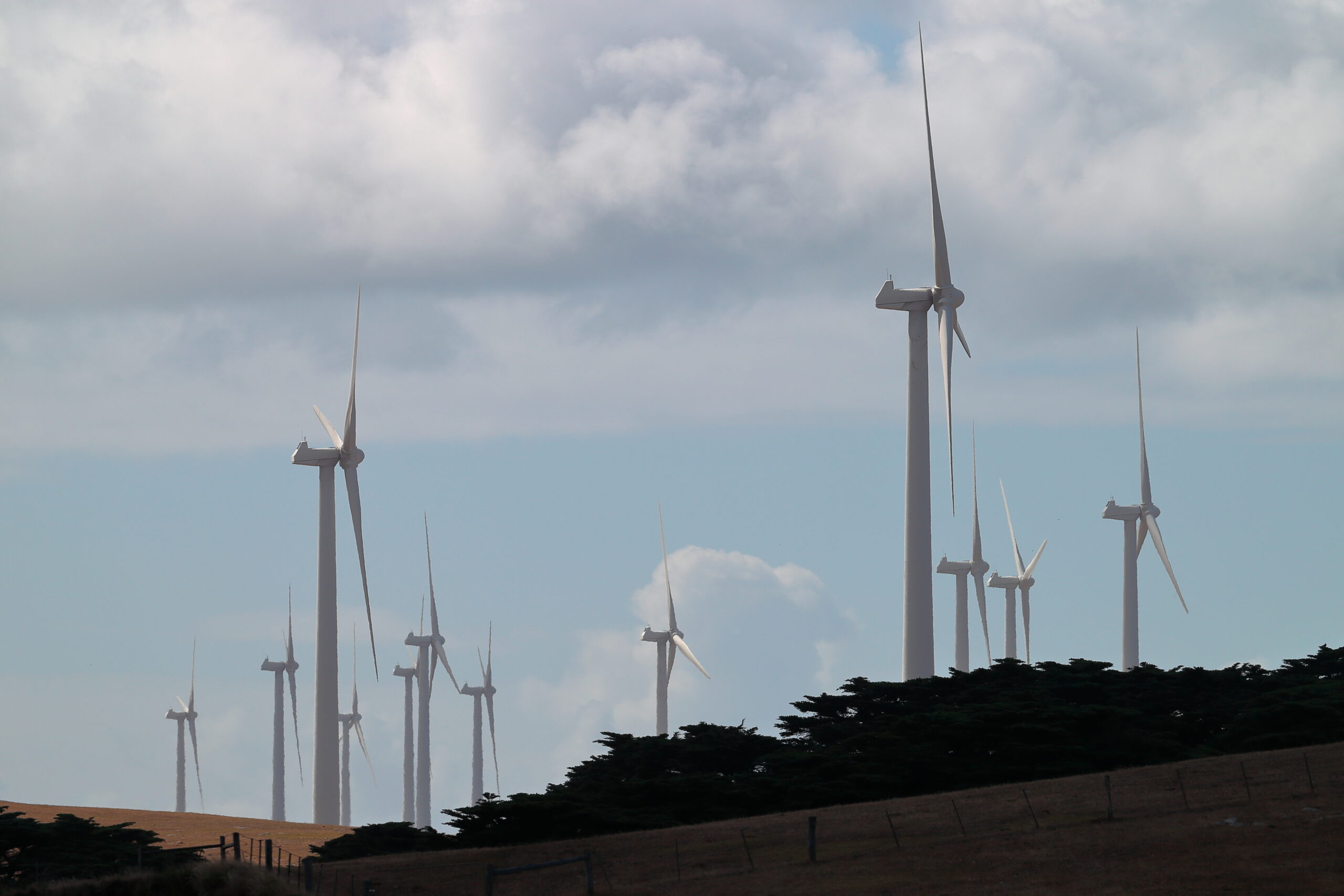
Photo: “Yambuk Wind Farm” by Ed Dunens, CC BY 2.0