Brazilians will go to the polls in October this year. The Master Bank scandal, although entangling both sides of politics, could lead to the consolidation of Brazil’s far-right.
Few presidential contests are set to capture as much global attention this year as Brazil’s October election, seen by many as another crossroads for Brazil’s democratic future. Election results will move tectonic plates, and either consolidate Brazil’s political institutions or eroding its politico-institutional framework. Incumbent left-leaning President Luiz Inácio Lula da Silva seeks re-election, running under Brazil’s Workers’ Party in what is likely to be a showdown with Flavio Bolsonaro from the Liberal Party. Flavio Bolsonaro is carrying the torch of Brazil’s far-right political agenda, after his father, former President Jair Messias Bolsonaro, was prosecuted for crimes committed against Brazil’s institutions in the Brasilia Riots. In a 2023 Brazil’s Electoral Tribunal decision, presided over by High Court Judge Alexandre de Moraes, he lost his right to run for the presidential office until 2030. Bolsonaro Senior is currently under house arrest.
Since January this year, the Bank Master scandal, which involves money laundering and fraudulent management of public funds, is entangling both sides of politics. Nonetheless, the scandal is causing reputational damage to Brazil’s High Court, particularly to High Court Judge Alexandre de Moraes, whose wife and children’s law firm held a 131-million-reais (US$25 million) contract with the Master Bank to represent the bank’s owner, Daniel Vorcaro. In an electoral year, a major corruption scandal, which could be Brazil’s new Operation Car Wash, could have devastating implications for the election results. The scandal could lead to a swing back to Brazil’s far-right with a democratic return of the Bolsonaro dynasty. Other adverse effects of the scandal is the legitimisation of a new ‘stop the steal’ and voter fraud claims in case Bolsonaro Junior has his presidential bid frustrated, or even worse, of US President Donald Trump attempts to meddle into Brazilian politics, which could lead to democratic fragmentation.
Brazil’s 2026 Presidential Race
Brazil’s 2026 presidential elections is a contest between Brazil’s left-leaning Luiz Inácio Lula da Silva from the Workers Party in a repeat ticket with Geraldo Alkmin from Brazil’s Socialist Party, and far-right Flavio Bolsonaro and Alfredo Gaspar, former secretary of public security of Alagoas, both from the Liberal Party.In a tight race, Flavio Bolsonaro won the first round of Brazil’s elections with 47.03 percent, followed by Lula with 45.16 percent of votes, with Lula now facing a run-off election.
Lula’s re-election draws from a strong social policy and participatory democracy framework, building on initiatives like the digital civic engagement platform. Lula’s re-election plan “A Sovereign, Democratic, Developed, Sustainable, and Creative Community” furthers his “Guidelines for the Programme for the Transformation of Brazil,” consolidating an economic plan of strong tax reform and small business support to re-paying fiscal debts, including labour reform ending the 6-day work week, with no more than 40 hours a week of work. His health policy aims to expand affordable medical care programs and affordable medicine with “Farmacia Popular.” The Lula government public security plan targets gun control and legal reform. His platform has a strong focus on environmental literacy and zero de-forestation programs, including a sustainable development plan and furthering the Amazon fund. Given fears of Trump’s political interference in Brazil, Lula runs in a strong platform of national sovereignty, and a defence strategy leveraging Brazil’s role as a middle power in the region.
Flavio Bolsonaro, formerly a senator representing Rio de Janeiro, runs for the first time for Brazil’s top job in a platform with far-right populist undertones: “For Brazil to Overcome Backwardness.” His economic plan pledges to roll back incumbent Lula’s tax reforms, including new privatisation programs and the expansion of private sector railway infrastructure through long term concessions. Flavio’s Overcome Backwardness proposes reform to Brazil’s High Court. The reform will be instrumental for the amnesty for his father, Bolsonaro Senior, and defendants of the January 8 Brasília riots. The reform supports the end of presidential re-election and restoring private campaign financing. Flavio’s foreign policy is emphatically aligned with Washington and Trump, with the introduction of a “Rubio Reform” in Brazil’s Itamaraty, increasing fears of US interference. One of the most controversial platforms in his campaign is “Brazil Without Fear,” is proposing the classification of Brazil’s leading criminal factions as narco-terrorist organisations. There are fears that the classification could legitimise a future US intervention. Flavio’s plan includes loosening gun laws, building or reforming prisons, drawing inspiration from El Salvador’s model. Another controversial issue is the the chemical castration of sexual offenders. Bolsonaro’s plan is similar to controversial measures implemented by former governor of Rio de Janeiro Wilson Witzel, supporting extrajudicial executions.
Another highlight of Flavio Bolsonaro’s “Overcome Backwardness” policy is a clear agenda for women. The Bolsonaro clan, infamously critical towards feminist ideals, developed a strong political platform focused on women called “Brazil For Women”. It focuses on women’s rights, aiming to secure the female vote. The political platform’s mastermind is Catholic woman Daniella Marques. A member of Brazil’s Republican Party, she is a leading voice in Brazil’s Christian right and the right arm of Paulo Guedes, Bolsonaro Senior’s former Minister of the Economy. She was considered as a prospective running mate for Bolsonaro to secure the female vote but ended up off the Liberal Party ticket.
Master Bank Scandal Implications to Brazil’s Democracy
The Bank Master is an ongoing political and financial crisis initiated with the liquidation of the bank amid revelations of fraudulent credit and Ponzi-like dealings. The bank’s president and leading share holder Daniel Vorcaro developed fraudulent portfolios with billions of assets. Under “Operation Compliance Zero”, Brazil’s Central Bank liquidated the bank and arrested Vorcaro. The scandal shows a wide web of connections, involving numerous high-profile politicians on both sides of the political spectrum, reaching even members of the judiciary such as High Court Justice Alexandre de Moraes. Although there is no proof of Moraes’ direct involvement in corruption, his wife and children represented Vorcaro legally. Flavio Bolsonaro also had connections with Vorcaro. In September, Brazil’s High Court unsealed documents from the Master case for receiving US$12 million to produce the unreleased movie “The Dark Horse,” a political biography about his father.
The Bank Master could be a political trojan horse for Brazil’s High Court, consolidating previous attempts to silence High Court Judge Alexandre de Moraes. In July 2025, Eduardo Bolsonaro, who resides in the US, lobbied the Trump administration to invoke Magnitsky sanctions against Judge Moraes. These were lifted only in December 2025. Moraes is the High Court Judge who presided over Brazil’s Electoral Tribunal case and the case of dissemination of fake news which led to political unrest and to Brazil’s 8 January. The case led to the arrest of Bolsonaro Senior and several of his supporters. Court decisions by High Court Judge Gilmar Mendes, and Brazil’s Electoral Tribunal Estela Aranha, cancelled last Thursday’s presidential debate at Brazil’s leading broadcaster. The decision is seen in a negative light by Brazilians in both sides of the political spectrum, aggravating negative perceptions towards Brazil’s High Court. The decision is likely to contribute to Flavio’s Bolsonaro campaign.
Eroding Brazil’s High Court reputation with internal fragmentation and disputes over the Master scandal are likely to cloud public perceptions towards their role as the “guardians of the constitution.” Although Flavio Bolsonaro is being investigated in the Master scandal, he continues to be a top contender in this presidential race. A Bolsonaro ballot box win gives him political legitimacy to use power and influence to undermine the High Court, reforming the decision leading to the imprisonment of Bolsonaro Senior, and compromise Brazil’s sovereignty with a stronger ideological alignment with US Trump’s political agenda. If Bolsonaro loses, we could see another campaign to cast aspersions in the electoral system and Brazil’s High Court, and further manifestations and riots, similarly to 2023, to undermine Brazil’s institutions. This is the political dilemma all Brazilians are confronted with as they cast their votes.
Dr Flavia Bellieni Zimmermann is a Visitor at Deakin’s Centre for Future Defence and National Security, an Academic Guest at the University of Melbourne, a Research Fellow at the University of Western Australia, and a Commissioning Editor for the Australian Outlook.
This article is published under a Creative Commons Licence and may be republished with attribution.
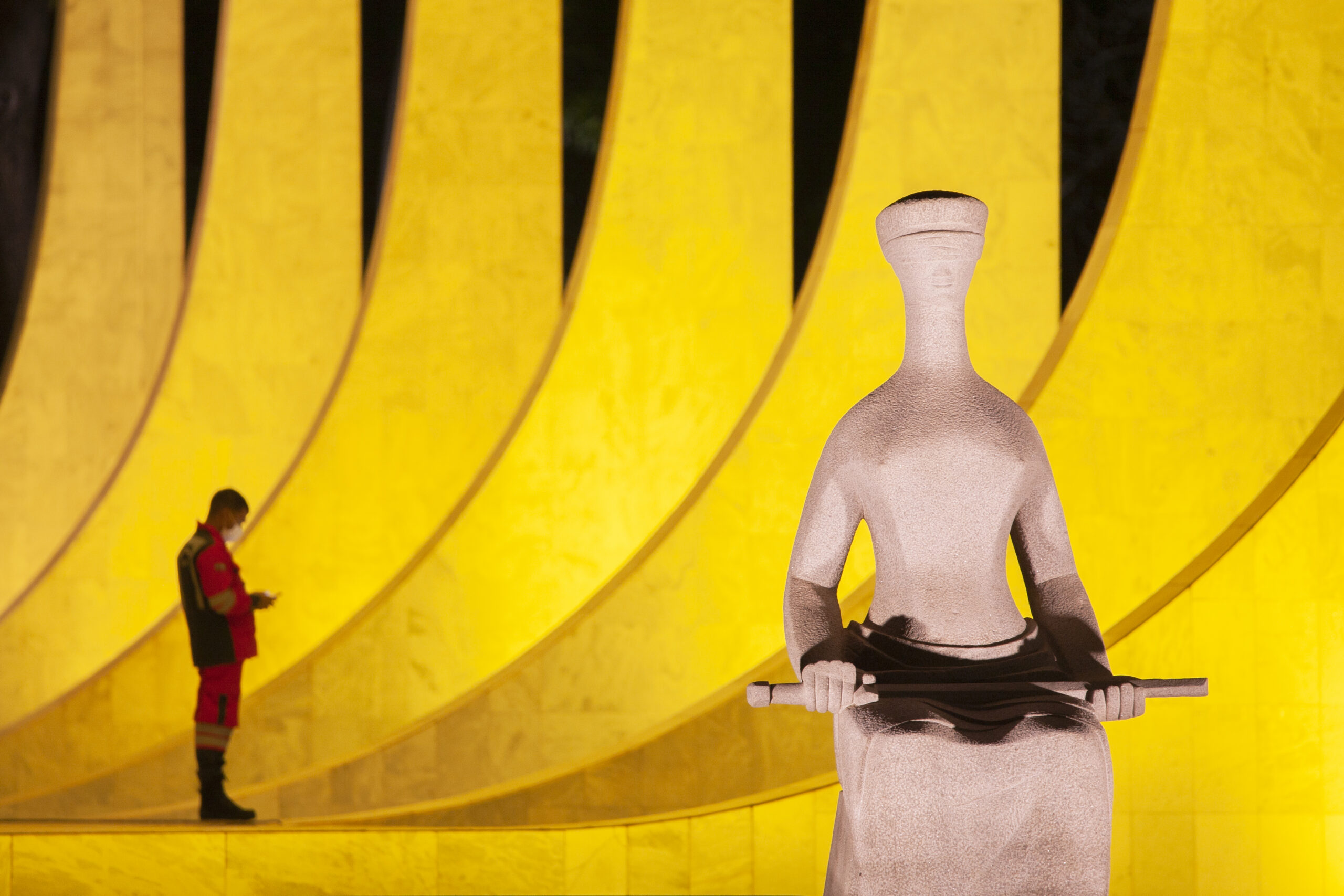
Photo: “Brazil’s Supreme Court” Wikimedia Commons (CC BY-SA 4.0)